
Industrial IoT guide · Updated November 2026
Industrial IoT in Pakistan: A Practical Guide for Factory Owners
Know what every machine is doing, what it costs you, and when it is about to fail. Industrial IoT sensors and live dashboards, designed and built in Pakistan for the machines you already own.
Costs in PKR, load shedding, solar, AI-ready data and how to start with one machine. Your data, your way.
Designed and built in Pakistan since 2015 · Cloud, your cloud or on-prem · Open protocols
Quick answer: what is industrial IoT in Pakistan? Industrial IoT (IIoT) in Pakistan means fitting sensors to factory machines and panels so they report vibration, temperature, energy use and output to a live dashboard. Pakistani factories use it to cut electricity bills, catch breakdowns early, log load shedding and prove production data to export buyers. A single machine can be monitored from about PKR 16,500.
Key facts at a glance
- What it monitors: vibration, temperature, current and energy, production counts and RPM, air quality, and engine data on boats.
- Starting cost: from $59 (about PKR 16,500) per machine for an Affordable Series device.
- Works with old machines: clamp-on and bolt-on sensors, no PLC needed.
- Load shedding: devices log every power cut and its duration once power returns.
- Internet drops: data is buffered and uploaded later with the original timestamps.
- Where data lives: IoTize Cloud, your own cloud, or a server inside your factory.
- Who makes it: IoTize.ORG, an industrial IoT company in Karachi, building devices in Pakistan since 2015.
What is industrial IoT?
Industrial IoT is the use of connected sensors on machines, panels and rooms to send live operating data to a dashboard, so problems show up before they cost money.
Instead of finding out about a fault when a machine stops, you see it building up: a bearing getting hotter, a motor vibrating more each week, a line that sits idle for two hours every shift. In short, industrial IoT turns machines you already own into machines that report on themselves.
People also call it IIoT, smart manufacturing, a smart factory or Industry 4.0. They all describe the same shop-floor idea: machine data, collected automatically, used to make decisions.
IoT vs industrial IoT
Consumer IoT connects things like smart watches and home cameras. Industrial IoT connects motors, pumps, compressors, presses and panels, so it needs industrial sensors, rugged enclosures, industrial protocols such as Modbus TCP, and data that keeps working when the power or the internet does not.
The three stages of a smart factory
Monthly bill and logbooks. Problems are found late.
Live data per machine. Waste and idle time show.
Alerts before failure. Maintenance is planned.
Why industrial IoT matters for Pakistani factories in 2026
Short answer: energy is expensive, power is unreliable, buyers want data, and solar has changed how factories pay for electricity. Each of these makes machine-level data worth more than it was a few years ago.
- Electricity is the biggest controllable cost. A study of a Pakistani automobile plant notes that industry is the country’s largest energy user, at about 35 percent of the total. An idle motor running through lunch is a real line item.
- Solar and net billing. Pakistan’s net-metering solar capacity has grown from about 201 MW in 2021 to about 6,975 MW, and the move from net metering to net billing under NEPRA’s 2026 prosumer rules has textile exporters rethinking their energy plans. When exported units earn less, using your own solar during the day matters more, and that needs per-machine energy data.
- Load shedding and unstable supply. Power cuts stop lines and hide where production time went. Most factories know an outage happened, not how often or how long per machine.
- Export buyers want proof. Textile contributes about 8.5 percent of GDP and over 40 percent of the industrial workforce. Many export customers now ask for data on production, energy and compliance.
- AI-ready factories. Analysts writing in Pakistani media in 2026 describe connected sensors and predictive maintenance as the first step to an AI-ready factory. You cannot apply AI to data you do not collect.
- The network is getting ready. PTA issued IoT licences to 23 more companies in April 2026, covering industrial automation and energy management.
Industrial IoT in Pakistan, by the numbers
Sources: Akhtar et al., Energies 2020; The News on Sunday, April 2026 (Power Planning and Monitoring Company data); ProPakistani, April 2026. Shown for context, not a guarantee of results.
Sources: Akhtar et al., Energies, 2020; The News on Sunday, April 2026; Express Tribune, April 2026; ProPakistani, April 2026; Petrillo et al., Applied Sciences, 2024; The News on Sunday, What an AI-ready factory needs.
Research also shows what holds factories back. A 2025 study of Pakistani manufacturing SMEs found that awareness, more than cost or perceived benefit, drove Industry 4.0 adoption. That is why this guide exists.
How does an industrial IoT system work?
Every industrial IoT system follows five steps: sense, process, connect, show on a dashboard, and alert.
- Sense. A sensor measures something physical: vibration, temperature, current, pulses from a counter or encoder, humidity.
- Process. The device turns raw readings into useful values: runtime, idle time, RPM, kWh, power factor, or vibration levels.
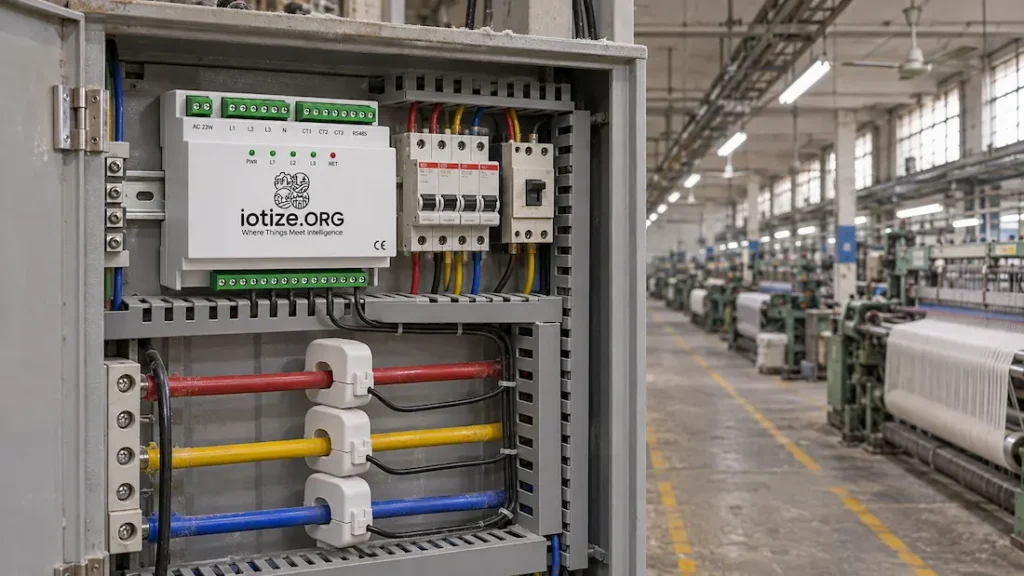
- Connect. The device sends data over the plant network. Affordable devices use Wi-Fi; Enterprise devices use Wi-Fi or Ethernet; RS485 and GSM/4G are available on selected and custom devices.
- Dashboard. Data lands on the IoTize IoT Platform, on your own server, or straight into your SCADA, MES or ERP through MQTT, HTTP or Modbus TCP.
- Alert and act. When a value crosses a limit, the right person gets an email alert and fixes the problem before it becomes a breakdown.
What can you monitor with industrial IoT?
Start with the signal that costs you the most money today. You do not need to monitor everything.
| What you measure | What it tells you | Typical machines | IoTize solution |
|---|---|---|---|
| Vibration | Imbalance, misalignment, bearing wear, looseness, weeks before failure | Motors, pumps, fans, gearboxes, compressors | Predictive Maintenance |
| Temperature | Overheating bearings, motors and panels | Motors, bearings, electrical panels | Predictive Maintenance |
| Current and energy | kWh per machine, idle running, power factor, phase imbalance, peak demand | Main panels, motors, compressors, chillers | Energy Monitoring |
| Production counts and RPM | Output, runtime, idle time, slow or over-speed running | Looms, embroidery machines, presses, packing lines | Production Monitoring |
| Environment | Temperature, humidity, CO2 and air quality | Warehouses, spinning halls, stores | Environmental Monitoring Device |
| Engine and navigation data | RPM, fuel use, idle time, routes | Boats and marine engines (J1939, NMEA 2000) | Marine CAN Bus Gateway |
A note on OEE: production counters and encoders capture output, runtime and idle time. They do not capture quality or rejects, so on their own they show availability and performance, not full OEE.
Industrial IoT in Pakistani conditions: load shedding, internet and old machines
Most industrial IoT guides are written for factories in Europe or the US. Pakistani plants face different problems, and a system has to be built for them.
Does industrial IoT work during load shedding?
Yes, with one limit. IoTize devices have no battery, so they stop measuring while the power is off. However, they do not lose track of the outage: when power returns, each device reports that a power loss happened and how long it lasted. As a result, the dashboard shows a log of every power cut, per machine and per line.
That log shows how much production time load shedding really costs, and it supports decisions about generators, solar or a UPS for critical machines. If a machine must be monitored through outages, power the device from the same UPS or generator supply as the machine.
What happens when the factory internet drops?
Nothing is lost. IoTize devices keep their data during a network outage (offline buffering) and upload it when the connection returns, with the original timestamps. In other words, a dropped Wi-Fi connection does not leave a gap in your reports.
Can industrial IoT run without internet?
Yes. The whole system can run on-prem, on your own server inside the factory, with no internet connection.
What about old machines with no PLC?
Many Pakistani factories run machines that are 20 or 30 years old. Industrial IoT does not need a PLC. Sensors clamp around a wire, bolt onto a bearing housing, or read an existing encoder in parallel, so the machine keeps working exactly as before. Most IoTize devices are simple enough for a factory’s own electrician to install.
Heat, dust and lint
Spinning halls, weaving sheds and yards are hard on electronics. Enterprise devices are DIN-rail units that sit inside the electrical cabinet, away from lint and heat, while the sensors sit on the machine.
Who owns the data, and is it stored in Pakistan?
You choose where your data lives.
| Option | Where the data sits | Best for |
|---|---|---|
| IoTize Cloud | IoTize’s cloud servers, hosted outside Pakistan | Fastest start, no IT work |
| Your own cloud | A cloud account of your choice | Companies with an IT policy on cloud providers |
| On-prem | Your own server inside the factory | Plants that want data to stay on site |
There is no lock-in. Devices speak open protocols (MQTT, HTTP, Modbus TCP), and data export is available on every plan.
Where is industrial IoT used in Pakistan?
IoTize.ORG has installed systems in several cities across Pakistan, and for clients in the UK and the Gulf. These are the sectors where we work today.
Textile, denim and garments
Textile is Pakistan’s largest manufacturing export, so small gains matter. IoTize.ORG devices already run in textile and denim units in several Pakistani cities. Typical uses are energy monitoring on compressors, humidification plants and main panels; production counts and idle time on looms and stitching lines; and vibration monitoring on fans and motors that run around the clock. See our guide: IoT for Textile Mills in Pakistan.
Embroidery
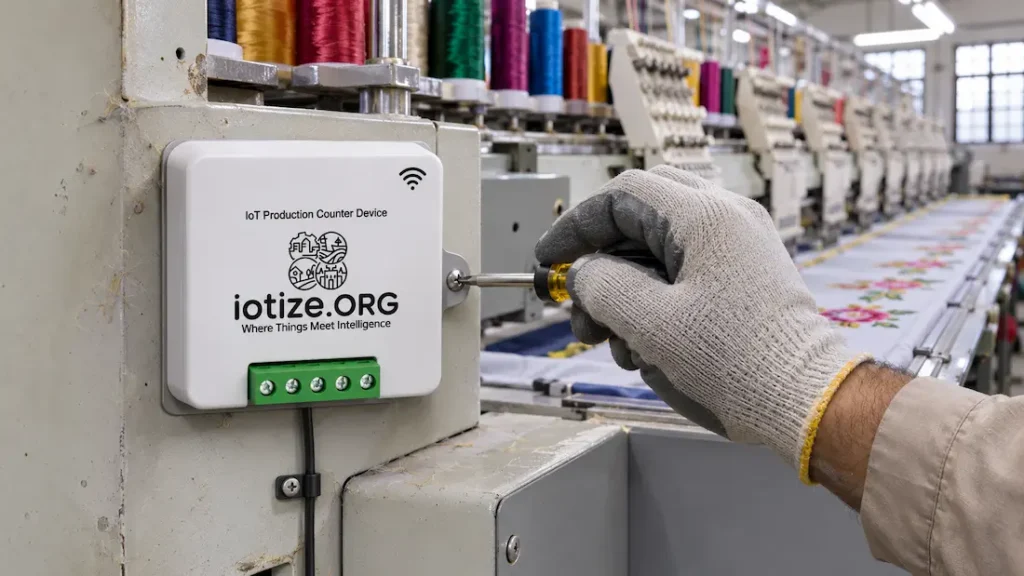
Multi-head embroidery machines run fast, often on night shifts with little supervision. Counting stitches and RPM per machine shows output per shift and catches machines run too fast, which wears them out early.
Real example: at a multi-head embroidery unit in Lahore, an IoTize production counter connected in parallel to the existing encoder showed on day one that some night operators ran machines at up to 1,400 RPM against a normal 800 to 900 RPM. With alerts and a talk with the operators, the owner got steadier round-the-clock work and lower maintenance. Read the embroidery case study.
General manufacturing
Motors, pumps, compressors, presses and packing lines exist in almost every plant: food, plastics, packaging, pharma, cement, steel. The same building blocks apply: vibration and temperature for breakdowns, current and energy for waste, counters for output. If your sector is not listed here, your machines usually are.
Marine
Boats carry expensive engines far from any workshop. A CAN bus gateway reads engine and navigation data (J1939 and NMEA 2000) and sends it over 4G.
Real example: a UK patrol boat operator used the IoTize marine gateway to find engines running at high RPM and wasting fuel, briefed crews with the data, and saw fuel and maintenance savings. Read the marine case study.
Environmental monitoring
Warehouses, stores and sensitive rooms need temperature, humidity and air quality kept in range. An environmental monitor logs these around the clock and alerts when a value drifts.
Control and custom systems
Some problems need a device that does not exist yet: a controller for a poultry shed, a vehicle counter for a car park, a gateway for a special machine. IoTize.ORG designs and builds custom hardware and controllers in Pakistan, from circuit board to firmware to dashboard. Talk to our team about a custom build.
How much does industrial IoT cost in Pakistan?
Short answer: from about PKR 16,500 per machine for the device, plus optional installation and an optional platform plan from about PKR 5,500 a month. You can start with one machine.
Device prices
IoTize starting prices from the live store, with an approximate rupee figure (about PKR 278 to the US dollar, November 2026):
| Device | Series | What it monitors | Price |
|---|---|---|---|
| Smart Machine Temperature Monitoring Device, Contact Sensor | Affordable | Temperature | $59 (about PKR 16,500) |
| IoT Production Counter Device | Affordable | Count, runtime, idle, RPM | $80 (about PKR 22,000) |
| Smart Energy & Hour Monitoring Device, Single-Phase | Affordable | Energy, power factor, running hours | $99 (about PKR 27,500) |
| Smart Machine Health Monitoring Device | Affordable | Vibration, temperature, current | $99 (about PKR 27,500) |
| IoT Environmental Monitoring Device | Affordable | Temperature, humidity, CO2, air quality | $120 (about PKR 33,500) |
| Enterprise IoT Production Counter, Encoder A/B/Z | Enterprise | Count, runtime, idle, reverse | From $160 (about PKR 44,500) |
| IoT Smart Energy Monitoring Sensor, Single-Phase | Enterprise | Energy and demand, Modbus TCP | From $180 (about PKR 50,000) |
| Enterprise IoT Vibration Monitoring Device | Enterprise | Vibration, bearing and alignment faults | From $199 (about PKR 55,500) |
| IoT Smart Energy Monitoring Sensor, Three-Phase | Enterprise | Per-phase power, power factor, imbalance | From $250 (about PKR 69,500) |
Enterprise devices add Modbus TCP for SCADA and MES, and final configuration is confirmed by quote. More devices are added over time; see the full store.
Installation
IoTize devices are designed so a factory’s own electrician can install them. Clamp-on and bolt-on mounting means most installs take from a few minutes to about an hour per machine, with no rewiring of the machine’s controls.
If you prefer an IoTize technician, installation typically costs about PKR 1,500 to 5,000 per machine, depending on the device and sensors, quoted per device. Site visits are free in Karachi; for other cities, we quote them separately.
Dashboard and platform
Data can go to the IoTize IoT Platform, with plans from $20 a month (about PKR 5,500) for up to 10 standard devices such as temperature sensors, production counters and single-phase energy meters. Devices that stream continuously, such as vibration and three-phase energy, are priced above the base rate. You can also send data to your own server or cloud. See the platform plans.
A simple example budget
Representative scenario, shown for illustration, not a specific customer or a quote.
| Item | Quantity | Approximate cost |
|---|---|---|
| IoT Production Counter Device ($80) | 10 looms | about PKR 222,000, one time |
| Installation by IoTize in Karachi | 10 machines | about PKR 15,000 to 50,000, one time |
| Cloud Starter platform plan | Up to 10 devices | about PKR 5,500 a month |
That gives ten machines with live output, runtime and idle-time data. In practice, many factories start even smaller, with one or two machines.
Where does the return on industrial IoT come from?
Industrial IoT pays back in four ways: fewer breakdowns, lower electricity bills, more output from the same machines, and records that buyers and auditors accept.
- Fewer breakdowns. Vibration and temperature trends warn weeks before a bearing or motor fails, so the repair is planned for a holiday instead of happening mid-order.
- Lower electricity bills. Per-machine energy data shows motors running idle, loads running at peak tariff and how much of your solar you actually use. The Pakistani automobile plant mentioned earlier saved about 10 percent of its energy a year after installing monitoring.
- More output from the same machines. Idle time, slow running and unplanned stops become visible per shift, so supervisors act on facts.
- Proof for buyers and auditors. Automatic logs replace manual registers for production and energy records.
Representative scenario, shown for illustration, not a specific customer. A Faisalabad weaving unit with 40 looms suspects its night shift produces less than the day shift but has no proof. It fits production counters on 10 looms first. Within a week, the dashboard shows two hours of idle time per loom on the night shift, mostly waiting for beams and yarn. The owner changes the material handover, then rolls out counters to all 40 looms and adds energy monitoring on the main compressor.
Industrial IoT and AI: why the data comes first
AI predictive maintenance is one of the most searched factory topics of 2026, but AI can only learn from data a factory actually collects. Industrial IoT is that data layer.
Every AI model for maintenance or energy needs months of clean, timestamped readings from real machines: vibration trends before a failure, energy use per shift, idle patterns per line. Most Pakistani factories do not have that history yet, because their records live in logbooks and monthly bills.
Therefore, the practical path to an AI-ready factory is simple:
Start collecting now with threshold alerts that pay back today. Because IoTize data is open (MQTT, HTTP, Modbus TCP, full export), that same history can feed any AI or analytics tool you adopt later, without being locked to one vendor.
Local or imported industrial IoT: an honest comparison
Imported systems from large global brands are excellent, and some plants need them. For most Pakistani factories, though, the comparison looks like this:
| Factor | Imported system | Locally designed system (IoTize.ORG) |
|---|---|---|
| Price | Usually priced for European budgets, plus import costs | Built for Pakistani budgets, from $59 a device |
| Support | Through a distributor, often from abroad | From the engineers who designed it, in Pakistan |
| Spares and lead time | Weeks, sometimes months | Designed, assembled and tested in-house in Pakistan |
| Local conditions | Often assumes stable power and internet | Power-loss logging, offline buffering, on-prem option |
| Customization | Hard and expensive | Custom devices and firmware possible |
| Data | Often tied to the vendor’s cloud | Cloud, your cloud or on-prem, open protocols |
The honest answer: if your plant is already standardized on one global automation brand, stay with it and connect IoTize data to it through Modbus TCP or MQTT. If you are starting from scratch with older machines, a local system usually gets you live data faster and for less money.
How to start with industrial IoT: one machine, one line, one plant
Start small. The plants that succeed with industrial IoT almost always begin with one problem and one or two machines.
- Pick one problem. The machine that breaks most often, the panel with the biggest bill, or the line whose output you doubt.
- Monitor one or two machines. Install the matching device, connect it to the dashboard and watch for two to four weeks.
- Act on what you see. Fix the idle time, the overheating or the overload, and measure the difference.
- Extend to the line. Add the same device to similar machines.
- Scale to the plant. Add energy, vibration and environment monitoring where the data shows value, and connect to your SCADA, MES or ERP if you have one.
Not sure where to begin? Tell us your machines and your biggest problem, and we will suggest the smallest setup that proves the value.
Where do I start? A 60-second selector
Answer one or two questions and get the IoTize device that fits your biggest problem.
What costs you the most today?
Frequently asked questions about industrial IoT in Pakistan
What is industrial IoT in simple words?
Industrial IoT means putting sensors on factory machines so they report their condition, energy use and output to a dashboard automatically. It helps you fix problems before they cause breakdowns or waste.
Is industrial IoT expensive in Pakistan?
No. A single machine can be monitored from $59 to $99 (about PKR 16,500 to 27,500) with an Affordable Series device, plus an optional platform plan from about PKR 5,500 a month. Most factories start with one or two machines and expand once the data proves its value.
Does industrial IoT work during load shedding?
Partly. The devices have no battery, so they pause while the power is off. When power returns, each device reports the power loss and its duration, so you get a record of every outage per machine. To monitor through outages, power the device from the machine’s UPS or generator supply.
Do I need internet at the factory?
No. Devices buffer data when the network drops and upload it later with the original timestamps. You can also run the whole system on-prem, on your own server, with no internet.
Can industrial IoT work with machines from the 1990s?
Yes. Sensors clamp around wires, bolt onto bearing housings or read existing encoders, so old machines without a PLC can be monitored without changing how they run.
Can industrial IoT help with solar and net billing?
Yes. Per-machine and per-panel energy data shows when your loads run and how much of your solar you use yourself. Under net billing, using your own solar during the day is usually worth more than exporting it, so that data helps you shift loads.
Is AI predictive maintenance possible in Pakistani factories?
Yes, but it starts with data. AI models need months of machine history, which industrial IoT sensors collect. Start with sensors and threshold alerts now; the same open data can feed AI tools later.
Who installs the devices?
Your own electrician can install most IoTize devices. If you prefer, an IoTize technician installs them for about PKR 1,500 to 5,000 per machine, quoted per device. Site visits in Karachi are free.
Is my data stored in Pakistan?
You choose. The IoTize Cloud is hosted outside Pakistan. If you need data to stay in Pakistan or inside your plant, use your own cloud or an on-prem server.
Is IoTize.ORG an IoT company based in Pakistan?
Yes. IoTize.ORG is an industrial IoT company based in Karachi that has designed, assembled and tested its devices in Pakistan since 2015, with installations across Pakistan and clients in the UK and the Gulf. IoTize.ORG is not related to IoTize SAS of France (iotize.com).
How long before we see results?
Live data starts the day a device is installed. Problems such as idle time, over-speed running or a machine running through lunch often show in the first week, as they did on day one in our Lahore embroidery case.
Make every machine in your plant report on itself
Start your industrial IoT journey with one machine and one problem. We will help you pick the device, and you will have live data on your phone within days.
No obligation. Tell us your machines and your biggest problem.
See all the industries we serve.
Solutions: Predictive Maintenance · Energy Monitoring · Production Monitoring · All solutions
Platform and proof: IoTize IoT Platform · Case studies · All devices
Guides: Predictive Maintenance in Pakistan · IoT Energy Monitoring in Pakistan · Best Energy Monitoring Solutions for Pakistani Factories · How to Reduce Energy Consumption in a Factory