Technical Reviewer: Zia ur Rehman
15+ years in embedded systems and industrial IoT · Reviewed
Pakistani factories lose significant production hours every year to invisible downtime — bearings that wear silently, motors that overheat slowly, breakers that trip without warning. Predictive maintenance changes this. With AI-driven IIoT sensors, your machines now warn you days before they fail. Here is how it works, what it costs, and why it now runs on factories of every size.
The 2 AM Phone Call: Why Reactive Maintenance Costs Pakistani Factories So Much
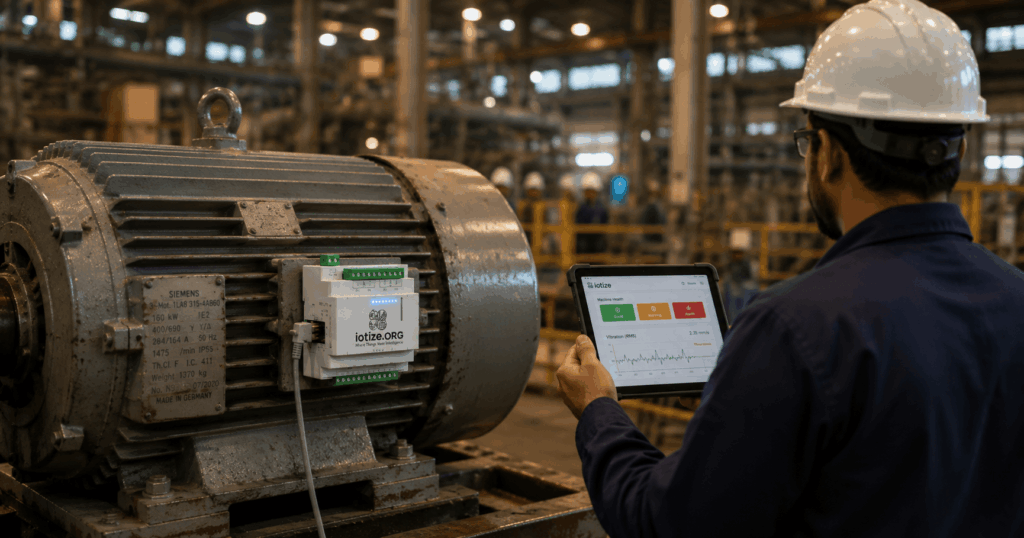
Imagine this: it’s 2 AM. Your most critical production line goes silent. A motor has burned out, the third time this year. Your maintenance crew scrambles. Your shift supervisor is on the phone. And somewhere in the noise, you are calculating what this unplanned stop is costing you: idle labor, missed orders, emergency spare parts, and the very real possibility of losing a client. As a result, this is the reality of factories across Pakistan that have not yet adopted predictive maintenance.
Now imagine a different scenario. Three days earlier, a small sensor on that same motor had already noticed something was wrong — a subtle rise in vibration, a heat signature slightly out of range. A dashboard alert fires. Your team schedules a repair during the weekend maintenance window and fix the motor in two hours. Production never stops.
Crucially, this is not a luxury available only to large multinationals. Predictive maintenance is now affordable for Pakistani manufacturers, textile mills, food processors, and factories of every size.
Predictive Maintenance Impact, What the Research Actually Shows
The following are the figures most consistently cited in published research. Specific outcomes will vary by industry, asset type, and implementation maturity.
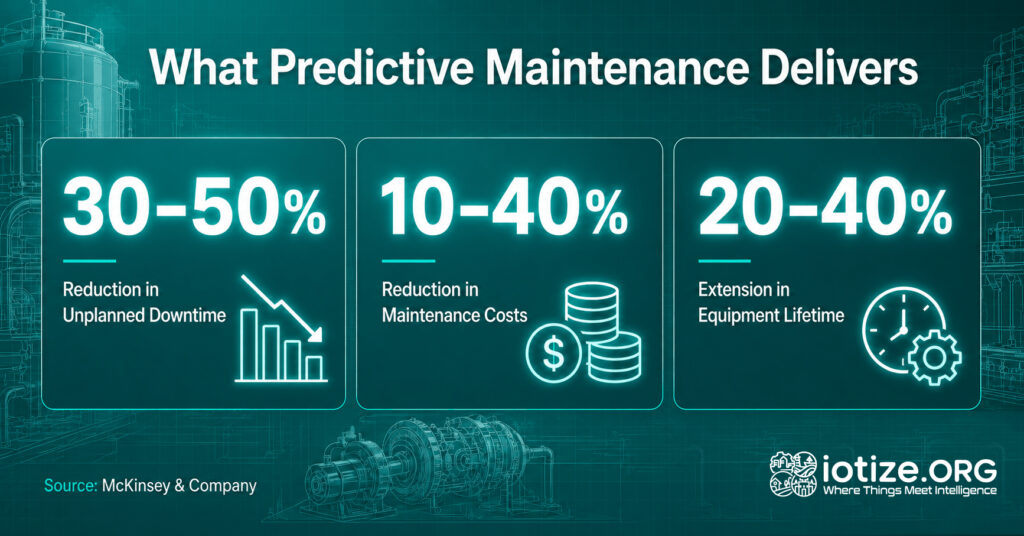
10 – 40% reduction in maintenance costs reported by factories globally after adopting predictive strategies.
10× more expensive to fix a breakdown reactively than to address a developing fault with real-time monitoring.
30 – 50% reduction in unplanned downtime for factories that adopt predictive maintenance
Source: McKinsey & Company research
Industry consensus — A significant share of equipment failures display detectable warning signs (vibration, thermal, electrical) before catastrophic breakdown. The exact percentage varies by equipment type and study.
The Hidden Cost of Reactive Maintenance: Why “If It Ain’t Broke, Don’t Fix It” Is Broken
Currently, Most factories in Pakistan operate on one of two maintenance strategies. Either they wait for a machine to fail and then fix it (reactive), or they follow a fixed schedule, oil changes every 500 hours, belt checks every month — regardless of whether the machine actually needs it (preventive). Unfortunately, Both approaches share one weakness: they are expensive, and they are flying blind. This is the problem predictive maintenance solves.
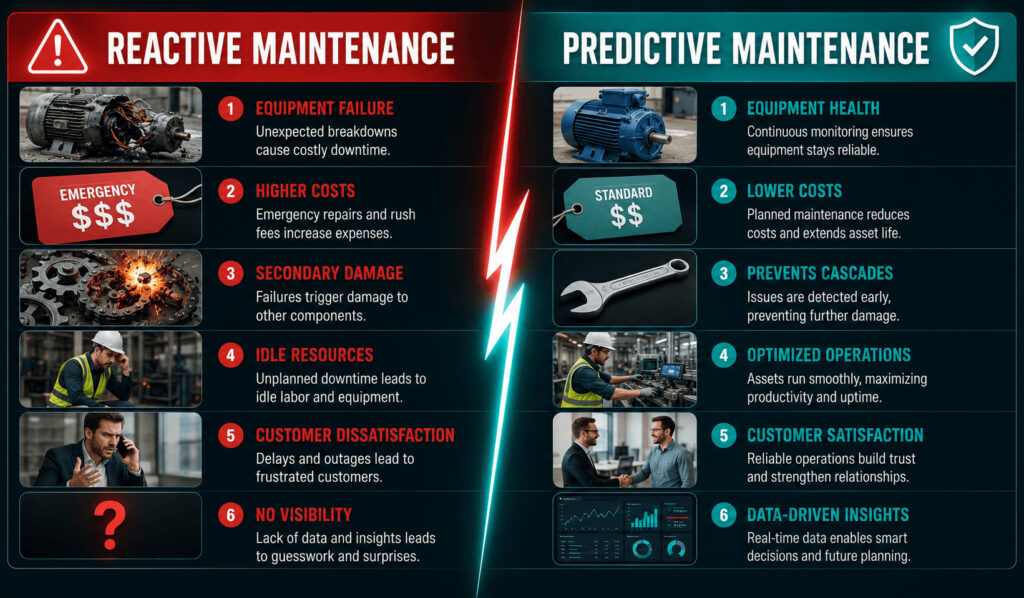
REACTIVE MAINTENANCE
- Breakdowns happen at the worst possible time
- Emergency spare parts at inflated prices
- Cascading failures damage adjacent equipment
- Idle workforce during unplanned stops
- Delivery delays and client penalties
- No warning — just a dead machine
PREDICTIVE MAINTENANCE
- Repairs scheduled entirely on your timeline
- Parts are ordered in advance at standard cost
- Isolated fixes prevent wider damage
- Production continues uninterrupted
- Client commitments honored
- Data tells you what to fix before it fails
Lost Production Costs You More Than the Broken Part
In reality, the most damaging cost is rarely the spare part — it is the lost production hours. A single hour of downtime in a mid-size textile factory can mean Rs. 200,000 to Rs. 500,000 in lost output (industry estimate, varies by line speed and product margin). Multiplied across 15 to 20 unplanned stops a year, the annual loss often exceeds any reasonable investment in monitoring technology.
“Machines do not break suddenly. They warn you in the language of heat, vibration, and current draw. The question is whether you are listening.”
What Is Predictive Maintenance and Why Pakistani Factories Need It
Predictive maintenance — also written as PdM — is the practice of monitoring the real-time condition of your equipment, predicting when it is likely to fail, and acting before it does. Unlike preventive maintenance that services on a fixed schedule, predictive maintenance acts only when the data says so. The result: less unnecessary downtime and less unnecessary servicing at the same time.
In practice, it works through a three-layer system.
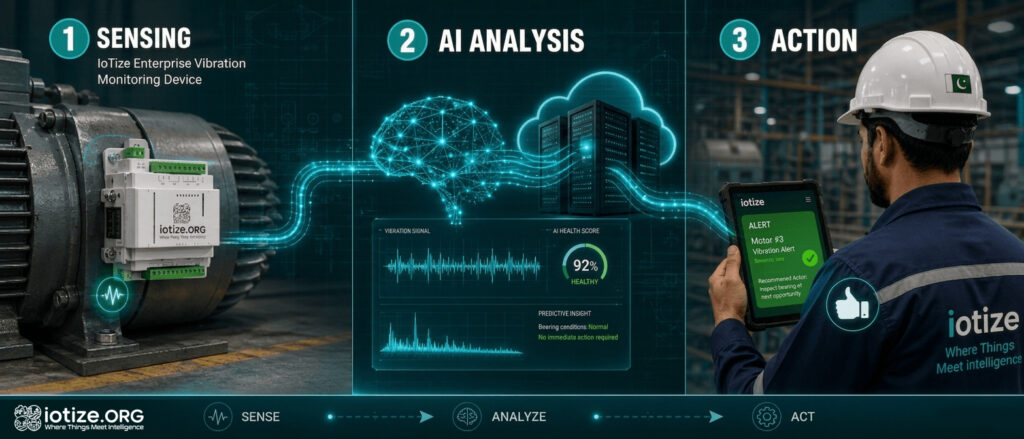
Layer 1: Sensing
Firstly, Sensors attached to machines continuously measure physical parameters: vibration, temperature, current draw, RPM, and pressure. These sensors transmit data in real time using protocols like MQTT or HTTP over your existing network or cellular connection. No new wiring required. No machine modifications.
Layer 2: AI Analysis
Next, Raw sensor data is processed by AI algorithms trained on machine failure patterns. The AI builds a “normal” baseline for each machine and watches for deviations. A motor that usually vibrates at 1.2 mm/s suddenly reading 3.8 mm/s is not just a number. To the AI, it is a red flag — typically indicating early-stage bearing wear, often weeks away from catastrophic failure.
Layer 3: Action
Finally, The system alerts your team — via dashboard notification, SMS, or email — while there’s still time to act. Your team plans the maintenance window in advance. The parts are ready. The repair takes two hours on a Saturday morning instead of 14 hours in the middle of a production week.
How AI Detects Early Warning Signs — The Signals Most Engineers Miss
The genius of AI-driven predictive maintenance is that it detects anomalies invisible to the human eye — and often to experienced engineers — until it’s too late. Here are the key signals modern IIoT sensors monitor continuously:
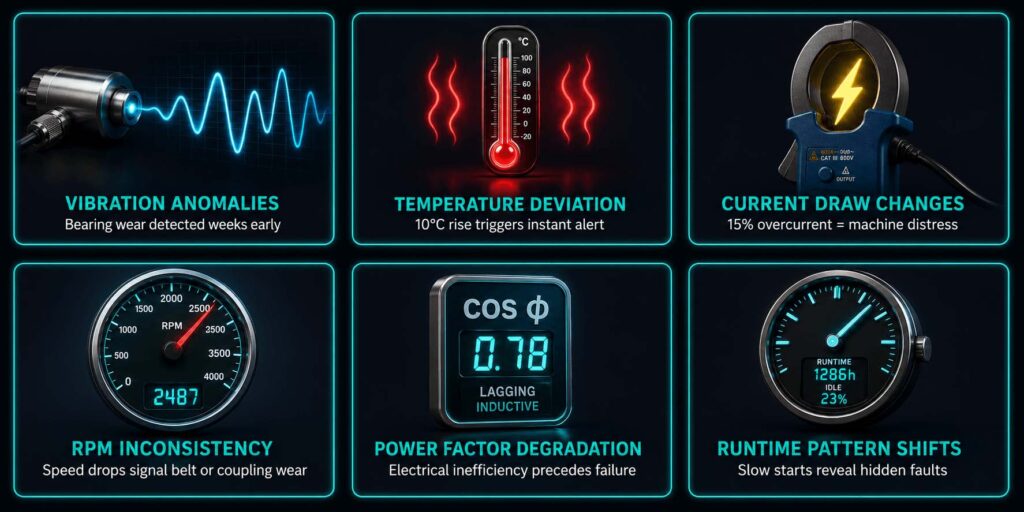
Vibration anomalies
Imbalance, misalignment, and bearing wear all show up as abnormal vibration patterns weeks before a physical failure.
Temperature Deviation
Motors, gearboxes, and bearings run hotter when they are struggling. A 10°C rise above the established baseline is an early warning.
Current Draw Changes
A motor pulling 15 percent more current than normal is working harder than it should. That extra effort usually indicates mechanical resistance — a sign something is wearing out.
RPM Inconsistency
Speed fluctuations in motors and drives often point to belt wear, coupling issues, or drive faults long before they escalate to breakdown.
Power Factor Degradation
Poor power factor signals electrical inefficiency and often precedes motor winding failure or capacitor breakdown.
Runtime and Idle Pattern Shifts
Machines that take longer to reach operating speed, or show unusual idle periods between cycles, are signaling that something is off.
Why Correlated Signals Matter Most
The AI does not just look at each signal in isolation. It correlates them. A simultaneous rise in temperature and current draw with an RPM dip is not three separate warnings — it is a specific failure signature. The AI knows the pattern, the typical severity, and the expected time-to-failure.
Predictive Maintenance Works on Old Machines — Not Just New Ones
At this point, this is the objection we hear most often from Pakistani factory owners: “Our machines are 20 to 30 years old. Will any of this actually work for us?”
The answer, however, is that age is not a barrier.. Older machines often benefit more than newer ones. They have run hard for decades. Bearings are worn. Insulation degrades over years of use. Failure patterns become increasingly unpredictable. And replacing entire fleets is rarely financially realistic.
“Modern IIoT sensors are entirely non-invasive. They attach to the outside of a machine — measuring vibration through a magnetic base, reading current through a clamp, monitoring temperature through a contact sensor — without modifying the machine itself or voiding any warranty.”
This is the predictive maintenance retrofit revolution. A 1995 lathe in a Karachi workshop can generate the same quality of predictive data as a brand-new CNC machine, as long as it has the right sensors on it. The machine does not need to be smart. The sensor is smart for it.
Furthermore, For factories with a mix of equipment — some legacy, some modern — this means a single unified dashboard giving full visibility across the entire floor, regardless of the age of each individual asset.
The IoTize Solution: Predictive Maintenance Built for Pakistani Factories
IoTize has been building predictive maintenance and Industrial IoT solutions in Pakistan since 2015. The principle behind the work is straightforward: the technology that large multinationals use to protect their machines should be accessible to Pakistani manufacturers without the matching price tag.
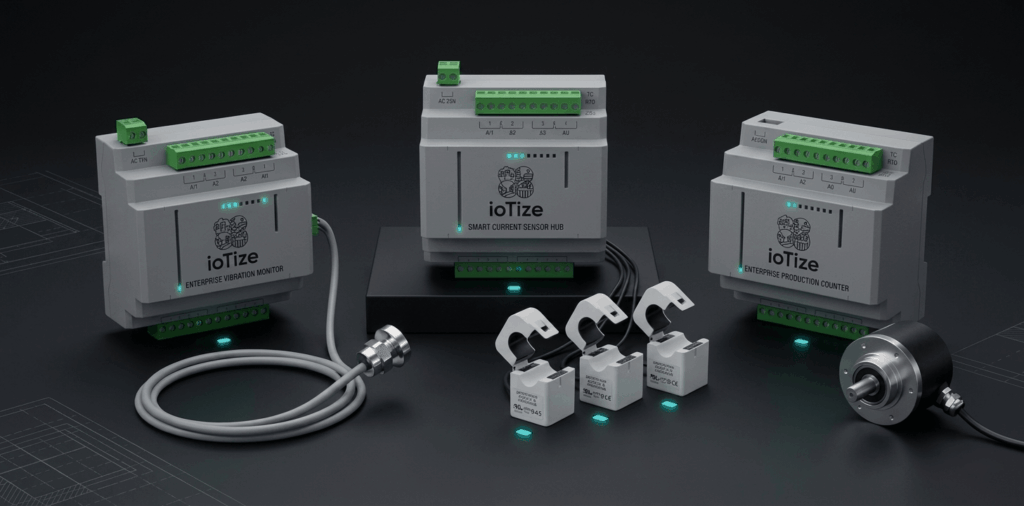
Hardware Built for Pakistani Industrial Realities
IoTize’s sensor lineup is designed for actual conditions on Pakistani factory floors — dust, unstable power supply, and a mix of single-phase and three-phase machinery. The Affordable Series is built for legacy factories starting with monitoring on a limited budget. The Enterprise Series delivers full telemetry for modern smart factories with high data precision requirements.
Vibration Monitoring for Bearing and Motor Health
The Enterprise Vibration Monitoring Device continuously tracks vibration in all axes, alerting your team to bearing degradation, imbalance, and resonance issues before they cascade into full breakdowns. It functions like an experienced mechanical engineer’s hand resting on every motor — 24 hours a day, 7 days a week.
Energy Monitoring for Efficiency and Fault Detection
IoTize’s single-phase and three-phase energy monitoring sensors track current, voltage, power factor, and active power in real time. These are not only energy-efficiency tools — they are early-warning systems. A motor pulling abnormal current is a motor in distress, and the sensor catches it long before the circuit breaker does.
Production Counters for Real-Time Output Tracking
The Enterprise Production Counter monitors runtime, idle time, RPM, and reverse events — giving management a complete picture of how each machine is actually performing versus how it should be performing. Combined with energy and vibration data, you get a complete health picture for every asset on the floor.
Custom Dashboards Your Team Will Actually Use
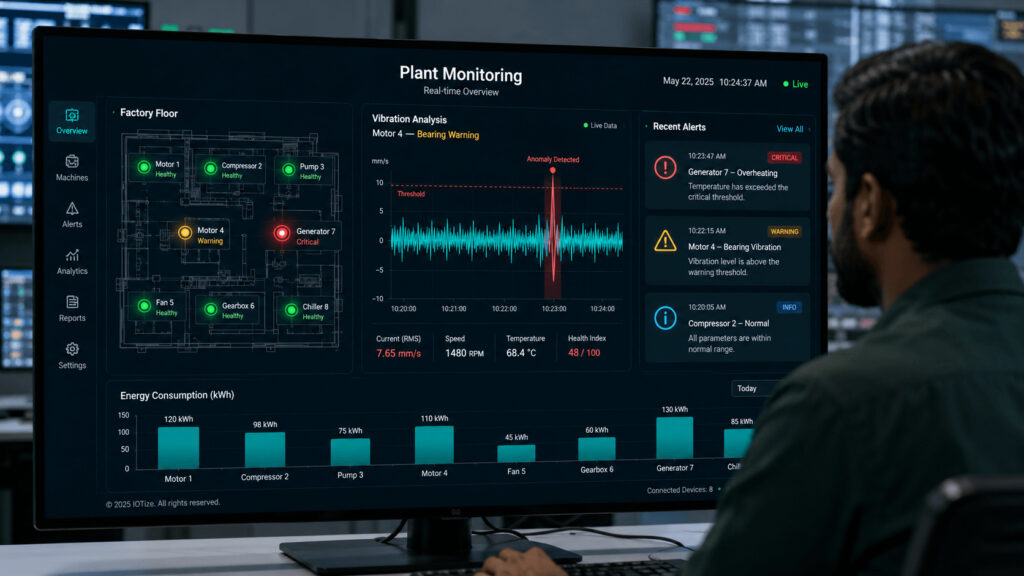
All sensor data flows into IoTize’s custom dashboard platform, configurable to show exactly what your team needs to see. Not a wall of overwhelming metrics — a clear, actionable view of machine health across the facility. The dashboard sends alerts via dashboard notification, SMS, or email, so your team always knows before a problem becomes a crisis.
What Does It Actually Cost — and What Do You Get Back?
The most common hesitation around IIoT adoption in Pakistan is the assumption that it is expensive. The reality is the opposite. IoTize’s Affordable Series sensors start at a fraction of what a single unplanned breakdown typically costs.
In fact, Most factories that deploy IoTize recover their full investment within the first two to three prevented machine failures, when properly accounting for emergency repair costs, lost production output, idle labor hours, and expedited shipping on spare parts.
There are no lock-ins and no forced cloud subscriptions. The system runs on-premises, on your own private cloud, or on IoTize’s SaaS platform — whichever fits your setup. You own your data, and you choose where it lives.
Frequently Asked Questions
What is predictive maintenance and how is it different from preventive maintenance?
Preventive maintenance follows a fixed schedule — a machine is serviced every X hours regardless of its actual condition. Predictive maintenance uses real-time sensor data and AI to act only when the data indicates a developing fault. Predictive avoids both unnecessary downtime and unnecessary servicing at the same time.
Can predictive maintenance work on old machines?
Age is not a barrier. IIoT sensors like those from IoTize are entirely non-invasive — they attach externally without machine modifications. A 30-year-old motor can generate the same quality of predictive data as a brand-new one.
How affordable is IIoT-based predictive maintenance for a Pakistani factory?
IoTize’s Affordable Series is priced specifically for small and mid-size Pakistani factories. Return on investment typically arrives within the first few prevented breakdowns, when emergency repair costs, lost production time, and idle labor are factored in. Get a facility-specific quote for exact numbers.
What sensors are needed to get started?
A core starter setup for most factories includes a vibration sensor for mechanical health, a temperature sensor for thermal anomalies, and a current or energy sensor for electrical faults. IoTize offers all three in both Affordable and Enterprise variants, along with production counters and RPM monitors.
Do I need a constant internet connection for this to work?
A constant connection is not required. IoTize devices support edge computing — they process and store data locally even without a stable cloud connection. Deployment is flexible: on-premises, private cloud, or IoTize’s own SaaS platform.
How long does it take to install IoTize sensors on a factory floor?
A typical pilot deployment of three to five sensors on a single line takes one working day, with no production downtime. Larger rollouts across multiple lines are usually phased over two to four weeks.
How accurate are the failure predictions?
Accuracy depends on the equipment type, the quality of the baseline period, and the specific failure mode. As with any predictive system, false positives and false negatives can occur. Industry-published research suggests well-tuned PdM systems significantly reduce unplanned breakdowns, but Pakistani facility-specific outcomes will vary.
Will my maintenance team need special training?
Basic operator training takes a few hours. The dashboard is designed to surface clear, actionable alerts rather than raw engineering data. IoTize provides onboarding and ongoing support during the first months of deployment.
Can this integrate with our existing CMMS or ERP system?
IoTize supports standard integration protocols and can push alerts and machine health data into most modern CMMS and ERP systems. Specific integrations depend on the system in use — discuss your stack during the assessment.
What happens to my data?
You own your data. Storage options include on-premises, your private cloud, or IoTize’s SaaS platform. IoTize encrypts your data in transit and at rest.
Stop Waiting for the Breakdown. Start Listening to the Warning.
Every machine in your factory is already talking. It speaks in vibration patterns, temperature curves, and current spikes. The question is whether you have the tools to listen — and the system to act on what you hear.
Since 2015, IoTize has been building these listening systems. From affordable retrofit sensors for legacy equipment to full enterprise monitoring dashboards, we make predictive maintenance real, local, and accessible. Your machines deserve better than waiting to break — and so does your business.