
Industrial Energy Monitoring Solutions: See Every Watt, Stop Paying for Waste
Your utility bill tells you what a whole factory spent last month. It never tells you which motor, line, or shift spent it. IoTize IoT energy monitoring reads voltage, current, power, and energy at the machine and panel level, in real time.
From an affordable single-phase energy monitor to a three-phase sensor wired straight into SCADA, each device installs in minutes. Your data, your way.
Industrial IoT since 2015, on-premise, private cloud, or IoTize SaaS, open protocols MQTT, HTTP, Modbus TCP
Unplanned energy waste starts long before the bill arrives
You cannot manage what you cannot measure. Most manufacturing plants measure energy exactly once a month, when the electricity bill arrives, and that single number hides everything that matters. Without real-time energy monitoring, the waste stays invisible, and you keep paying for it. This is the core problem industrial energy management solves.
Four hidden costs of running your plant blind on energy:
- No machine-level visibility. The bill is one lump sum, so machine-level energy monitoring is the only way to separate a failing motor from an oversized compressor from a line left on.
- The monthly bill hides the peaks. Many industrial tariffs charge for peak demand, and a monthly meter never shows the spike that set your demand charge.
- Idle and phantom loads run unwatched. Machines left energized between shifts and compressors cycling against leaks burn power around the clock until energy consumption monitoring makes them obvious.
- Drifting equipment costs more before it fails. A motor pulling steadily rising current is both a rising energy cost and an early failure warning, which motor current monitoring catches.
The payoff of seeing your energy clearly
Sources: IEA 4E EMSA (electric motor systems); Clean Energy Ministerial via Natural Resources Canada. Industry potentials, not a guarantee.
What industrial energy efficiency really means
Industrial energy efficiency is getting the same production from less energy. In practice that rarely means buying new machines. It means finding and removing the waste already hiding in the machines you run today: oversized motors, poor power factor, idle loads, avoidable demand peaks, and equipment that has quietly drifted out of tune.
Energy monitoring is the measurement layer that makes efficiency possible. It continuously records how much electricity each machine, line, or panel actually uses, then turns that raw data into trends, benchmarks, and alerts. You cannot reduce energy consumption in manufacturing that you have never measured, so monitoring always comes first. Most plants sit somewhere on this path, and the goal is to move to the right.
No visibility. Waste is invisible. Highest cost.
Monitoring and alerts. Waste becomes visible.
Waste is designed out. Lowest, sustained cost.

How IoT energy monitoring works
An IoT based energy monitoring system turns raw electricity into decisions in five steps, from the sensor on the panel to the alert on your phone.
- Sense. Non-invasive split-core current-transformer clamps read current without cutting a wire, and a voltage tap reads the supply. Nothing is disconnected.
- Process at the edge. The device computes active and reactive power, power factor, energy in kWh, peak demand in kW, and runtime hours locally.
- Connect. Data streams over Wi-Fi or Ethernet using MQTT, HTTP, and Modbus TCP, so an IIoT energy monitoring node drops into the systems you already run.
- Deliver. Send data to IoTize SaaS, your private cloud, a fully on-premise server, or straight into SCADA, MES, and your own dashboards.
- Act. Configurable thresholds fire instant alerts on abnormal load, poor power factor, or a demand peak, turning smart factory energy monitoring into action.
What you can see and control
A single IoTize energy monitoring device turns one supply into a live picture of the numbers that drive your electricity bill and your equipment health. Watch one machine or a whole panel, and set a high or low limit on any of them.
- Current and voltage: how hard equipment works and how clean the supply is. Motor current monitoring catches overload, imbalance, and drift.
- Active and reactive power: the real cost driver, and the wasted non-working power that flags where power factor correction pays back.
- Power factor: how efficiently you draw supply. A poor power factor can add penalties to the bill.
- Energy in kWh: machine-level and line-level cost accounting over any period.
- Peak demand in kW: your highest short-term draw, so you can manage the demand charges that inflate bills.
- Runtime hours: actual on-time versus idle, which exposes phantom loads left running.

Single-phase, three-phase, and machine-level monitoring
Industrial energy hides at three levels, and you can monitor any or all of them. Single-phase energy monitoring uses one clamp on a machine or circuit and is where most plants begin. Three-phase energy monitoring uses three clamps to read all phases at once, and it also exposes phase imbalance. The biggest wins come from energy submetering: putting a monitor on each major machine, line, or department instead of only the main incomer, so you can finally say “Line 2 uses 30 percent more energy per unit than Line 1”.
- Level 1, the utility incomer: one three-phase sensor reads total plant load and peak demand.
- Level 2, feeders and departments: a sensor per feeder gives you submetering by area.
- Level 3, machine-level: a sensor per major machine reveals energy per unit and line versus line.
Because every IoTize energy sensor is a wireless energy monitoring device over Wi-Fi, with Ethernet on the enterprise units, you can add submeters without pulling new network cable across the plant.
Deployment and data ownership
Most energy monitoring vendors funnel your data into their cloud and keep it there. IoTize is built on data freedom, so the same energy monitoring device connects the way your IT and security teams prefer. This is energy monitoring without vendor lock-in, and you can switch paths later.
Device to cloud dashboard. Nothing to host, the fastest start.
Device to your own server. Energy data never leaves your network.
Modbus TCP into SCADA and MES, or JSON and MQTT into your own platform.
Choose your energy monitoring device
You can start with a single machine on one phase, or meter a full three-phase panel, and scale plant-wide when you are ready. Every device installs in minutes with non-invasive clamps and no rewiring. Monitoring one single-phase machine at the lowest cost? Choose the Smart Energy and Hour Monitoring Device. A critical single-phase feeder that must talk to SCADA calls for the Enterprise Single-Phase sensor. And any three-phase load, panel, or incomer is best matched to the Enterprise Three-Phase sensor.
| Smart Energy & Hour Monitor | Enterprise Single-Phase | Enterprise Three-Phase | |
|---|---|---|---|
| Series | Affordable | Enterprise | Enterprise |
| Phases | Single-phase | Single-phase | Three-phase (3 clamps) |
| Reads | Voltage, current, power, PF, energy, runtime hours | Voltage, current, power, PF, energy, demand | Per-phase power, PF, energy, demand, imbalance |
| Connectivity | HTTP, MQTT, Modbus TCP | HTTP, MQTT, Modbus TCP | HTTP, MQTT, Modbus TCP |
| SCADA or MES ready | Via Modbus TCP | Yes | Yes |
| Price | $99 | Request a Quote | Request a Quote |
| Best for | One single-phase machine | A critical single-phase feeder | Panels, incomers, three-phase machines |
The IoTize energy monitoring devices
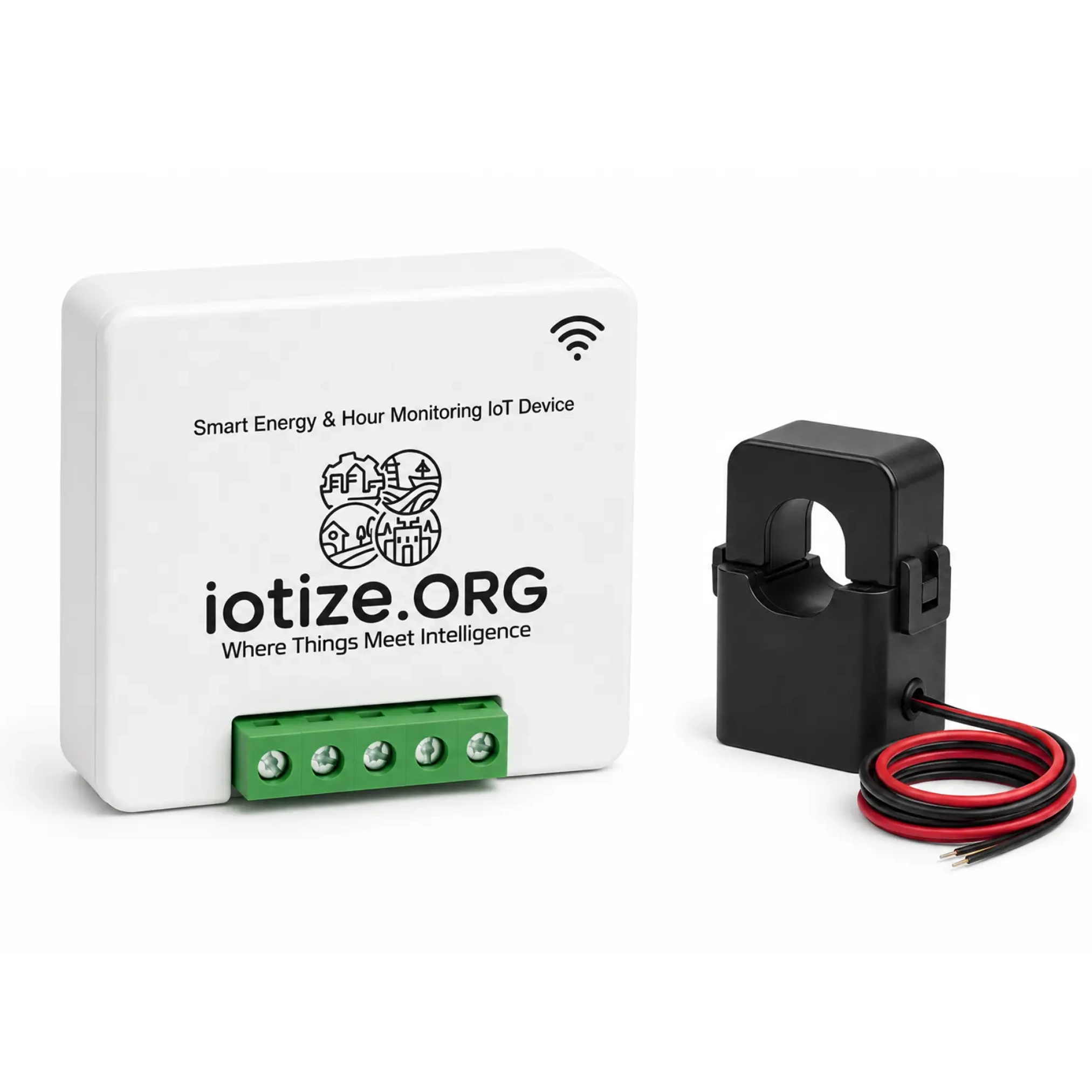
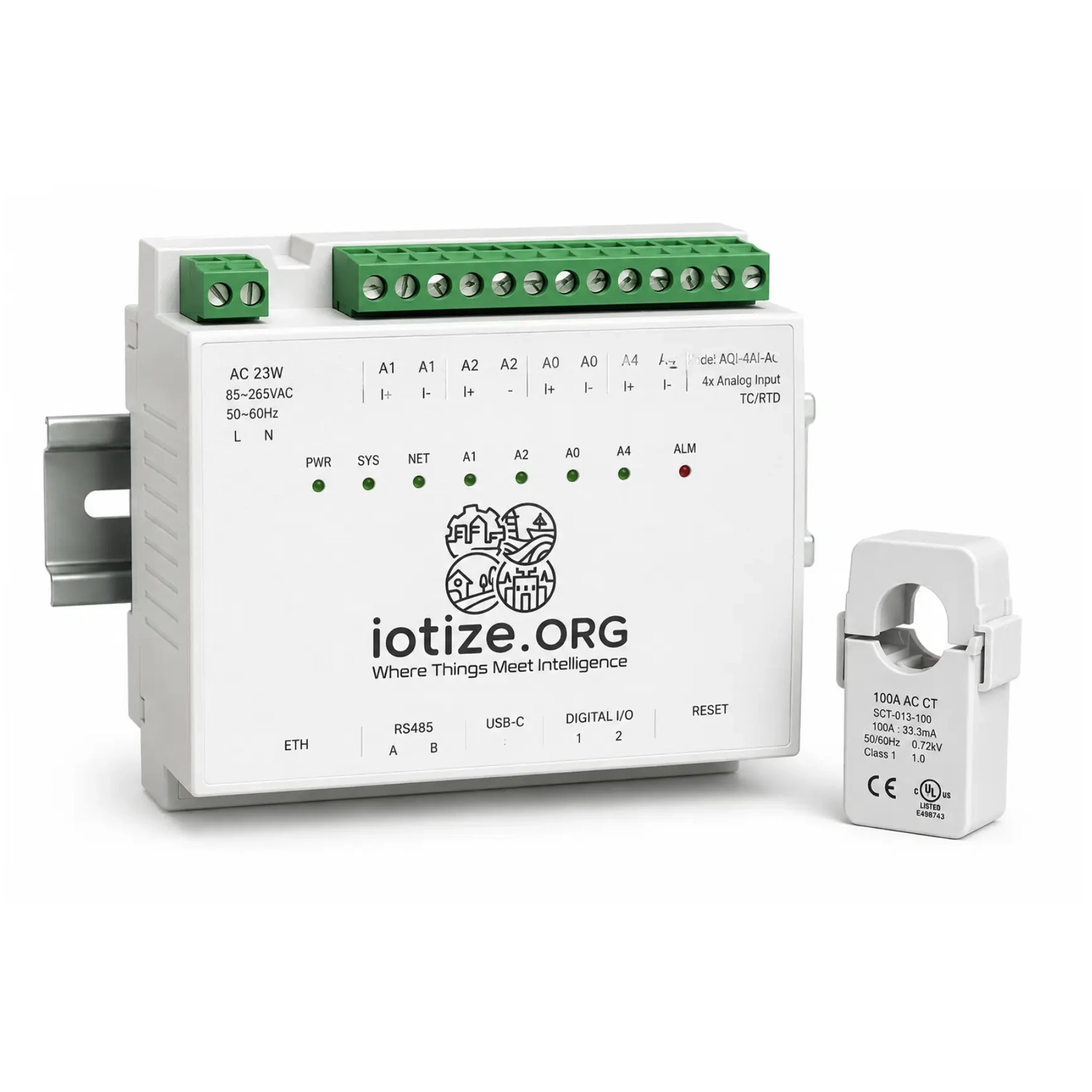
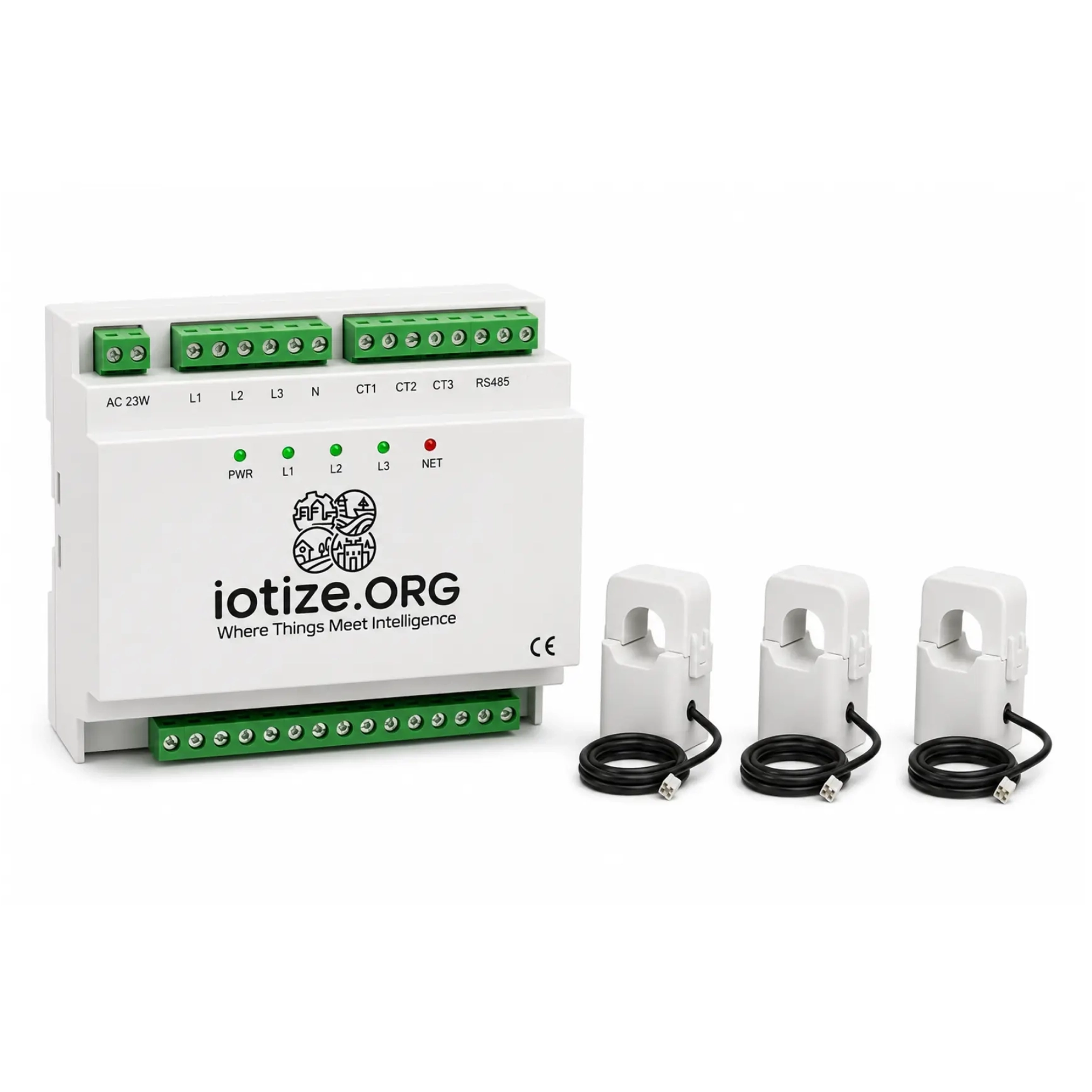
More energy devices are on the way. As IoTize expands the range, new sensors will slot into the comparison and cards above. Ask our team what is shipping next.
Pairs well with
- Smart Machine Health Monitor ($99): adds vibration and temperature to current, so one bolt-on device covers both energy and machine health.
- IoT Production Counter ($80): pairs energy with output, so you can measure true energy per unit and connect OEE and energy efficiency.
- Environmental Monitoring Device ($120): watches temperature, humidity, CO, and air quality, useful where HVAC is a major energy load.
Find your device in 60 seconds
Answer a couple of quick questions and this selector recommends the right IoTize energy monitoring device, matching your single-phase or three-phase load to the sensor that fits.
60-second energy device selector
Is the load you want to monitor three-phase?
A three-phase panel, incomer, or three-phase machine.
Question 2
Is this a critical single-phase feeder that must feed SCADA or MES?
A feeder you need to integrate directly and cannot afford to lose.
Question 3
Do you want the lowest-cost way to monitor one single-phase machine and its runtime?
Energy plus runtime and idle hours on a single machine.
Question 4
Do you also need vibration and temperature on this machine, not just energy?
Full machine health, current plus vibration plus temperature.
Enterprise Three-Phase Energy Sensor
Request a Quote
Three clamps read all phases at once for full three-phase energy monitoring, including per-phase power factor and imbalance, with Modbus TCP for direct SCADA and MES. Built for panels, incomers, and three-phase machines.
Enterprise Single-Phase Energy Sensor
Request a Quote
Full single-phase electrical monitoring with demand, on a rugged enterprise build with Wi-Fi and Ethernet, and Modbus TCP for direct SCADA and MES integration. The specialist for a critical single-phase feeder.
Smart Energy and Hour Monitoring Device
$99
The most affordable way to bring one single-phase machine into view. Reads voltage, current, power, power factor, and energy, and tracks runtime and idle hours. HTTP, MQTT, and Modbus TCP. The most popular starting point.
Smart Machine Health Monitor
$99
Current, vibration, and temperature in one affordable bolt-on device, so you get energy visibility and predictive maintenance on the same machine. The complete early-warning picture for a single asset.
Where energy monitoring pays off
The same energy monitoring devices watch very different loads. Here is where energy monitoring for factories and manufacturing plants returns the most, and which device fits.
- Motors and drives: rising current, overload, phase imbalance, and drift. Best fit: Three-Phase sensor or Machine Health Monitor.
- Compressors: cycling against leaks, oversized running, idle load. Best fit: Three-Phase sensor.
- HVAC and chillers: off-hours running, seasonal creep, oversized draw. Best fit: Three-Phase sensor plus Environmental Monitor.
- Production lines: energy per unit, idle-shift consumption, line versus line. Best fit: Single-Phase or Three-Phase plus Production Counter.
- Pumps and fans: running against closed valves or dampers. Best fit: Three-Phase sensor.
- Lighting and small feeders: circuits left on, phantom loads between shifts. Best fit: Single-Phase sensor.
- Whole-plant incomer: peak demand events, tariff exposure, total load profile. Best fit: Three-Phase sensor.
Motor energy efficiency monitoring deserves its own line. Because electric motor systems account for roughly 72 percent of industrial electricity, the motors are where the money is, so watching motor current and power is the single highest-value place to start.

The ROI of energy monitoring
The ROI of energy monitoring is simple to reason about. The hardware cost is small and fixed, while the waste it exposes recurs every month, so you pay once to see the leak, then save on it for years. Here is where the return comes from.
- Cut avoidable demand charges by seeing peaks as they happen and staggering machine startups. Lower demand charges show up on the next invoice.
- Fix poor power factor by seeing exactly which loads pull it down, so correction is targeted, not guessed.
- Eliminate idle and phantom loads that runtime tracking exposes. Turning them off is free.
- Catch drifting equipment early, since a motor drawing rising current wastes energy long before it fails.
- Benchmark and hold the gains by comparing line versus line and month versus month, with alerts when consumption creeps back.
For context on the scale, structured energy management programs have saved up to 30 percent of industrial energy use, and manufacturers running an ISO 50001 energy management system have averaged around 4 percent energy savings per year, sustained for over a decade. Monitoring is the measurement layer those programs are built on. These are industry figures, not a promise for any single plant, and your result depends on what you do with what you see.
Energy monitoring in practice
Representative scenario, shown for illustration. Not a specific customer.
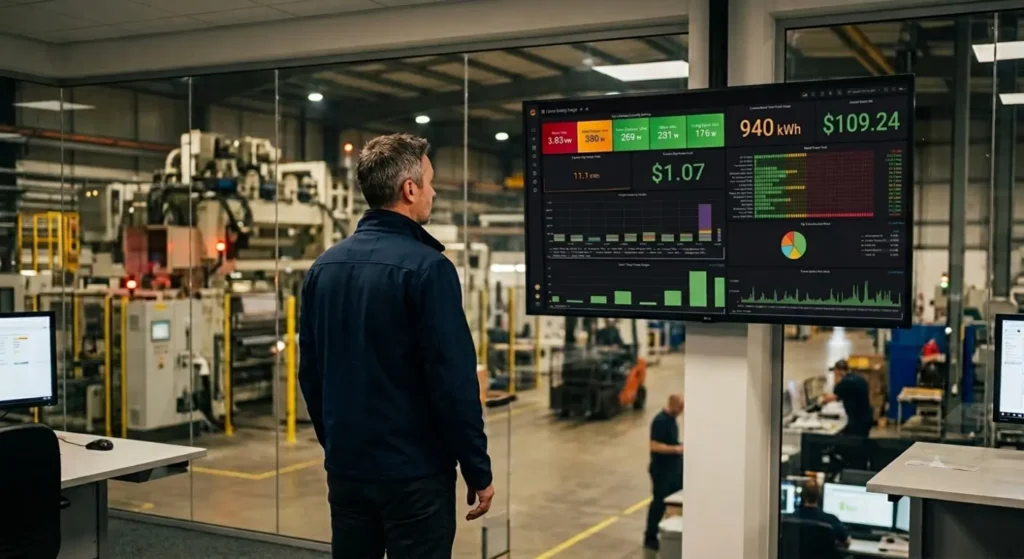
A mid-sized textile plant runs three lines of electric motors and two air compressors around the clock. The monthly bill keeps climbing, but nobody can say why, because the plant meters only at the main incomer. The plant fits three-phase energy monitoring sensors to the compressors, the main feeders, and its largest motors, and single-phase monitors on a few lighting circuits. Within a week, the picture is clear: one compressor cycles hard against an air leak overnight, a motor draws steadily rising current, and two lighting feeders never switch off between shifts. The leak is repaired, the drifting motor is serviced during planned downtime instead of failing mid-shift, the lighting is put on a schedule, and the peaks are staggered to trim the demand charge. The plant now runs an energy routine guided by real numbers, and the bill reflects it.
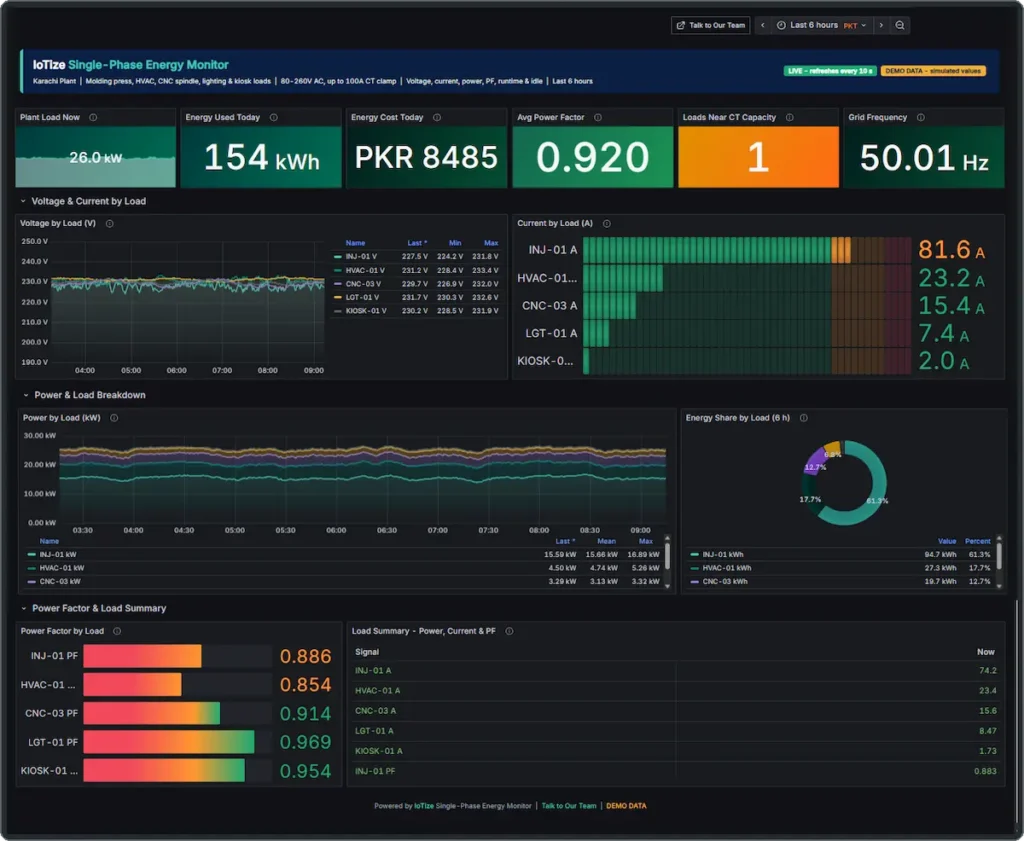
Energy monitoring meets predictive maintenance
Energy data and machine health are the same signal read two ways. A motor pulling steadily rising current is both a rising energy cost and a failing bearing warning, which is why current monitoring sits at the heart of both ranges. Monitor energy and you often catch the fault first; monitor machine health and you often catch the waste first. If failing equipment is your bigger worry, start with our predictive maintenance solution. For a deeper look at how real-time data cuts bills, read our guide to IoT energy monitoring on the blogs.
Industries we serve
- Manufacturing: meter lines, motors, and compressors to cut factory energy costs and benchmark line against line.
- Marine: monitor engine and auxiliary electrical load in rugged environments.
- Utilities: submeter distributed assets and manage load across sites.
- Smart cities: connect and monitor distributed equipment and facilities from one platform.
- Healthcare: track the electrical load of critical facility systems and cut avoidable consumption.
We are based in Pakistan and ship worldwide, so whether you are cutting an electricity bill in Karachi or a demand charge in the EU, the same devices and the same data freedom apply.
Why factories choose IoTize
- Data freedom, no vendor lock-in: run on IoTize SaaS, your private cloud, or fully on-premise.
- Deploy your way: one device, three deployment paths, including direct SCADA and MES over Modbus TCP.
- Non-invasive and fast to install: clamps retrofit onto existing and legacy switchgear in minutes, with no rewiring.
- Entry to enterprise: from an affordable $99 single-phase monitor to a SCADA-ready three-phase sensor.
- Open protocols: MQTT, HTTP, and Modbus TCP, ready for the systems you already run.
- Field-proven industrial IoT: designing and shipping IIoT devices since 2015.
Get started in five steps
- Pick your biggest question: the main incomer for total load, or the machine you suspect wastes the most.
- Choose a device: single-phase for one machine, three-phase for a panel or incomer.
- Clamp it on in minutes, with no rewiring, even on legacy switchgear.
- Connect it your way: IoTize SaaS, on-premise, private cloud, or straight into SCADA and MES.
- Set thresholds, act, and scale. Prove the saving on one load, then submeter plant-wide.
All Your Devices, One Live Platform
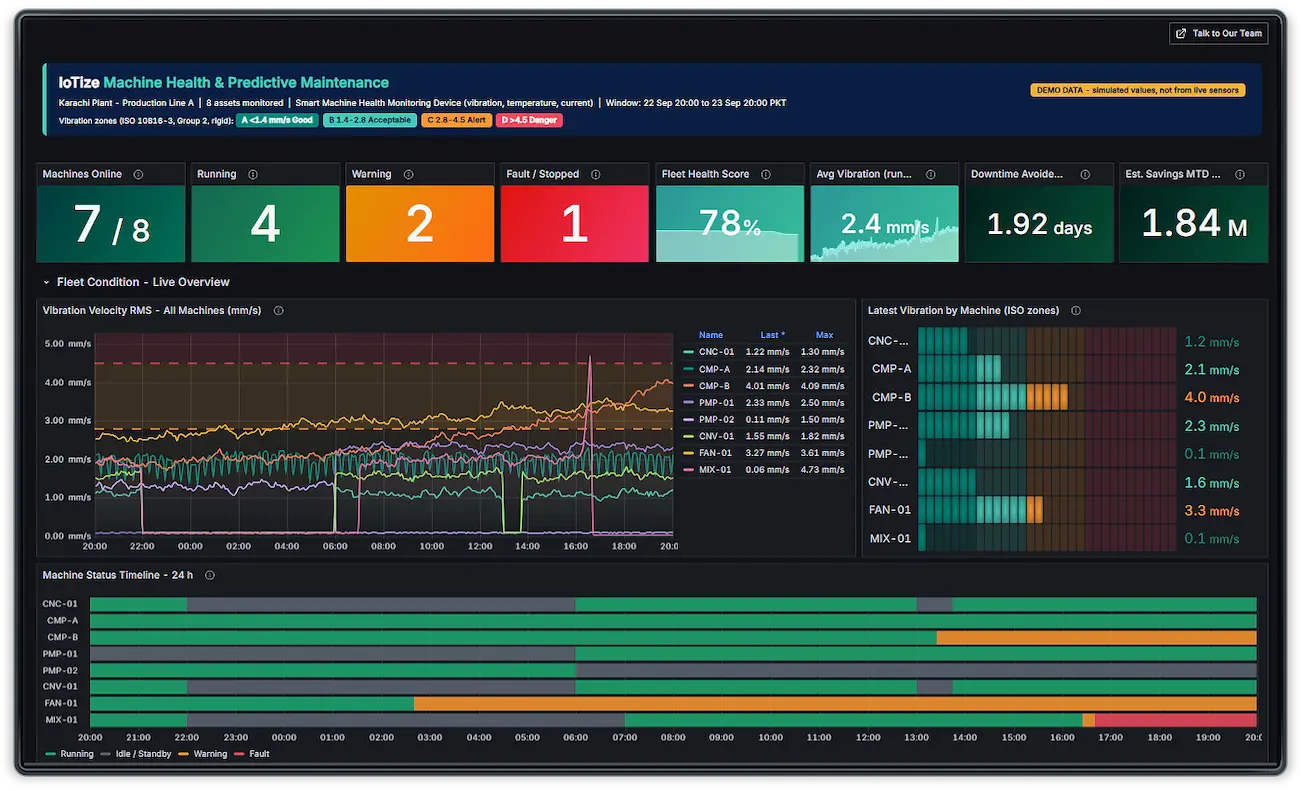
This solution is just one piece. The IoTize Platform brings every connected device together, so you can monitor, analyse and act on live data from a single place.
- Real-time dashboards and instant alerts
- Health, energy and production data side by side
- Access from any browser, on any device
Stop paying for energy you cannot see
See every watt at the machine and panel level, cut the waste, and lower your factory electricity bill with IoTize energy monitoring. Start with one machine. Your data stays yours.
Frequently asked questions
How does IoT energy monitoring work?
Non-invasive clamps read current and a tap reads voltage, the device computes power, power factor, energy, and demand at the edge, and it streams over MQTT, HTTP, or Modbus TCP to IoTize SaaS, your own server, or SCADA. You set thresholds and get real-time alerts.
How much energy do factories waste?
It varies by plant, but the potential is large. Electric motor systems alone use around 72 percent of industrial electricity, and roughly 20 to 30 percent of that can be recovered cost-effectively. You cannot recover waste you cannot see, which is why monitoring comes first.
How can manufacturers reduce energy costs?
Measure at the machine and panel level, then act on what appears: fix poor power factor, remove idle and phantom loads, stagger startups to cut demand charges, and service drifting equipment before it wastes more energy or fails.
What is the ROI of energy monitoring?
The device cost is small and one-time, while the waste it exposes recurs every month, so payback is usually fast. Structured energy management programs have saved up to 30 percent of industrial energy, and monitoring is the measurement layer they rely on.
Can energy monitoring detect equipment problems?
Yes. A motor drawing steadily rising current or showing phase imbalance is often failing, so energy monitoring doubles as an early machine-health signal. This is where energy monitoring and predictive maintenance overlap.
What is the difference between energy monitoring and a building management system?
A building management system controls building services such as HVAC and lighting. Industrial energy monitoring measures electrical consumption at the machine, line, and panel level, and it integrates with SCADA and MES. Many plants run both, and IoTize data can feed a BMS over MQTT or Modbus TCP.
Do I need a separate gateway?
No. The energy devices stream directly over Wi-Fi, with Ethernet on the enterprise units, using MQTT and HTTP, so there is no extra gateway to buy.
Will this work on my old switchgear?
Yes. The clamps are non-invasive and clamp onto existing wiring without rewiring, so you can retrofit energy monitoring onto legacy panels without replacing them.
Can I keep all my data on-premises?
Yes. You can run fully on-premise or on your own private cloud, so energy data never leaves your network. IoTize SaaS is optional.
Does this integrate with my SCADA or MES?
The enterprise energy sensors speak Modbus TCP alongside MQTT and HTTP, so they connect directly into SCADA, MES, and ERP systems.
Single-phase or three-phase, which do I need?
Match the load. One clamp reads a single-phase machine or circuit; three clamps read a three-phase machine, feeder, or incomer and also expose phase imbalance.
Energy products: Smart Energy and Hour Monitor · Enterprise Single-Phase · Enterprise Three-Phase
Related solution: Predictive Maintenance
From the blog: Visit the IoTize blog →