
White Label EV Charging Software: Your Charger, Our Application
You bring the charger. We bring the platform that makes it earn. A branded driver app that finds and navigates to your chargers, an operator web dashboard that watches every unit, host logins for each venue, and local payment gateway integration, all on your own brand.
One platform, three winners: the charger company sees its whole fleet, the host sees its own site and share, and the driver finds the nearest free charger, navigates to it, and pays in seconds. OCPP 1.6 and 2.0.1 chargers, AC or DC. Any site.
Powered by IoTize IoT engineering since 2015 · Open OCPP, no vendor lock-in · Deploy on our cloud, your cloud, or on-prem
The problem: a charger without software is just a box
Buying an EV charger is the easy part. However, the hard part starts the moment you want it to behave like a business. An unmanaged charger cannot tell you who used it, cannot bill them, cannot stop a session, and cannot tell you it has failed until a customer calls to complain. As a result, you have capital sitting on a wall, drawing power, earning nothing you can measure.
If you make or sell chargers, the box alone is a shrinking business. Meanwhile, importers and local assemblers now compete on price for hardware that all looks the same on a spec sheet. In short, the buyer no longer wants a charger, the buyer wants a charging business: an app, billing, monitoring, and support. Therefore the maker who ships hardware plus a branded app and a live dashboard wins the deal, and keeps earning after the sale.
Here is what the status quo really costs a charger maker, a site host, or an operator:
- No billing, no revenue. Without software, you cannot charge per kWh or per session, so the charger is a free amenity at best and a loss at worst.
- Zero visibility. You do not know uptime, faults, or utilization, so you cannot fix problems or plan the next site.
- Someone else’s brand. Drivers use another company’s app, so every session builds their network, not yours.
- Payments that fail locally. International-only checkout is a dead end in a market that runs on local wallets, cards, and bank rails.
- Lock-in. Closed networks tie your software to their hardware, so switching later means ripping equipment off the wall.
- No software arm. Charger makers and sellers ship a dumb box, lose the recurring revenue, and never see the installed base once it leaves the warehouse.
So the fix is not more hardware. Instead, it is the software layer that turns a charger into a managed, monitored, revenue-generating endpoint that carries your name, and lets everyone connected to it, the maker, the host, and the driver, see and do exactly what they need.
The numbers behind Pakistan’s charging opportunity
Policy is setting the demand curve for EV charging in Pakistan
Sources: Government of Pakistan NEV Policy 2025-30 (as reported by Arab News); Grand View Research market outlook. Industry and policy figures shown for context, not a guarantee of any specific result.
The demand curve is being set by policy, not just by early adopters. In fact, fuel retailers must convert a share of forecourts to charging, a national commercial charging tariff was fixed near Rs 39.7 per kWh at policy launch, and two- and three-wheelers are leading adoption. As a result, every one of those chargers needs a management layer. Whoever supplies that layer, under whichever brand, owns the customer relationship.
What EV Charging Platform as a Service is
EV Charging Platform as a Service is a cloud software platform that you subscribe to, rather than build, to operate EV chargers as a business under your own brand. In practice, it is the operational layer that sits between the driver and the charger: it authenticates the user, starts and stops the session, meters the energy, applies your pricing, takes the payment, watches for faults, and reports on everything. The category has collected several names that mostly mean the same thing:
- White label EV charging software. The same platform, delivered under your brand instead of ours: your logo, your app name, your colors.
- EV charging management software or EV charging platform. The general term for the cloud software that runs chargers.
- CPMS (Charge Point Management System). The older term, tied to OCPP 1.6.
- CSMS (Charging Station Management System). The newer term, used in OCPP 2.0.1. CPMS and CSMS describe the same backend; the name changed with the protocol, the job did not.
- EVSE management software. The same layer described from the hardware side, where EVSE means the charger itself.
- eMobility platform. Emphasizes running a public-facing network with a driver app.
One distinction matters more than all the acronyms, because it decides who owns your business. Platform as a Service is not the same as Charging as a Service. In Charging as a Service (CaaS), a third party owns, installs, and operates the charger for you, and you pay a subscription for the whole bundle. In our Platform as a Service model, you own or buy the charger, and we provide only the software that runs it. You keep the asset, the brand, the pricing, the customer, and the data. Put simply: your charger, our application.
No billing, no data. Earns nothing you can see.
Remote control and data. You can see it and fix it.
Revenue per session, your brand, and data to plan the next site.
How the platform works
In practice, a charging session is a short conversation between four things: the driver, your app, our cloud platform, and the charger. OCPP is the shared language that lets your charger talk to our software even though different companies made each one.
- Start. The driver opens your branded app or scans the QR code on the charger, then taps start. Access rules (open to all, members only, or fleet only) are applied here.
- Authorize and connect. The platform authenticates the driver and sends the start command over OCPP to the specific charger. OCPP 1.6 and OCPP 2.0.1 are both supported, so mixed-brand hardware runs on one dashboard.
- Meter and control. The charger reports live meter values back to the platform. You can stop, pause, or limit power remotely, and load management balances draw across several chargers so you do not trip the site’s supply.
- Bill. When the session ends, the platform applies your tariff (per kWh, per minute, flat, or free for members) and produces a charge detail record.
- Pay and record. The driver pays through your local payment gateway, gets a receipt in the app, and the session lands in your reporting. Revenue settles through your own gateway account, into your business account. IoTize never holds your funds.
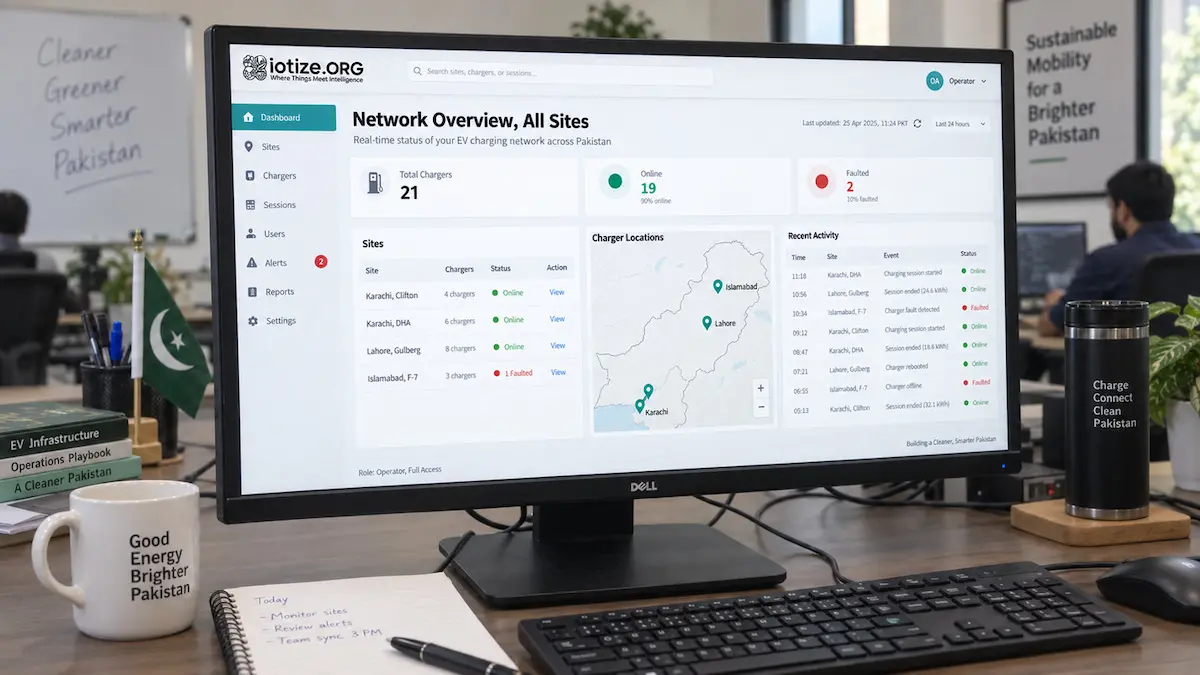
One platform, three winners: the charger company, the host, and the driver
The platform ships as one system with a different door for each person a charger touches: a branded driver app (iOS and Android) and a matching web portal for customers, and a web back-office dashboard for operators and makers. Underneath, in addition, sit the two things that make it work: an OCPP connectivity layer that speaks to any brand of charger, and local payment gateway integration that settles money the way Pakistan actually pays. More modules are added as your network grows.
Most charging software is written for one person, the operator. By contrast, ours is written for all three, because a charger only earns when the company behind it, the venue hosting it, and the driver using it all get what they need.
Monitors every charger it makes, sells, or runs from one screen, adds recurring software revenue, and supports customers remotely.
Sees its own chargers, uptime, and share of the revenue in a private login, with fault alerts for its location only.
Finds the nearest available charger, navigates to it, and pays with a method they already use, so they come back.
What it costs
The platform is licensed per charger, per month, with a one-time setup and onboarding fee to brand the apps, commission your chargers, and connect your payment gateway. Pricing scales with the size of your network, so two chargers and two hundred are quoted differently. Talk to our team for a quote against your actual sites and charger count.
What drivers get: find the nearest charger, navigate, reserve, and pay
A charging network lives or dies on the driver experience: a driver who cannot find a free charger, or cannot pay easily, does not come back, and an empty charger earns nothing. Therefore the branded driver app removes the friction between a low battery and a finished, paid session.
- Find the nearest free charger. A live map shows every charger with a real-time status (available, busy, offline), sorted by distance and filterable by connector, AC or DC, power, and price, so a low battery is pointed straight at a working unit.
- Navigate straight to it. One tap opens turn-by-turn directions to the exact charger, and drivers save favourites for next time. On sites that allow it, they can reserve a charger before arriving.
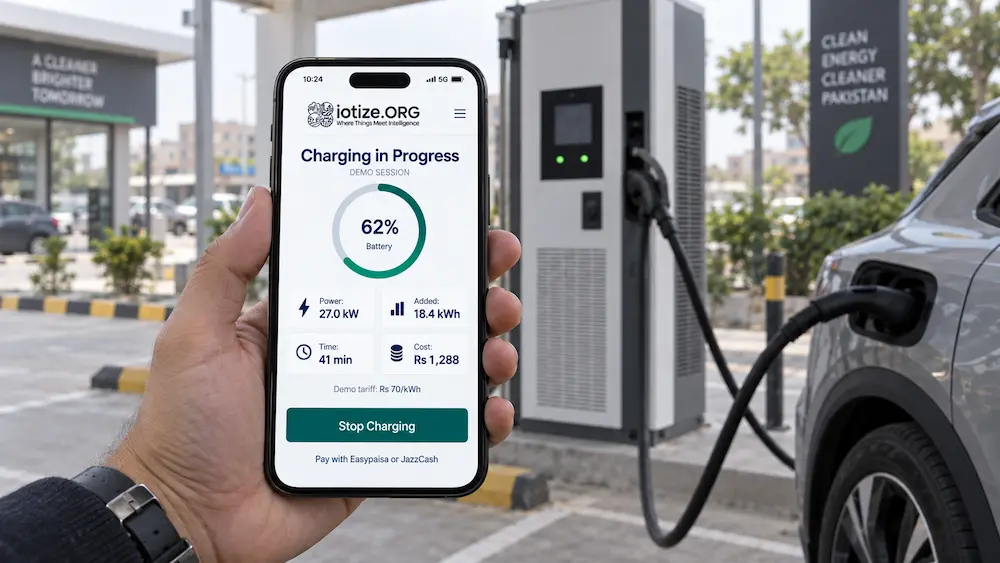
- Charge and watch it live. Scan the QR or tap start, then track kWh, battery percent, time, and cost in real time, and stop from the phone at any moment.
- Pay the local way. Pay with the local wallets and cards drivers already use, or an in-app wallet, get an instant receipt, and keep a full session history. Push alerts flag a free charger nearby, a finished session, or a low balance.
Built first for the two- and three-wheeler riders, rickshaw drivers, and car owners who lead Pakistan’s charging demand, in a fast, low-data, Urdu-and-English app. Finally, the full driver feature list is in the feature set below.
What hosts get: watch your own chargers and your share
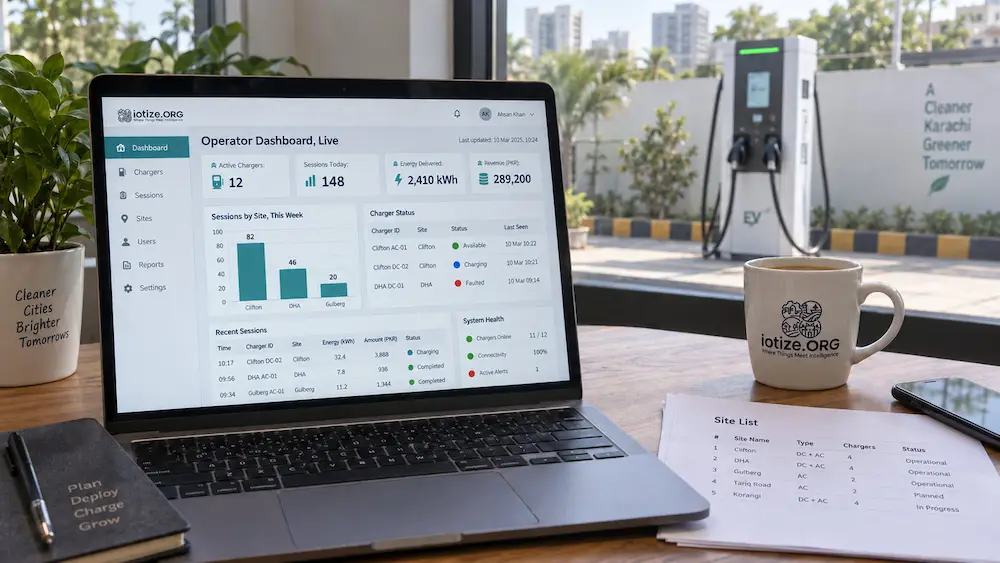
A site host is the mall, the fuel station, the workplace, or the housing society that lends its space and its electricity to a charger. A host does not want to run a whole network, but a host does want to see what is happening on its own patch, and to trust the revenue split. The platform gives every host a private, role-limited login that shows its own site and nothing else:
- Live status of the chargers on its site (available, charging, fault, offline), so it knows its amenity is working and can chase a fault fast.
- Sessions and energy delivered at its location, showing the real footfall the charging drives.
- Revenue and the host’s own share, per day and per month, with numbers it can hand straight to finance, under flexible revenue-share agreements tailored to each site.
- Utilisation by hour and day, so it can plan parking, staffing, and promotions around peak times.
- Fault and offline alerts for its own chargers only, so it reports a problem the same day.
- Downloadable statements to reconcile the charging line in its own accounts.
Because access is role based, the host sees only its own site and the operator sees the whole network, turning a car park into a transparent, revenue-sharing amenity rather than a black box on the wall.
For EV charger makers and sellers: ship hardware and software as one product
This section is for the companies that build, assemble, import, or sell EV chargers, especially in Pakistan, where the hardware market is filling fast and starting to look the same. If that is you, the platform turns you from a box seller into a complete-solution vendor, without writing a line of software yourself.
- Sell the charger with the app, not just the charger. Bundle your hardware with a branded driver app, an operator dashboard, billing, and monitoring, all under your name. You quote a charging business, not a commodity box, and you win against importers who only offer steel.
- See your whole installed base. Every charger you ship reports into one multi-tenant dashboard: which units are online, which are faulting, firmware versions, usage, and uptime, across every customer and site. Each operator or host you sell to gets its own branded, role-limited login, cleanly separated from the rest.
- Support remotely and update over the air. Diagnose faults, read logs, restart units, and push over-the-air firmware to the whole fleet or one charger from your desk. Fewer truck rolls, faster fixes, lower warranty cost.
- Earn after the sale. Add a recurring software and support revenue line on top of one-time hardware margin. The installed base you already sold becomes an income stream, and a reason customers stay with you rather than switch. A maker who offers a live app, remote support, and OTA updates is simply a better vendor than one who ships a dumb box.
The complete feature set: application and platform
Everything the platform does, in one place. Firstly, the application features are what people touch. Secondly, the platform features are the engine underneath that makes the whole thing run, scale, and stay open.
Driver app features
- Live charger map: every charger with a real-time available, busy, or offline status.
- Nearest available charger: sorts by distance and hides busy or offline units.
- Search and filters: by connector, AC or DC, power, price, and amenities.
- Turn-by-turn navigation: one tap routes the driver to the exact charger.
- Reserve ahead: hold a charger for a short window before arriving, where enabled.
- QR or tap to start, plus remote stop from the phone.
- Live session view: kWh, battery percent, time, cost, and progress in real time.
- In-app wallet and top-up, and local payment methods drivers already use.
- Receipts and a full session and spend history.
- Push notifications: charger free, session done, target reached, low balance, faults.
- Favourites and recents, ratings, and fault reports.
- Urdu and English, low data, for the local market.
Operator back-office features
- Real-time fleet monitoring: live status of every charger on one screen.
- Remote control: start, stop, pause, reset, and limit power on any charger.
- Flexible pricing: per kWh, per minute, flat, time-of-day, and member vs public tariffs.
- Billing and invoicing: automatic charge detail records and invoices per session.
- User and access management: drivers, members, and fleet accounts with access levels.
- Smart charging and load management: balance power so a site never trips its supply.
- Fault and uptime alerts: catch faults and offline units before drivers do.
- Reports and analytics: uptime, utilisation, energy, and revenue by charger, site, and day.
- Role-based access, multi-site management, and data export whenever you want.
Platform features: the engine underneath
- OCPP 1.6 and OCPP 2.0.1: runs any compliant charger, so no hardware lock-in.
- Hardware-agnostic: mixed brands and AC or DC on one dashboard.
- Cloud, private cloud, or on-premise: deploy to fit your IT and data rules.
- Local payment gateway integration: money settles to your account, the local way.
- White-label branding and role-based multi-tenant access, so maker, operator, host, and driver each see the right slice.
- Reservation engine, smart charging, and dynamic load balancing.
- Alerting and monitoring across the fleet, plus APIs and integrations for fleet, ERP, or accounting systems.
- Security and data ownership: your data, exportable, never sold.
- Scalable from two chargers to thousands, without re-platforming.
More modules are added as your network grows. If a capability you need is not listed, ask, because the platform is built to extend.
Your charger, our application: hardware-agnostic and OCPP-ready
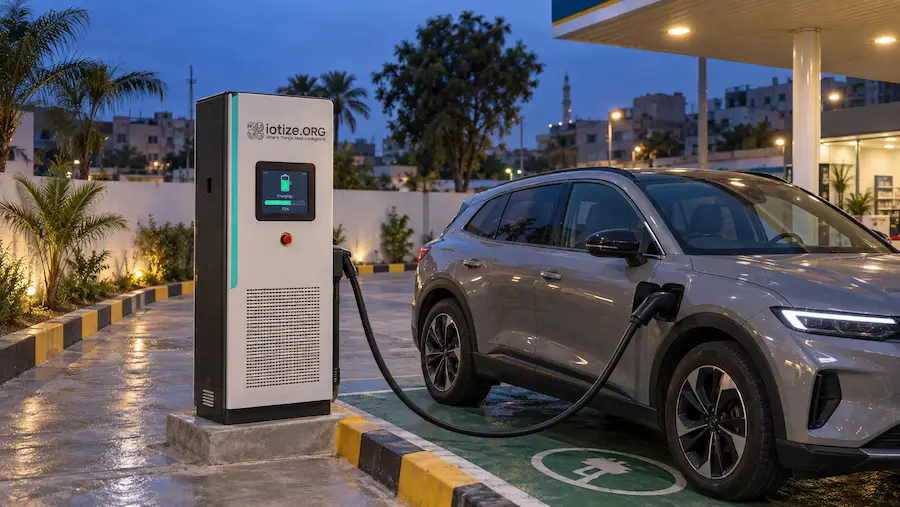
This is the heart of the model. You are not locked to one charger vendor, and you are not renting hardware from us. If your charger speaks OCPP, our platform can run it.
- Bring your own charger, mixed brands, one dashboard. Connect AC wallboxes or DC fast chargers you already own, or buy from any OCPP-compliant maker, local or imported, and run a 7 kW shop unit, a 22 kW mall unit, and a highway DC charger from a single back-office.
- OCPP 1.6 and 2.0.1. The open standard means you can switch software providers later without replacing chargers, which is the opposite of a closed network.
- Tuned for Pakistan’s mix. AC chargers in the 3.3 kW to 22 kW range for the two- and three-wheeler and car segment that leads local adoption, plus DC fast charging for highway and fleet sites.
Local payment gateway integration for Pakistan
A charging business only works if drivers can actually pay, in the way they already pay for everything else. International-only checkout is a dead end here. So the platform is built to connect to the local payment rails that Pakistani drivers use every day:
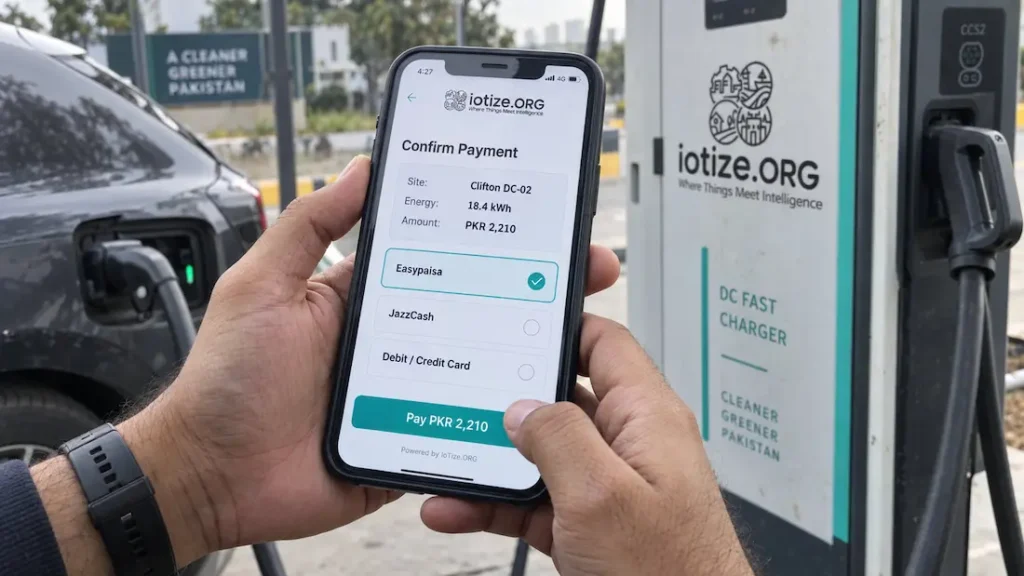
- Local wallets and bank rails. The platform supports local payment gateways and wallets, including Easypaisa and JazzCash, alongside card and account-based methods your drivers already have, so payment feels normal, not foreign.
- Your pricing, your account. Set per-session, per-kWh, per-minute, flat, or member pricing per site. Charging revenue settles through your own payment gateway account, directly into your business account. IoTize never holds your funds.
- Transparent receipts. Every driver gets a clear in-app receipt and history; every session lands in your reporting for reconciliation.
Because a national commercial charging tariff has been set near Rs 39.7 per kWh, transparent per-kWh billing is not just convenient, it is how a compliant, trusted charging business runs.
Deploy your way and own your data
Software that runs your business should not hold your business hostage. Therefore managed SaaS on our cloud is the recommended route for almost every operator, and private cloud or on-premise are available on request for enterprise deals. Whichever path you choose, the brand, the pricing, the customer relationship, and the data are yours, and fully exportable, and open OCPP means you can change hardware without tearing out the chargers.
- Managed SaaS (our cloud), recommended. Fastest launch, least IT overhead, and the option almost every operator should take. Your data stays yours and fully exportable.
- Private cloud, on request. For enterprise deals where you want your own cloud account and controls. Your data stays in your tenancy.
- On-premise, on request. For enterprise sites with strict data-residency or security rules. Your data stays on your own infrastructure.
Which model fits you: a 60-second selector
Answer a few quick questions to see whether white-label Platform as a Service is your route, or whether a different model fits better.
White-label software vs joining a network vs full CaaS
Three ways to get into EV charging. This page is about the first one. If you want to build a business rather than host someone else’s, white-label Platform as a Service is the route: you keep the asset, the brand, the customer, and the revenue, and you subscribe only to the software.
| White-label software (your charger, our app) | Join a closed network | Full Charging as a Service (CaaS) | |
|---|---|---|---|
| Who owns the charger | You | You, but tied to their platform | A third-party provider |
| Whose brand drivers see | Yours | Theirs | Usually theirs or co-branded |
| Who sets pricing | You | Often them | Them, within the contract |
| Who owns the customer and data | You | Them | Them |
| Local payment to your account | Yes | Often no | No |
| Hardware freedom (OCPP, mixed brands) | Yes | Limited | Limited |
| Upfront hardware cost | You buy the charger | You buy the charger | Low, the provider funds it |
| Best for | Operators and site hosts who want a real branded business | Hosts who just want a charger listed | Hosts who want zero capex and no operations |
Download the operator buyer’s guide
Not sure which chargers, sites, or pricing model to start with? In that case, get the short IoTize EV Charging Operator’s Guide: a practical walk-through of choosing OCPP hardware, setting tariffs, planning your first sites, and launching your branded app in Pakistan.
Where it pays off: sites and use cases
The same platform runs very different sites. Specifically, here is where operators put chargers, what the platform gives each one, and who charges there:
- Fuel station forecourt: public paid charging, per-kWh billing, and uptime monitoring, for cars, bikes, and rickshaws on the go.
- Shopping mall or retail park: access control, tariffs by hour, and revenue reporting, for shoppers, staff, and visitors.
- Two- and three-wheeler charging hub: fast turnover, QR start, and small-value local payments, for riders, delivery fleets, and rickshaws.
- Workplace or corporate campus: members-only access and free or subsidised staff charging, for employees and company vehicles.
- Housing society or apartment block: resident accounts and shared-charger scheduling, for residents.
- Delivery or logistics fleet depot: fleet-only access, load management, and cost per vehicle, for company two- and three-wheelers and vans.
- Highway or motorway stop: DC fast charging, remote fault handling, and public billing, for long-distance car and fleet drivers.
How the platform makes money
The return on a charging business is simple to describe and easy to track once the software is in place. Revenue comes from three levers, and the platform gives you the dials for each:
- Sessions. Every paid session earns a margin over your energy cost. More uptime and better-placed chargers mean more sessions.
- Pricing. Per-kWh, per-minute, time-of-day, and member versus public tariffs let you match price to demand and to the commercial charging tariff.
- Utilization. Real usage data tells you which sites earn and which do not, so your next charger goes where it pays.
Against those, the platform cuts the costs that quietly kill charging businesses: remote monitoring and fault alerts reduce truck rolls, automated billing removes manual reconciliation, and reporting turns blind site selection into a plan.
Representative scenario, shown for illustration, not a specific customer. A retail site host in Karachi installs four AC chargers at a mall and lists them on a generic app. Sessions happen, but the host cannot see uptime, cannot set peak pricing, and payments are messy. The host moves the same four chargers onto white-label software: a branded app, per-kWh pricing that rises at peak shopping hours, fault alerts, and local payment settling to the host’s account. With the same hardware, the host now sees which of the four chargers earns, sets a higher evening tariff, catches an offline unit the same day it fails, and reports revenue per charger to the mall’s finance team. The change was software, not steel.
Who this is built for
- EV charger makers, assemblers, importers, and sellers (especially in Pakistan) who want to ship hardware plus branded software, monitor their whole installed base, and add recurring software revenue.
- Charge point operators (CPOs) who run chargers and need a real back-office to monitor, price, and bill at scale.
- eMobility service providers (eMSPs) who face drivers with an app and need branded, billable sessions.
- Fleet operators electrifying two- and three-wheelers or vans who need depot charging with fleet-only access, load management, and cost per vehicle.
- Site hosts (malls, fuel stations, workplaces, housing societies) who own the location and want charging as a branded, revenue-earning amenity.
- New entrants who want to launch an EV charging brand in Pakistan without building software from scratch.
Why IoTize
- An IoT company, not a reseller. IoTize has engineered connected devices and platforms since 2015. EV charging is IoT: sensors, connectivity, cloud, and control, which is exactly what we build.
- One platform, three winners. The maker monitors its fleet, the host watches its own site and share, and the driver finds, navigates, and pays. Everyone connected to the charger gets what they need from the same software.
- Hardware-agnostic and OCPP-ready. Bring any OCPP charger. No lock-in to one vendor’s steel.
- Local payments and your data. Support for the payment rails Pakistani drivers actually use, with revenue settling through your own gateway account, on a white-label app and dashboard with data you can fully export.
- Deploy your way. Managed SaaS as standard, with private cloud or on-premise on request, to fit your IT and compliance.
- Built in Pakistan, ready to travel. Tuned for the local two- and three-wheeler-led market and the national charging tariff, and able to run anywhere OCPP does.
Get started in five steps
- Talk to our team. Show us your sites, your chargers (owned or planned), and your goals.
- Confirm hardware. We check your chargers speak OCPP and commission the models you use.
- Brand it. Your logo, name, and colors on the app, web portal, and dashboard.
- Connect payments. We connect your local payment gateway so revenue settles through your own account.
- Go live. Chargers connect, sessions bill, and you watch it all from one dashboard, then scale to the next site.
All Your Devices, One Live Platform
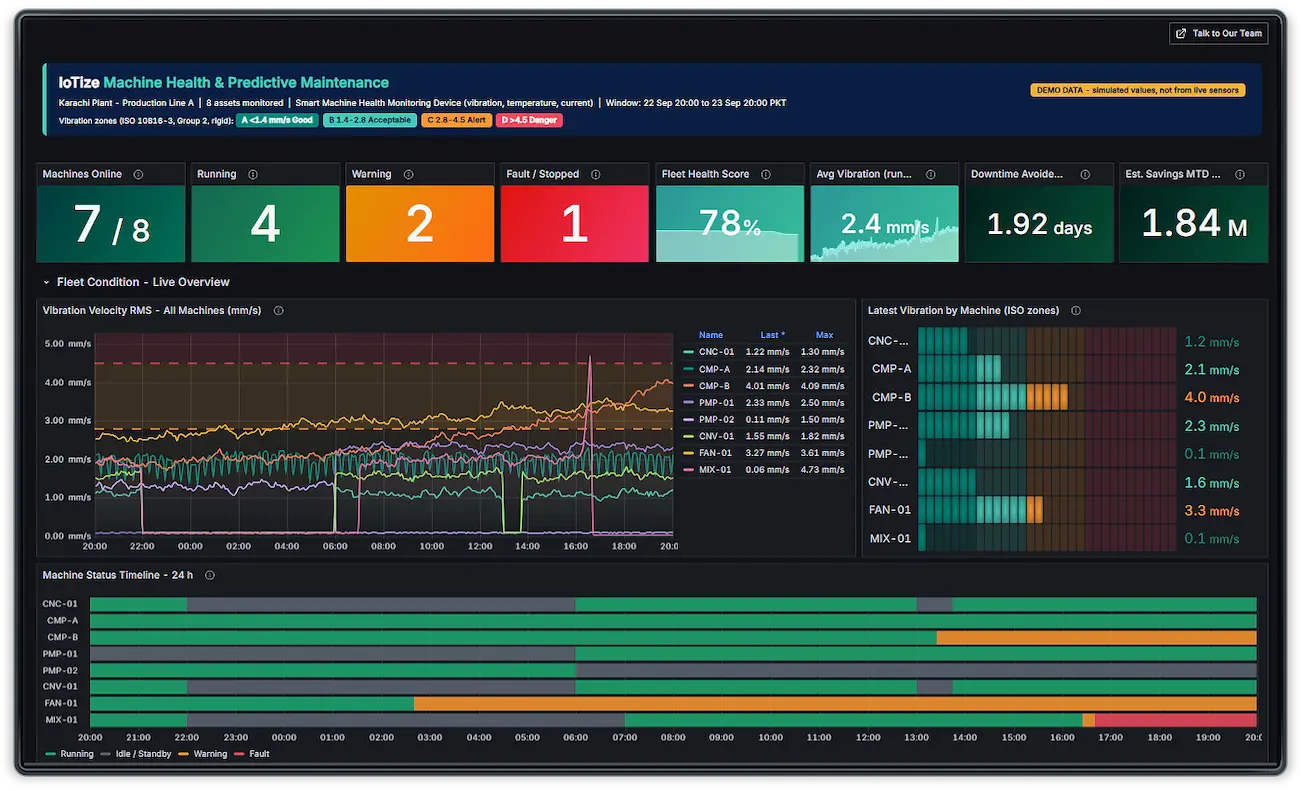
This solution is just one piece. The IoTize Platform brings every connected device together, so you can monitor, analyse and act on live data from a single place.
- Real-time dashboards and instant alerts
- Health, energy and production data side by side
- Access from any browser, on any device
Your charger, your brand, your customers. Our platform underneath.
The charger company sees its whole fleet, the host sees its own site and share, and the driver finds the nearest free charger, navigates to it, and pays in seconds. Whether you make chargers, sell them, operate two, or plan two hundred, IoTize gives you the white label EV charging software to run them as a real business in Pakistan and beyond.
No obligation. Bring your charger list and your sites, and we will map the fastest route to launch.
Frequently asked questions
What is white label EV charging software?
It is a cloud platform that runs your EV chargers under your own brand. You get a branded driver app, a driver web portal, and an operator dashboard, all carrying your name, plus the OCPP connectivity and payment integration that turn a charger into a billable service. You subscribe to the software instead of building it.
What is Charging as a Service, and how is it different from your platform?
Charging as a Service (CaaS) is a subscription model where a third party owns, installs, and operates the charger for you. Our model is the opposite side of that: you own or buy the charger, and we provide only the software that runs it. In short, CaaS is their charger, their operation; our Platform as a Service is your charger, our application, so you keep the asset, brand, customer, and data.
Can I use my own chargers with your platform?
Yes, if they are OCPP-compliant. The platform is hardware-agnostic and supports OCPP 1.6 and OCPP 2.0.1, so you can connect chargers you already own, buy new ones from any compliant maker, and run mixed brands on one dashboard. We commission your specific models so you are not relying on OCPP support in theory.
Do I need OCPP for my EV chargers?
For a managed, billable, future-proof network, yes. OCPP is the open standard that lets your charger talk to management software from any vendor. It also protects you from lock-in, because you can change software later without replacing the chargers on the wall.
What is the difference between a CPMS and a CSMS?
They are the same thing under two names. CPMS (Charge Point Management System) is the older term tied to OCPP 1.6; CSMS (Charging Station Management System) is the newer term used in OCPP 2.0.1. Both mean the backend software that manages charging stations.
Does the platform support local payments in Pakistan?
Yes. The platform supports local payment gateways and wallets, including Easypaisa and JazzCash, plus card and account-based methods, so drivers pay the way they already do. Charging revenue settles through your own payment gateway account, directly into your business account. IoTize never holds your funds. You set per-kWh, per-minute, flat, or member pricing per site.
Do I get a mobile app and a web application?
Both. A branded mobile app for iOS and Android for drivers, a driver web portal for the browser, and a separate operator back-office web dashboard for you to monitor, price, bill, and report. All three carry your brand.
How do I start an EV charging business in Pakistan?
Pick your sites, choose OCPP-compliant chargers you can own, put white-label software behind them for the app, dashboard, and billing, connect a local payment gateway, and launch under your brand. IoTize supplies the software layer and helps you commission the hardware and connect payments. Talk to our team to map your first sites.
Where can I run this? Only in Pakistan?
It is built and tuned for Pakistan, including the local payment rails and the two- and three-wheeler-led market, but because it runs on open OCPP it can operate anywhere. Pakistan is the first market, not the only one.
How is my data handled, and am I locked in?
Your data is yours and fully exportable. Managed SaaS on our cloud is the recommended deployment, and private cloud or on-premise are available on request for enterprise deals. Open OCPP means you keep hardware freedom and are not trapped in one vendor’s ecosystem.
Can drivers find and navigate to my chargers?
Yes. The branded driver app shows every charger in your network on a live map with a real-time available, busy, or offline status, sorts them by distance, and lets a driver open turn-by-turn directions to the exact charger with one tap.
Does the app show real-time charger availability, and can drivers reserve one?
The map updates each charger’s status live, so drivers only drive to units that are actually free. On sites where you enable it, a driver can also reserve a charger for a short window before arriving.
I make, assemble, or sell EV chargers. Can I use this to sell a complete solution?
Yes, that is one of the platform’s core uses. You ship your hardware together with a branded app, an operator dashboard, billing, and monitoring, all under your name, and you monitor your entire installed base across every customer from one multi-tenant dashboard. You add recurring software and support revenue on top of hardware margin, and you support customers remotely, including over-the-air firmware updates. Talk to our team and ask about the maker tier.
Can each site host see its own chargers and revenue?
Yes. Every host gets a private, role-limited login that shows only its own site: live charger status, sessions, energy, its own share of the revenue, utilisation, and fault alerts, with downloadable statements for finance.
Do you support over-the-air firmware updates and remote support?
Yes. You can diagnose faults, read logs, restart units, and push over-the-air firmware updates to the whole fleet or a single charger from the dashboard, which cuts truck rolls and warranty cost.
What does the platform cost?
The platform is licensed per charger, per month, with a one-time setup and onboarding fee covering app branding, charger commissioning, and payment gateway connection. Pricing scales with the size of your network, so we quote against your actual sites and charger count. Talk to our team for a quote.
Talk to us: Contact the IoTize team
Related solutions: Energy monitoring and management · All IoTize solutions
Shop: The IoTize store →