
IoT for Textile Mills in Pakistan: Monitor Every Loom, Frame and Kilowatt
See which looms, frames and heads are running, which are idle, and where your electricity goes. Monitor the machines you already own.
Designed and built in Pakistan since 2015 · Installed in denim, textile and embroidery units in multiple Pakistani cities · Cloud, private cloud or on-prem
Quick answer: IoT for textile mills means fitting small sensors to looms, ring frames, embroidery machines, compressors and electrical panels so that runtime, idle time, speed, output, vibration, humidity and energy use stream to one live dashboard. With IoTize.ORG, mills can retrofit older machines without replacing their controls. Production counters start at $80 per machine. Devices buffer readings if the network drops and report the outage after power returns.
Key facts
- What it measures: machine running and idle time, RPM, picks and stitch-based output, vibration, temperature, humidity, and energy in kWh.
- What it fits: Air-jet, rapier and older looms, plus ring frames, preparatory machines, multi-head embroidery machines, stitching machines and utilities such as compressors, fans, pumps and panels.
- Price to start: from $80 (about PKR 22,200) per machine for the Affordable Series, plus a platform plan from $20 per month for up to 10 devices.
- Installation: your team or an IoTize technician can fit the devices. In our Lahore embroidery case, the retrofit took about one hour per machine.
- Built where: designed, assembled and tested by IoTize.ORG in Pakistan.
What textile mills in Pakistan are losing today
Most mills already know their monthly electricity bill and their monthly output. What they cannot see is which machine, which shift and which hour made the difference. That blind spot is now expensive.
Textile is still the backbone of Pakistan’s exports. According to Pakistan Bureau of Statistics data reported by Profit, textile exports reached $16.67 billion in the first 11 months of FY2025-26, up just 1.83 percent. Meanwhile, the Federation of Pakistan Chambers of Commerce and Industry said in January 2026 that high electricity rates and taxes had led to the closure of 150 textile units in two years (reported by Dawn). Margins are thin, so every idle hour and every wasted unit counts.
Here is where the money usually leaks:
- Hidden idle time. Stops between shift handover and restart can go unrecorded in a manual register.
- Speed drift. Machines run below their set speed, or above it, without anyone noticing until quality or maintenance suffers.
- Compressed air and utilities. Compressors, humidification plant fans and pumps run full time, including when the shed is half idle.
- Surprise breakdowns. A change in vibration on a compressor or main motor can give maintenance teams an early reason to inspect a bearing.
- Paper reports. Efficiency is calculated a day late from handwritten sheets, so problems are found after the shift that caused them.
- Buyer questions you cannot answer. European buyers increasingly ask for energy and emissions data per product. Without machine-level data, mills guess.
Textile mill costs in context
Sources: Pakistan Bureau of Statistics via Profit, FPCCI via Dawn, tariff notification via Geo News, and Compressed Air Best Practices. Figures describe the cited periods or site.
What is IoT in the textile industry?
IoT (Internet of Things) in the textile industry means connecting machines that were never designed to talk, so a mill can see production, condition and energy in real time instead of reading it from paper the next day. It is the practical first step of Industry 4.0 for a textile mill, and the data layer that AI predictive maintenance needs later.
A simple IoT setup follows the data from the machine to the people who use it.
How machine data reaches the mill team
A smart textile mill is not a mill full of new machines. In practice, it is the same looms and frames with a thin layer of sensors that turns every stop, every kilowatt and every speed change into a number someone can act on.
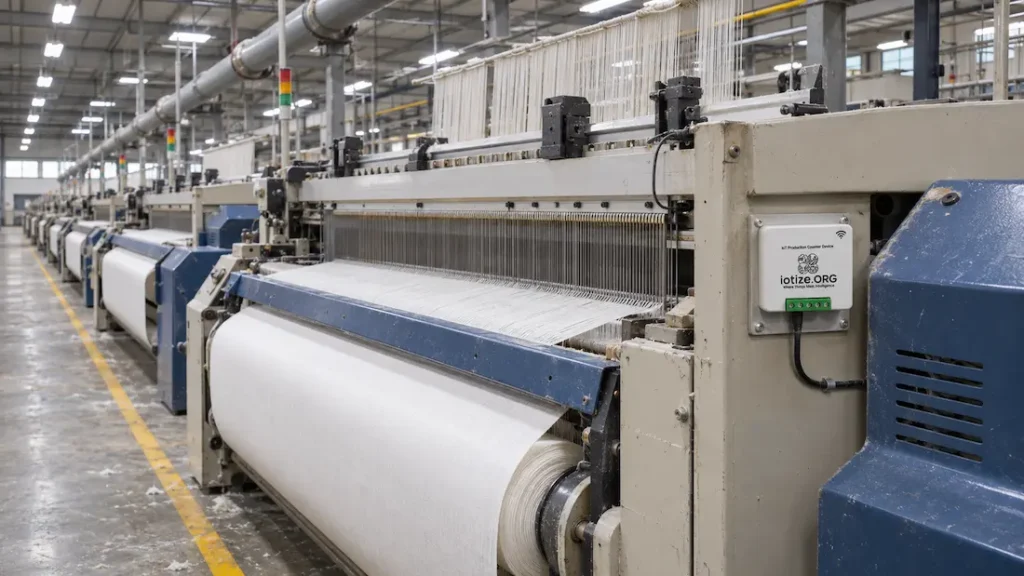
How IoT works in each department of a textile mill
Weaving: loom monitoring system
A loom monitoring system tells you, loom by loom, how long each machine ran, how long it stood, and how fast it ran, so loom efficiency is measured, not estimated.
The IoTize IoT Production Counter Device uses an inductive proximity sensor that sees a metal target on a rotating part, usually the main shaft. On the shuttleless looms IoTize.ORG has verified, one main shaft revolution corresponds to one pick. Confirm that ratio for your loom before converting counts to picks. From there, the platform works out:
- Running time, idle time and stop count for each loom, each shift and each weaver.
- Speed (RPM) against the set speed, with alerts when a loom runs slow or idle for too long.
- Approximate fabric output: picks divided by picks per centimetre gives centimetres of fabric. Enter the picks per inch of each quality once, and the dashboard shows metres per loom per shift.
For high-speed looms or where you need direction and precise position, the Enterprise IoT Production Counter Device (Encoder A/B/Z) reads a shaft encoder instead, and adds Modbus TCP over Ethernet for an existing SCADA or MES.
For air-jet weaving, add a three-phase energy monitor on the compressor room. Air-jet looms rely on compressed air. Measuring the compressor feeder lets you compare utility demand with the number of looms running.
Accuracy note: stop reasons such as warp break or weft break come from the loom’s own controller. An external counter sees that the loom stopped and for how long, not why. Where your looms have a data port, ask us about reading it directly.
Read more: Production Monitoring
Spinning: ring frames, preparatory machines and humidity
In a spinning mill, IoT adds machine-level running time, speed and energy for each frame, plus temperature and humidity across the halls. Compare those readings with output and end-break records to see when they change together.
- Ring frames and preparatory machines (carding, draw frames, simplex): a production counter on the front roller or main drive shows running and idle time and speed per frame.
- Energy per frame: an IoT Smart Energy Monitoring Sensor, Three-Phase on the frame or section feeder gives kWh per frame. Divide by the frame’s production and you get energy per kilogram of yarn, the number spinning managers watch most closely.
- Humidity and temperature: the IoT Environmental Monitoring Device measures temperature, humidity, CO2 and air quality. Mount one per zone, not one per hall, because conditions near the humidification plant and at the far end of a hall differ. Set relative humidity targets for your fibre, yarn count and department with your spinning master. Then configure alerts for readings outside those targets.
Accuracy note: IoTize devices monitor at machine level. They do not count end breaks on individual spindles. Spindle-level monitoring needs a sensor at every spinning position, which is a separate class of system offered by ring frame makers. If you already have one, the IoTize energy and humidity data sits alongside it.
Denim, dyeing and processing
In denim and processing units, the biggest risks are large motors, pumps and fans that cannot stop without stopping a whole range.
- Machine health: the Smart Machine Health Monitoring Device (vibration, temperature and current) on single critical motors, or the Enterprise Smart Machine Health Monitor, Dual-Point on larger drives, helps the maintenance team investigate signs of bearing wear, imbalance, misalignment or looseness. Use ISO 20816-3 zones where the machine and measurement setup fall within the standard’s scope.
- Energy: three-phase energy monitoring on dyeing ranges, washers, stenter drive panels and pumps shows which range uses what, and when.
- Runtime: production counters on washers and finishing machines record running and idle hours.
Read more: Predictive Maintenance and IoT Vibration Sensors for Motor Failure Detection
Embroidery
On embroidery machines, a shaft counter estimates total stitches by multiplying shaft rotations by the number of active heads, once the machine’s count ratio and active heads are configured.
IoTize.ORG production counters record stitch counts, running time, idle time and RPM for each embroidery machine and each shift. That turns a night shift from a black box into a chart. See the field example in section 5.
Stitching and garment lines
Garment units run both single-phase and three-phase sewing machines, so an energy and hour monitor matched to each machine’s supply shows its real working hours and power use.
- Smart Energy & Hour Monitoring Device, Single-Phase ($99): working hours and kWh on single-phase machines.
- IoT Smart Energy Monitoring Sensor, Three-Phase (from $250): kWh on three-phase machines or on a whole line’s feeder.
- IoT Production Counter Device ($80): runtime, idle time and speed on cutting, pressing or packing machines.
Utilities: compressors, humidification plants, generators and fans
Utilities rarely appear on a production report, yet they often carry the largest share of a mill’s electricity.
- IoT Smart Energy Monitoring Sensor, Three-Phase on compressor, humidification plant and main distribution feeders.
- Enterprise IoT Vibration Monitoring Device or Enterprise Smart Machine Health Monitor, Dual-Point on compressors and large fans (ISO 20816-3 covers industrial machines above 15 kW).
- Smart Machine Temperature Monitoring Device ($59) on bearing housings that tend to run hot.
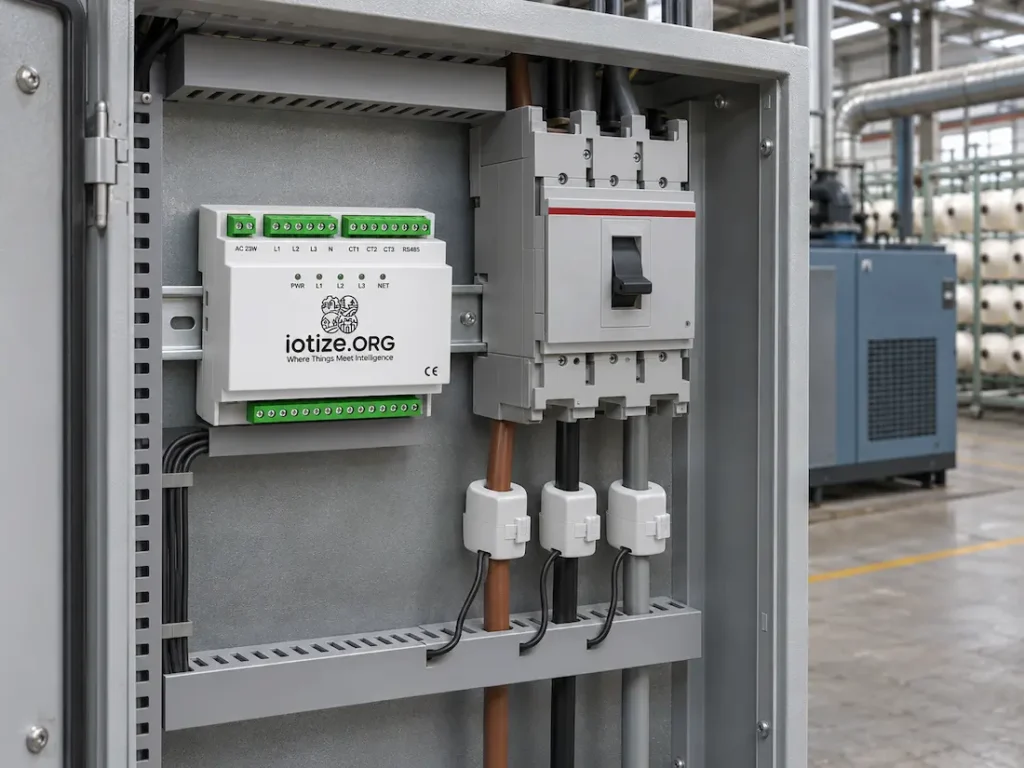
Machine by machine: what to measure and with which IoTize device
Choose the device by the signal you need to measure, from loom picks and motor vibration to feeder kWh.
| Machine or area | What to measure | IoTize device | Series and price |
|---|---|---|---|
| Air-jet, rapier and older looms | Picks, runtime, idle, RPM | IoT Production Counter Device | Affordable, $80 |
| High-speed looms, SCADA/MES sites | Encoder count, direction, runtime, idle | Enterprise IoT Production Counter Device (Encoder A/B/Z) | Enterprise, from $160 |
| Ring frames and preparatory | Runtime, idle, speed | IoT Production Counter Device | Affordable, $80 |
| Ring frame or section feeders | kWh, kWh per kg of yarn | IoT Smart Energy Monitoring Sensor, Three-Phase | Enterprise, from $250 |
| Spinning and weaving halls | Temperature, humidity, CO2 | IoT Environmental Monitoring Device | Affordable, $120 |
| Multi-head embroidery machines | Stitches, runtime, idle, RPM | Enterprise IoT Production Counter (Encoder A/B/Z) or IoT Production Counter Device | Enterprise from $160 / Affordable $80 |
| Single-phase stitching machines | Working hours, kWh | Smart Energy & Hour Monitoring Device, Single-Phase | Affordable, $99 |
| Three-phase stitching machines or line feeders | kWh, load by shift | IoT Smart Energy Monitoring Sensor, Three-Phase | Enterprise, from $250 |
| Compressors, humidification fans, pumps | Vibration, temperature, current | Smart Machine Health Monitoring Device | Affordable, $99 |
| Critical large drives | Dual-point vibration with FFT, temperature, current | Enterprise Smart Machine Health Monitor, Dual-Point | Enterprise, from $249 |
| Motor and gearbox bearings | Vibration trend | Enterprise IoT Vibration Monitoring Device | Enterprise, from $199 |
| Bearings that run hot | Surface temperature | Smart Machine Temperature Monitoring Device | Affordable, $59 |
Affordable Series devices use Wi-Fi with MQTT and HTTP. The listed Enterprise devices also support Ethernet and Modbus TCP. The IoTize.ORG store lists starting prices for Enterprise models. RS485 and GSM/4G are available on selected and custom devices.
Field proof: a multi-head embroidery unit in Lahore
On the first day of monitoring, the owner saw that some night operators were running machines far faster than the normal speed. Nobody had known before.
The site: a garment embroidery unit in Lahore running multi-head embroidery machines around the clock.
What we installed (April 2021): the Enterprise IoT Production Counter Device, tapped in parallel onto each machine’s existing A/B/Z encoder, so nothing in the machine’s own control changed. Installation took about one hour per machine. Data went over Wi-Fi to a dashboard the owner checks himself, with email alerts.
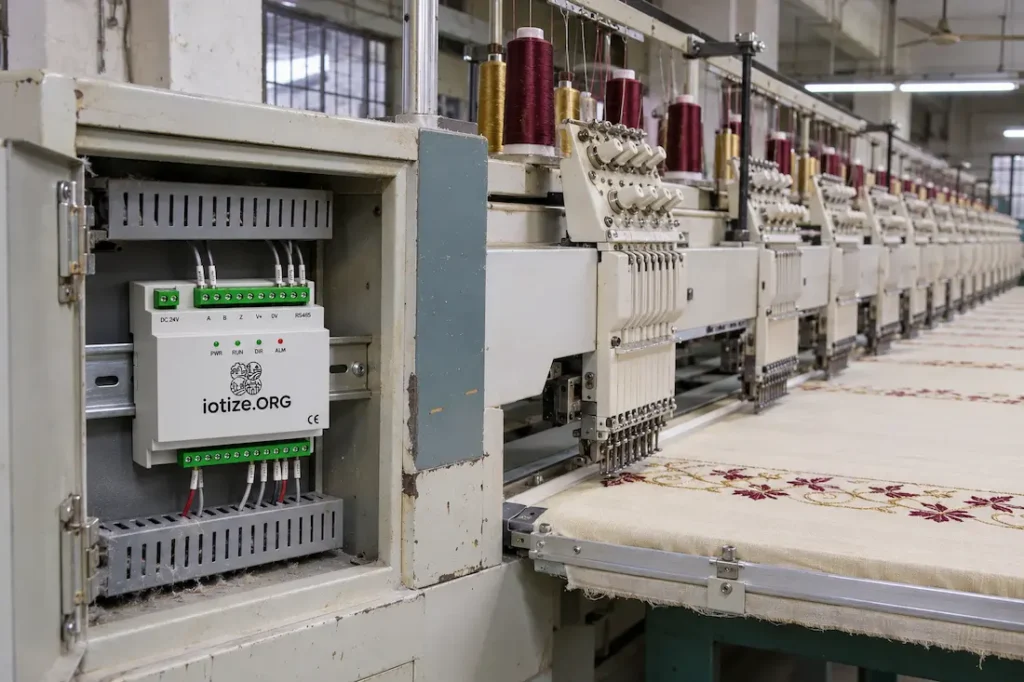
What the data showed: the Lahore embroidery case study records a normal range of 800 to 900 RPM. Some night operators ran machines up to 1,400 RPM, about 56 percent above 900 RPM. The higher speed can accelerate wear on needles, hooks and drives.
What changed: speed alerts went on, and the owner spoke to the operators with the data in hand. The case study reports steadier around-the-clock operation, less maintenance and follow-on device orders.
Energy monitoring for textile mills
Energy monitoring for a textile mill means measuring kWh at the feeders and machines that matter, then dividing by production, so you can see energy per kilogram of yarn or per metre of fabric by shift.
Geo News reported a cut to the B4 industrial energy charge in February 2026. To see what you can control inside the mill, put three readings on the wall dashboard.
- kWh per kg of yarn (spinning) or kWh per metre of fabric (weaving), by shift and by section.
- Compressor kWh against looms running. If fewer looms are running and compressor demand stays high, investigate leaks, pressure settings and how the compressors unload.
- Night and weekend base load. Separate equipment you can switch off from lighting, safety and humidification systems that need to keep running.
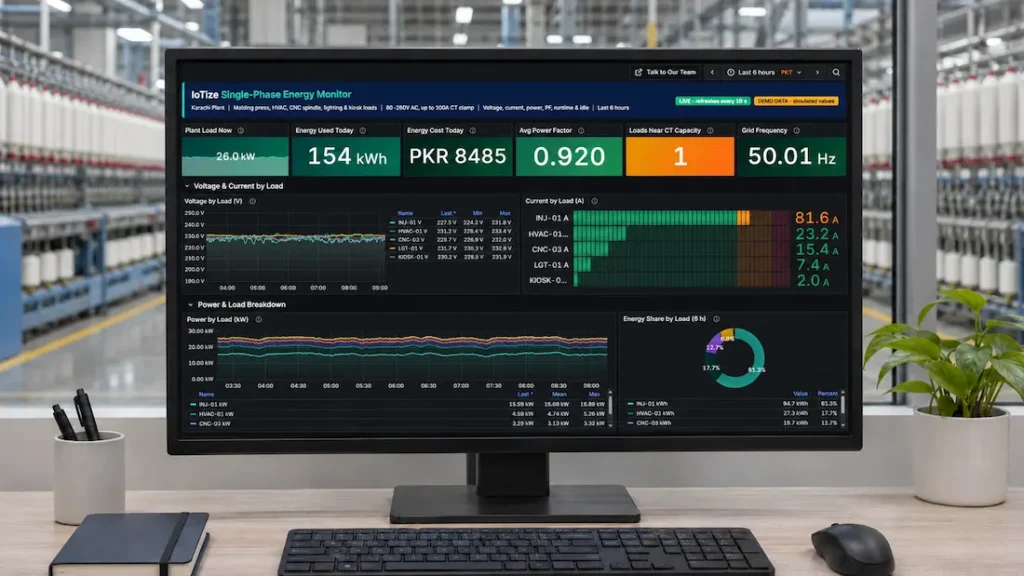
Typical first finds: compressors that never unload, humidification plant fans at full speed in mild weather, machines left idling between shifts, and a power factor problem on one feeder. Compare readings over several shifts to decide which of these patterns warrants a closer look.
If your mill has rooftop solar, monitoring the main feeders also shows how much load runs during solar hours, which helps plan when heavy machines and utilities run.
Read more: Energy Monitoring and How to Reduce Energy Consumption in a Factory
Built for Pakistani mill conditions
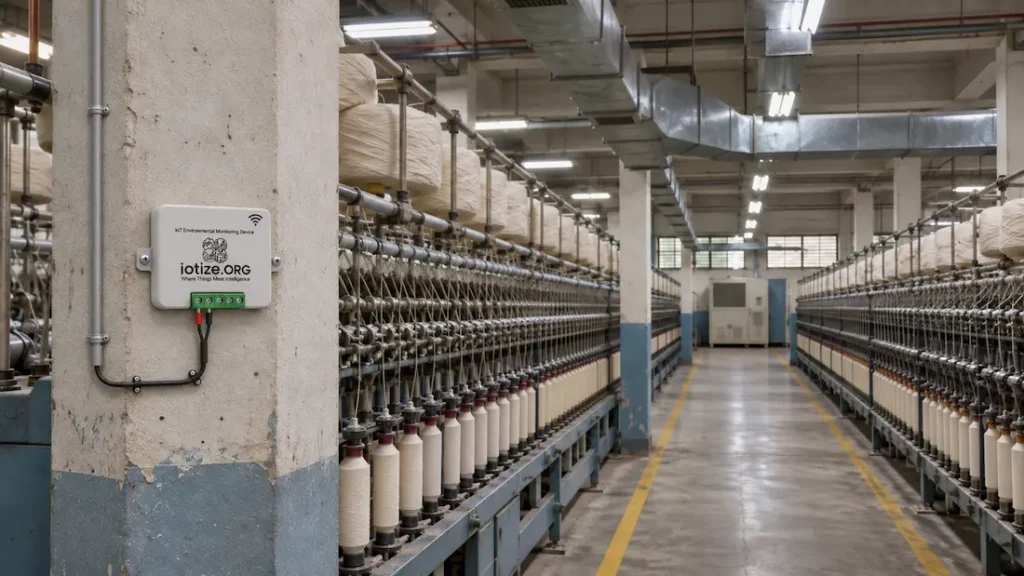
IoTize devices were designed in Pakistan for Pakistani factories, so they assume power cuts, patchy networks, lint, heat and old machines.
- Load shedding and power cuts: devices have no battery. They pause during a power cut, then report on power-up that power was lost and for how long, so outages appear on the timeline instead of looking like missing data.
- Internet drops: devices buffer readings on board and send them when the network returns, with the original timestamps.
- Big sheds and weak Wi-Fi: most installs use Wi-Fi. Enterprise devices also run on Ethernet, and RS485 and GSM/4G are available on selected and custom devices.
- No internet at all: the whole system can run on-prem, on a server inside your mill, without the internet.
- Old machines: sensors read the shaft, encoder or current from outside. Nothing in the machine’s PLC or control circuit is rewired, so it works on 1990s looms and new ones alike.
- Lint and heat: devices mount on frames and panels, out of the fabric path. Mount environmental devices where airflow is representative, not directly in a humidifier’s spray.
- Data ownership: choose IoTize Cloud (hosted outside Pakistan), your own cloud, or on-prem. Your data can be exported at any time.
- Local support: designed, assembled and tested in Pakistan, with site visits free in Karachi and installation available in other cities.
Export buyers, CBAM and traceability: what machine data helps with
European buyers are already asking Pakistani mills for energy and emissions data, even though textiles are not yet inside the EU’s carbon border tax.
The EU’s Carbon Border Adjustment Mechanism (CBAM) entered its definitive phase on 1 January 2026. Its initial scope covers specified goods in iron and steel, cement, aluminium, fertilisers, electricity and hydrogen. Business Recorder reports that buyers already ask Pakistani textile exporters for emissions data. Separately, the European Commission is developing textile Digital Product Passport requirements under the Ecodesign for Sustainable Products Regulation.
What IoT data helps with, honestly:
- Measured electricity per machine, section and product run, instead of an estimate from the monthly bill. This is the raw input for Scope 2 (grid electricity) reporting.
- Energy per kg or per metre, the kind of per-unit figure buyers ask for.
- Runtime records that show when and where an order was produced.
Use IoTize.ORG machine and energy data as an input for the software or consultant that prepares carbon accounts or Digital Product Passports.
What it costs: IoT for a textile mill in Pakistan
Hardware for a 10-loom pilot with one three-phase compressor meter starts at $1,050, or about PKR 291,000.
The IoTize.ORG store lists hardware in USD. PKR figures use an illustrative rate of PKR 277 per USD, rounded for planning. Platform and installation costs are separate.
| Item | USD | About PKR |
|---|---|---|
| IoT Production Counter Device (per loom, frame or machine) | $80 | 22,200 |
| Smart Energy & Hour Monitoring Device, Single-Phase | $99 | 27,400 |
| Smart Machine Health Monitoring Device | $99 | 27,400 |
| IoT Environmental Monitoring Device | $120 | 33,200 |
| Enterprise IoT Production Counter Device (Encoder A/B/Z) | from $160 | from 44,300 |
| IoT Smart Energy Monitoring Sensor, Three-Phase | from $250 | from 69,300 |
| Cloud Starter (up to 10 standard devices) | from $20 per month | from 5,500 per month |
| Installation by an IoTize technician | quoted per device | about 1,500 to 5,000 per machine |
Example pilot (10 looms + compressor room):
- 10 x IoT Production Counter Device = $800 (about PKR 222,000)
- 1 x IoT Smart Energy Monitoring Sensor, Three-Phase on the compressor feeder = from $250 (about PKR 69,300)
- Hardware total: from $1,050 (about PKR 291,000)
- Platform: Cloud Starter covers up to 10 standard devices. This 11-device pilot includes a three-phase meter, so we confirm the plan and price in your quote.
- Installation: your team can self-install, or an IoTize technician installs at about PKR 1,500 to 5,000 per machine.
A representative scenario (shown for illustration, not a specific customer)
This example shows how a weaving mill can translate measured idle time into potential output. Assume 10 looms run at 600 picks per minute on fabric with 24 picks per centimetre. Each loom loses 25 minutes per shift to slow restarts after breaks and handovers.
- 25 minutes x 600 picks = 15,000 picks per loom per shift.
- 15,000 picks / 24 picks per cm = 625 cm, so about 6.25 metres of fabric per loom per shift.
- 10 looms x 3 shifts = 187.5 metres of potential fabric output per day if all 25 minutes per loom per shift become productive time.
Your figures will differ by loom speed, quality and current practice. The point is that the counters make the lost minutes visible, and the dashboard shows whether they come back.
Where machine monitoring needs other inputs
Production counters record machine motion. Spindle events, fabric quality and stop reasons need their own data sources.
- Spindle-level end breaks: use a dedicated sensor at each spinning position.
- Fabric defects: use a camera-based inspection system at the loom or inspection table.
- Full OEE: combine availability and performance from counters with quality data from inspections.
- Loom stop reasons: pair stop duration from the counter with cause codes from the loom controller or the weaver.
IoTize devices fill the machine-level gap that these systems leave: runtime, speed, condition and energy on every machine, including the old ones those systems do not support.
How to start
Start with one section of the mill and one measurable problem, such as loom idle time or compressor load.
- Talk to us. Tell us your departments, machine types and counts, and what hurts most (energy, idle time, breakdowns).
- Site visit. Free in Karachi, by appointment elsewhere. We check machines, panels and Wi-Fi.
- Pilot one section. Usually 5 to 10 looms, frames or heads, plus one energy sensor on the biggest utility.
- Read the first month. Idle time, speed drift, base load and compressor behaviour usually show up in the first weeks.
- Scale. Extend to the whole shed or mill, add machine health on critical motors, and connect to your ERP, SCADA or MES if needed.
Frequently asked questions about IoT for textile mills
How is IoT used in the textile industry?
IoT connects looms, ring frames, embroidery machines, compressors and panels to one dashboard. Mills use it to track running and idle time, speed, output, machine health, humidity and energy live, instead of reading them from paper the next day.
What is a loom monitoring system?
A loom monitoring system records each loom’s running time, stops, speed and picks in real time. It turns loom efficiency into a live number per loom, shift and weaver, and alerts the floor when a loom stands too long.
How much does loom monitoring cost in Pakistan?
With IoTize.ORG, a loom counter starts at $80 (about PKR 22,200) per loom. Cloud Starter starts at $20 per month for up to 10 standard devices. Installation by our technician is about PKR 1,500 to 5,000 per machine, or your team can fit it.
Can IoT work on old looms and machines?
Yes. The sensors read the main shaft, an encoder or the motor current from outside the machine, so nothing in the control circuit is rewired. It works on older shuttleless looms, embroidery machines and frames that have no data port.
Does it work during load shedding?
The devices pause during a power cut because they have no battery. On power-up, they report that power was lost and for how long. If only the internet drops, they buffer data and send it when the connection returns.
Can IoT monitor every spindle on a ring frame?
Not with IoTize devices. They monitor each frame’s running time, speed, energy and the hall’s humidity. Counting end breaks on every spindle needs a dedicated sensor at each spinning position.
Can it show fabric production in metres?
Yes. On the shuttleless looms IoTize.ORG has verified, one main shaft revolution corresponds to one pick. Confirm the ratio on your loom, then enter the picks per inch for each fabric quality so the platform can estimate metres per loom and shift.
How do I measure energy per kg of yarn?
Put a three-phase energy sensor on each frame or section feeder, and enter or integrate production in kilograms. The platform divides kWh by kilograms for each shift and section.
Do I need internet at the mill?
No. The system can run fully on-prem on a server inside your mill. With internet, you can also use IoTize Cloud or your own cloud and see the dashboard from anywhere.
Is my data stored in Pakistan?
You choose. IoTize Cloud is hosted outside Pakistan. If you need data to stay in Pakistan, use your own cloud or an on-prem server.
Will it help with CBAM or EU buyer data requests?
It helps with the measured part. Machine and feeder energy data, energy per kg or per metre, and runtime records are what buyers and carbon consultants ask for. Use those measurements as inputs for your carbon accounting or Digital Product Passport workflow.
Who installs it?
Your own electrician can install Affordable Series devices. For larger sites, IoTize technicians install and commission the system, with site visits free in Karachi.
Start with one section of your mill
Tell us which looms, frames or embroidery machines you want to monitor. Share your machine list and electricity bill so we can recommend a textile mill IoT pilot.
Get a free recommendationYou can also message us on WhatsApp.
Explore more: Industrial IoT in Pakistan | Production Monitoring | Energy Monitoring | Predictive Maintenance | IoT Platform | Store | Industries we serve.