

Technical Reviewer: Zia ur Rehman
15+ years in embedded systems and industrial IoT · Reviewed
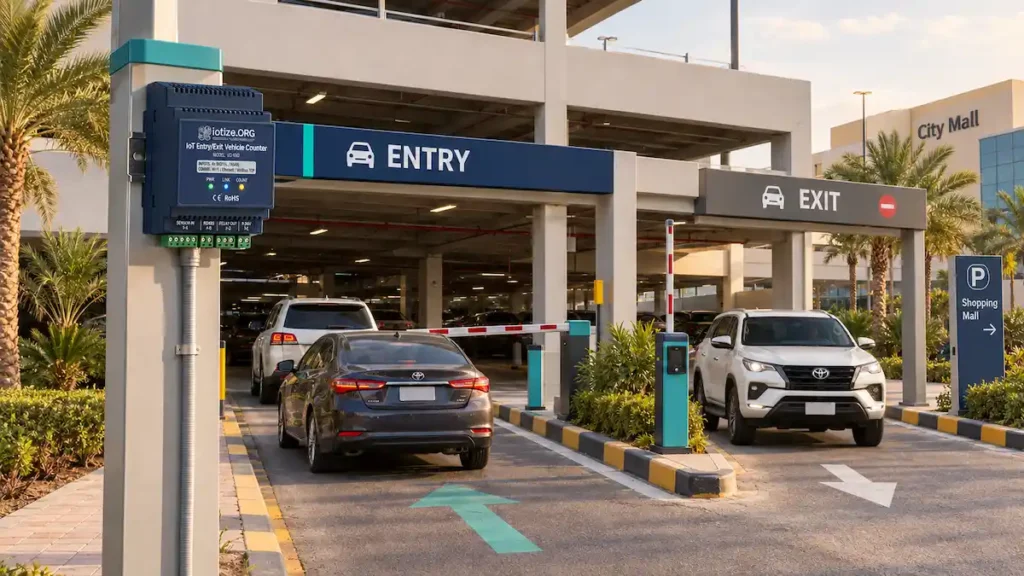
Your car park is the first thing a visitor uses and the last thing they remember. Before anyone reaches your store, your clinic, your gate, or your front desk, they circle a deck looking for a space. So the parking experience sets the mood for everything that follows, and a good parking guidance system fixes it at the source. This guide walks through smart parking for shopping malls, hospitals, airports, campuses, and city streets, because each site feels the same problem in a different way. You want to see your own building on this page, so we put it here.
Guidance is not glamorous, yet it pays back fast. Drivers waste real time hunting for a spot. In fact, across sixteen studies of congested downtowns between 1927 and 2001, Donald Shoup found that it took drivers between 3.5 and 14 minutes to find a curb space, and that anywhere from 8 to 74 percent of the cars on those streets were cruising for parking (Shoup, Transport Policy, 2006). You have probably seen this quoted as a flat “30 percent of traffic,” which is not what the research says. We break down what the GPS evidence actually shows in What Is Smart Parking? How It Works, Types and Benefits. The lesson still carries into every gated lot: when drivers cannot see where the space is, they circle, they idle, and they get frustrated before they even arrive.
A connected parking management system removes the guessing. It counts what is free, and it shows drivers where to go.
What a Parking Guidance System Actually Does
A parking guidance system does three simple jobs, and it does them continuously. First, it counts. Sensors or entry and exit counters track how many spaces are taken in each lot, each level, or each zone. Then, it decides. A small edge controller turns those counts into a live occupancy picture and works out which route still has room. Finally, it shows. Dynamic signage points drivers to the nearest open space with a number and an arrow, so nobody has to guess.
That is the whole loop: count, decide, show, then repeat every few seconds. Vendors dress it up with license-plate readers, apps, and per-bay cameras, and those extras have their place. However, the core value comes from real-time occupancy tracking plus clear signage. Get those two right, and circling drops immediately.
IoTize builds exactly that visibility layer. We give you the count and the signage, on your own network, without forcing a camera into every bay or locking your data on someone else’s cloud. As a result, you keep the guidance honest and the budget sane.
Smart Parking for Shopping Malls
Malls live and die on dwell time. The longer a shopper stays comfortable, the more they spend, so a stressful arrival costs you real revenue at the till. Yet three problems keep repeating across mall car parks.
- Turn-aways at the gate. During weekend peaks, drivers see a queue, assume the deck is full, and leave for a competitor. Often, spaces sit empty two levels up. A count sign at the entrance tells them the truth before they turn around.
- Uneven deck filling. Everyone crowds the ground floor while the roof stays half empty. Zone-level signs balance the load and cut the search on the busy levels.
- Long dwell in the aisles. Every minute a car spends hunting is a minute of congestion for everyone behind it. Guidance shortens that hunt to a straight line.
Smart parking for shopping malls, then, is really revenue protection. When arrival feels easy, visitors relax, stay longer, and come back. Meanwhile, your team gets occupancy data that shows exactly when each deck fills, so you can plan staffing and events around real patterns instead of hunches.
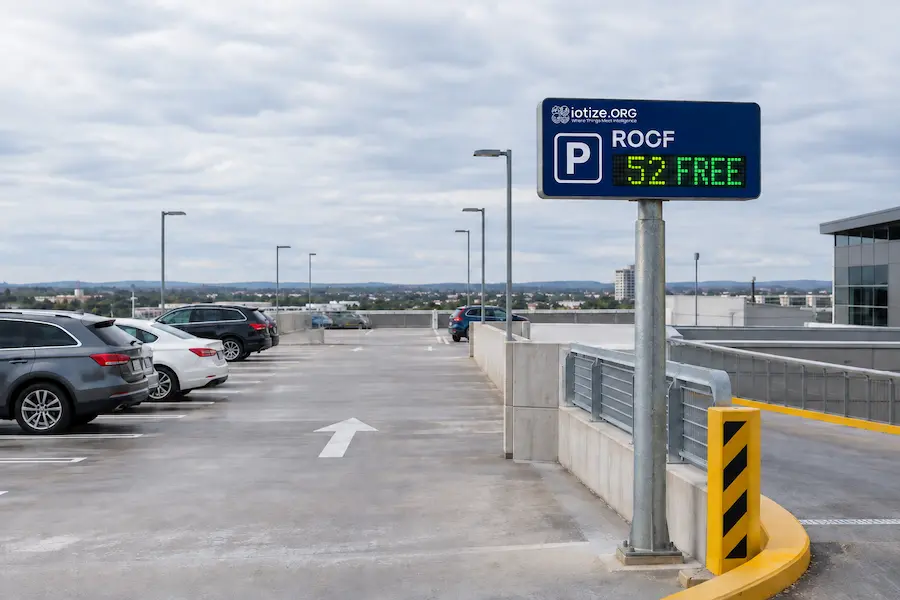
Hospital Parking Management System
A hospital car park is the most emotionally charged parking on this list. Patients arrive stressed, sometimes in pain, often running late for an appointment they waited weeks to get. So a hospital parking management system carries a different weight than a mall: it protects care, not just revenue.
Four pressures define it. First, visitor stress and missed appointments. When a worried family circles for ten minutes, they arrive rattled and behind schedule, and clinics lose slots. Clear guidance to the nearest open bay takes that pressure off.
Second, emergency lane clearance. Ambulance routes and drop-off zones must stay open, so entry and exit counting helps you spot when a zone is filling and reroute general traffic before it blocks a critical lane.
Third, 24/7 reliability. Hospitals never close, so the signage has to run through the night and read clearly in low light and bad weather. Fourth, mixed users. Staff, patients, contractors, and visitors all compete for the same asphalt, and zone-level occupancy data helps you keep each group in the right area.
Because hospital lots are often open-air and spread across multiple buildings, outdoor durability matters most here. That is exactly where solar, weatherproof signage earns its keep: it runs where mains power is hard to reach and stays readable at 3 a.m.
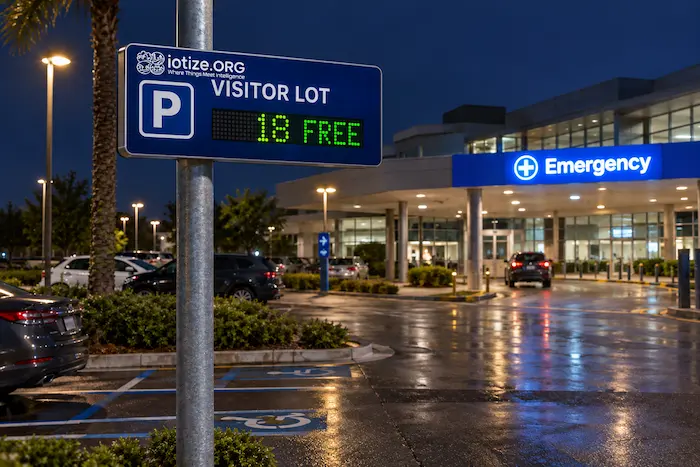
Airport Parking Guidance System
Airports raise every stake. The driver is time-pressed and anxious about a flight, the facility spans several garages and surface lots, and demand swings from empty to overflowing with the flight schedule. An airport parking guidance system has to route across all of that in real time.
Start with the driver. Nobody wants to learn a garage is full after they have committed to the ramp. So the first sign belongs on the approach road, telling arriving traffic which garage or lot still has room. That single decision, made early, prevents the worst airport parking backups. Real airports are proving the point: Phoenix Sky Harbor rolled out a camera-based guidance system in its Terminal 3 garage in late 2025, using real-time space monitoring and simple red and green indicators to cut search time and idling before a flight (Phoenix Sky Harbor press release )
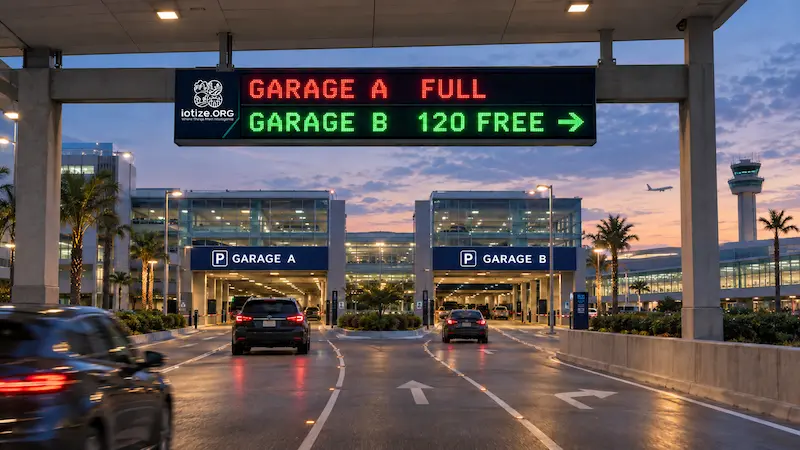
Then handle the surges. Because a bank of arrivals or a holiday weekend can fill a garage in an hour, you need count data that updates fast enough to reroute drivers between garages while there is still room to move them. Entry and exit counters at each facility feed a campus-wide picture, and the edge controller decides which lot to point traffic toward next. In practice, that turns a multi-garage maze into a managed flow.
Corporate Campus and Office Parking
Campuses and offices look calmer, yet they hide the trickiest rules. A corporate campus parking solution has to respect permit zones, manage constant turnover, and hand facilities the planning data they need to justify every square meter.
Permit zones come first. Staff, visitors, reserved spots, and EV bays each have their own logic, so zone-level counting keeps each group visible without turning the lot into a maze. Turnover comes next. Office lots empty and fill in daily waves, and visitor spaces cycle fast, so live occupancy stops visitors from clogging staff areas and the other way around. Planning data comes last, and it matters most to the people signing the budget. When facilities can show which lots run full and which sit half empty, they can right-size parking, defend against needless expansion, and plan smart parking for offices around real demand.
University campuses run on the same pattern at larger scale, blending student permits, staff lots, and event surges. Either way, the value is the same: fewer circling cars, cleaner permit compliance, and a usage record you can actually plan against.

Municipal and On-Street Parking Guidance
On the street, the problem changes shape again. There are no gates and no ceilings, just curb spaces spread across a district. So municipal parking guidance is about routing drivers between blocks and zones before they ever start circling, which is where connected parking management pays back at city scale.
Here the physics get harder. Curb-side signs sit far from mains power, weather is unforgiving, and a district may need dozens of signs that all report to one place. As a result, signage that runs on solar and battery, survives rain and heat, and talks wirelessly to a central controller is not a nice-to-have, it is the only practical option. City drivers then see which nearby zone still has room and head straight there, which cuts the block-circling that Shoup measured decades ago.
The through-line across every setting is scale. A single clinic entrance might need one sign. A city district might need a hundred. Because they run on the same platform, you start small and grow without swapping systems.
The Signage Pattern That Works on Every Site
Sites differ, but the winning placement pattern repeats. Put a sign at each decision point, in this order.
- Approach or street entry. A count sign that answers one question early: which lot, garage, or zone still has room? This is the highest-value sign, because it prevents the wrong turn before it happens.
- Facility entrance or gate. An entry and exit counter plus an entry sign showing how many spaces are free inside. This is your live occupancy source and your first in-lot reassurance.
- Interior decision points. Directional signs at ramp splits and level transitions, each with a number and an arrow, so the driver never has to guess which way the free spaces are.
Which lot or zone has room
Live entry and exit count
Ramp splits and level transitions
For most malls, hospitals, campuses, and city districts, that count-and-direct pattern solves the problem without a camera in every bay. If a specific high-value zone needs per-space indicators later, you can add them, but you do not need to start there. Notably, this same three-tier pattern maps cleanly onto a garage parking guidance system, a surface lot, or an on-street district. The signs and counts scale up or down; the logic stays the same.
The IoTize Smart Parking Kit
Every setting above uses the same small set of parts, arranged differently. IoTize builds four live smart-parking products, and together they form a complete guidance kit that scales from one sign to a whole city.
The counting and control layer
- IoT Entry/Exit Vehicle Counter. Mounted at gates and lane entries, it counts vehicles in and out to give live lot-level and zone-level occupancy, without a camera in every bay. This is the honest, retrofit-friendly way to know how full a facility is. Custom Series, from $249, Request a Quote. View product.
- Parking Guidance Gateway (IoT Edge Controller). The brain of the system. It aggregates counts from every counter and sensor, works out which zones still have room, drives the signage, and streams the occupancy picture to your dashboard or your own platform. Because it runs at the edge, guidance stays fast and keeps working even if the internet blips. Custom Series, from $449, Request a Quote. View product.
The signage layer
- IoT Indoor LED Signage Display (1000×200 mm, full color). A bright, full-color LED panel with animated arrows, text, and logos, ideal for indoor garage entrances and interior decision points where drivers need a clear number and direction. Custom Series, $999. View product.
- Smart Parking Flip-Dot Guidance Signage (7×20, wireless, solar and battery, IP65). A rugged outdoor sign that needs no mains power and no trench for cabling. It runs on solar and battery, survives weather at IP65, and talks wirelessly to the gateway, which makes it the natural fit for hospital lots, rooftop decks, remote airport lots, and on-street district signs. Custom Series, $1,600, sizes customizable. View product.
Put simply: counters tell the system what is free, the gateway decides where to send drivers, and the signs show them the way. Add more of any part, and the same platform grows with you.
IoT Entry/Exit Vehicle Counter
Count-in, count-out occupancy at the lane, without a camera in every bay.
Request a Quote →Parking Guidance Gateway
The edge controller that runs your rules and drives every connected sign.
Request a Quote →IoT Indoor LED Signage Display
Full-color LED panel, 1000 by 200 mm, at every indoor decision point.
View Product →Smart Parking Flip-Dot Guidance Signage
Solar and battery powered, IP65, for curbs and lots with no mains power.
View Product →One Platform, One Sign to a Whole City
This is the part that matters when you are comparing vendors. Many parking systems assume a full, expensive install: cameras in every bay, cloud lock-in, and a rip-out of whatever you have today. IoTize takes the opposite path. You retrofit onto your existing lot, you count at the gate instead of over every space, you power outdoor signs with solar, and you keep your data on your own network.
As a result, the same platform serves a single clinic and a city center. Start with one flip-dot sign at a busy entrance. Then add a second lot, a garage, a district. Because every part speaks to the same gateway, nothing gets orphaned as you grow. That modularity is the whole point, and it is the difference between a pilot that stalls and a system that spreads across your entire site.
What It Costs and Where to Start
The honest next question is budget. Signage, counting, and control each carry a cost, and the right mix depends on your site, so a realistic figure needs a real breakdown rather than a sticker price. We wrote a full guide for exactly that: How Much Does a Smart Parking System Cost in 2026? walks through what drives the number and how to build a defensible business case. (Editor: this post is not published yet, see Links to Set below for the placeholder.)
When you are ready to map this to your own lots, the IoTize Smart Parking Solutions page shows the full approach by site type, and our team can size a kit for your mall, hospital, airport, campus, or district. Talk to Our Team and we will start with your site, not a template.
You came here to see your own building on the page. Now you have: the pressure it feels, the signs that fix it, and a platform that scales from the first sign to the whole city.
Guide Your First Entrance This Quarter
Detect, decide, display, with four live products. Start a smart parking system at one lane, then scale it to your whole site.
Frequently Asked Questions
What is a parking guidance system?
A parking guidance system counts how many spaces are free, decides which route still has room, and shows drivers the way with dynamic signage. It turns a slow circle around a lot into a straight line to an open space.
How does a smart parking system work?
It runs a simple loop: entry and exit counters or sensors track occupancy, an edge controller turns those counts into a live picture and picks the best route, and LED or flip-dot signs display the number and arrow. The loop repeats every few seconds, so the guidance stays current.
Do parking guidance systems work outdoors and in low light?
Yes. Outdoor-rated signage like the IoTize flip-dot guidance sign is built to IP65, runs on solar and battery, and stays readable in low light and bad weather, which is why it suits hospital lots, rooftop decks, and on-street use.
Can a parking guidance system scale from one lot to a whole city?
Yes. Because IoTize counters, gateways, and signs share one platform, you can start with a single sign at one entrance and grow to dozens of signs across a district without changing systems.
What makes hospital parking different from mall parking?
A hospital parking management system has to keep emergency lanes clear, run reliably 24/7 in low light, and reduce the stress that makes patients miss appointments. A mall system focuses more on dwell time, turn-aways at the gate, and even deck filling.
Do I need a camera in every parking space?
No. IoTize uses entry and exit counting for lot-level and zone-level occupancy, which covers most malls, hospitals, campuses, and city districts without per-bay cameras. Per-space bay sensors and indicator lights are on the IoTize roadmap for sites that need exact space-by-space guidance later.
How much does a smart parking system cost?
It depends on how many signs, counters, and controllers your site needs. See our full breakdown in How Much Does a Smart Parking System Cost in 2026? to build a defensible budget. (Editor: link this once Post 6 is live, see Links to Set.)
Products: IoT Entry/Exit Vehicle Counter · Parking Guidance Gateway · Indoor LED Signage Display · Flip-Dot Signage
Read first: What Is Smart Parking? How It Works, Types and Benefits
Read next: How Much Does a Smart Parking System Cost in 2026? (not published yet)
From the blog: Visit the IoTize blog →