

Technical Reviewer: Zia ur Rehman
15+ years in embedded systems and industrial IoT · Reviewed

Smart parking is a connected system that detects which parking spaces are free, updates that status in real time, and guides drivers straight to an open space using signs, apps, or dashboards. Rather than leaving drivers to hunt blindly, smart parking technology turns an invisible problem into live, usable information.
Anyone who has circled a mall basement in Karachi or Dubai on a weekend evening knows the problem first hand. That daily frustration is exactly what a smart parking system sets out to remove. Yet before you weigh any vendor or budget, it helps to understand the term itself in plain language.
This guide explains what smart parking is, how it works, the main types you will encounter, and the benefits it delivers for drivers, operators, and whole cities. It also covers where Pakistan and the Gulf currently stand, and draws a clear line around what smart parking does not fix, so you can form an honest opinion before talking to anyone selling a solution.
What Is a Smart Parking System?
A smart parking system is a connected setup that detects space occupancy and shares that status with drivers and operators in real time. In other words, a smart parking system answers two questions continuously: which spaces are free right now, and how does a driver get to one of them?
Traditional parking is essentially blind. A driver enters, guesses, and searches. Meanwhile the operator has little idea how full the facility is until someone counts by hand or a contractor reports the day’s collection. Smart parking replaces that guesswork with data.
To do this, every smart parking system combines three basic ingredients:
- Detection hardware that senses whether a space or zone is occupied.
- Connectivity that moves that status to a central system, usually over the internet.
- A display layer that shows the result to people, whether on signs, apps, or dashboards.
Because these three parts can be mixed and matched, smart parking describes a family of solutions rather than a single product. The rest of this guide unpacks how those pieces fit together.
How Does a Smart Parking System Work?
A smart parking system works by running a continuous three-step loop: detect, decide, display. Sensors detect whether a space or zone is occupied, a controller updates the live count of free spaces, and signs or apps display the result to drivers. The loop repeats second by second as cars come and go.
Understanding this loop is the fastest way to grasp how smart parking works, no matter which brand or sensor sits underneath. First, a sensor registers a change, such as a car entering a lane or arriving over a space, and that single event becomes a data point. Next, a controller or software layer updates the live count of free spaces and applies any rules, such as reserving bays for staff, disabled access, or electric vehicles. This is where raw detection becomes real-time parking availability. Then the system pushes the result outward, so a driver sees an open-space count at the entrance or an arrow down the correct aisle, while an operator sees the same truth on a dashboard. Consequently the picture stays current instead of going stale the moment someone parks.

What Are the Types of Smart Parking Systems?
The main types of smart parking systems are lane and vehicle counting, per-space in-ground or overhead sensors, camera and license plate recognition systems, RFID access control, and parking guidance signage. Each detection method differs in how precisely it locates a free space and how much hardware a site needs.
There is no single smart parking sensor. Instead, several detection methods exist, and each suits a different site and budget. The table below compares them at a glance, and the sections after it explain each one.
| Detection type | What it detects | Granularity | Relative cost | Best fit |
|---|---|---|---|---|
| Lane and vehicle counting | Cars entering and leaving | Whole facility count | Lowest | Gated lots, campuses, malls stepping off blind parking |
| Per-space sensors | A vehicle in one bay | Individual bay | Highest | Large garages routing drivers to an exact space |
| Camera with computer vision | Many bays in view | Bay level, needs sightlines | Medium plus software | Open lots and decks with clear sightlines |
| License plate recognition (LPR) | Vehicle identity at entry | Vehicle, not bay | Medium | Ticketless entry, enforcement, reserved bays |
| RFID access control | A tagged vehicle at a barrier | Access event, not bay | Low to medium | Campuses, industrial sites, gated schemes |
| Guidance signage | Displays what sensors detect | Depends on the sensors | Varies | Any site where drivers need directing |
How does lane and vehicle counting work?
Lane counting works by watching an entrance and exit, adding one when a car enters, subtracting one when a car leaves, and deriving how many spaces remain. Because this method needs very little hardware, lane counting is a common first step toward automated parking management. The trade-off is granularity, since a vehicle counter system tells you the total free count, not which specific bay is open. For many sites in Pakistan and the Gulf that are starting from zero data, that total count is still a large leap forward at a fraction of the cost of full bay-level sensing.
What are per-space (in-ground) parking sensors?
Per-space sensors are devices installed at each individual bay that detect whether a car is present directly above them, typically using magnetic, ultrasonic, or infrared sensing. Overhead versions mount on the ceiling and point down at the bay instead. These parking occupancy sensors form the most granular kind of parking space monitoring system. As a result, per-space sensors can light a single green or red lamp over each bay and route a driver to the exact space, though they cost more to install because every spot needs its own device.
How do camera and LPR parking systems work?
Camera-based parking systems use computer vision to analyse a video feed and flag which bays are occupied, covering many spaces with one device. Camera systems can also read number plates through license plate recognition, which supports ticketless entry, enforcement, and reserved-bay checks. The trade-off is that cameras depend on clear sightlines and good lighting, and they raise privacy questions that operators must handle carefully. Dust, glare, and heat are also practical considerations in regional outdoor deployments.
What is RFID parking access?
RFID parking systems identify a vehicle at the access point rather than at the bay. A tag on the windscreen or a card at the barrier identifies the vehicle or permit holder, which opens the gate and logs the movement. RFID shines for controlled sites such as corporate campuses, industrial estates, and gated residential schemes, where the operator cares more about who enters than which bay they choose.
What is a parking guidance system?
A parking guidance system is the display layer that turns occupancy data into directions a driver can follow. Digital parking signage at the entrance shows a live free-space count, while overhead signs and bay indicators point drivers down the right aisle to the right spot. Detection is only useful if a driver can act on it. Guidance is what most people actually feel as smart parking, because guidance removes the searching. The next post in this series covers this layer in depth.
Where do parking apps and payment fit?
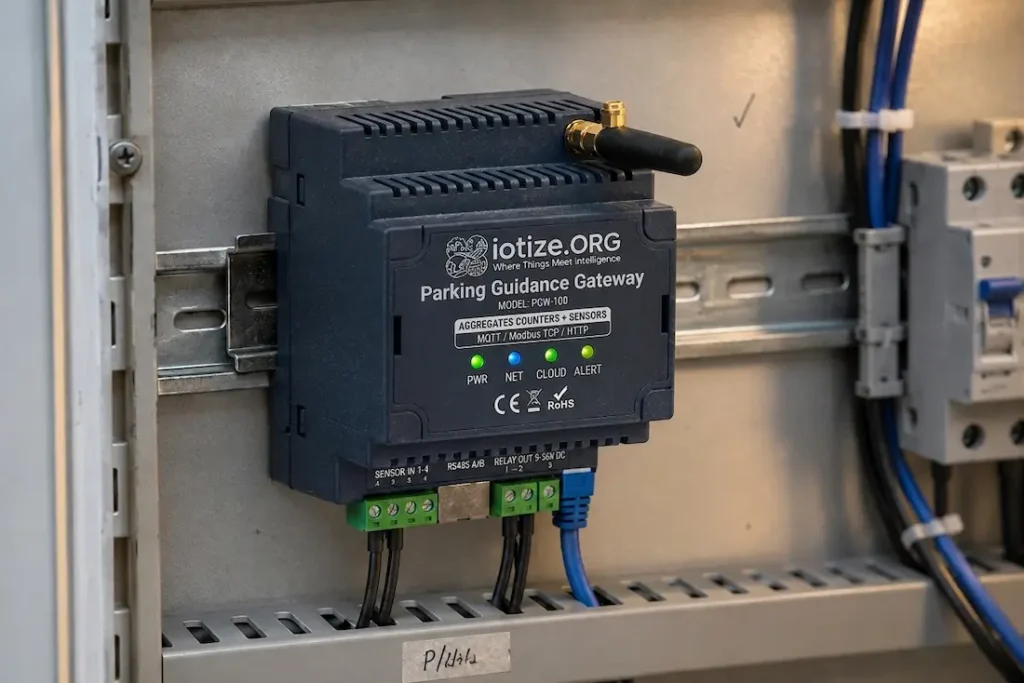
Parking apps sit on top of the physical system as a driver-facing software layer. Apps can show real-time availability on a map, let users reserve a bay, and handle payment without a ticket, connecting the hardware to the phone in the driver’s pocket. Across this whole taxonomy, hardware companies tend to specialise in one or two layers. IoTize, for example, builds in the detection and guidance layers, with an IoT entry and exit vehicle counter, a parking guidance edge controller, and flip-dot guidance signage, rather than the payment app on top.
How Is IoT Used in Smart Parking?
IoT is used in smart parking to connect the sensors, controllers, and signs to software over a network, so that a bay in a basement can update a sign at the street in near real time. That connection is what makes occupancy data flow rather than sit trapped in one device.
In an IoT smart parking setup, smart parking IoT sensors detect occupancy at the edge, a controller aggregates the data, and the cloud or an on-site server serves that data to signs, dashboards, and apps. Most modern systems are, at heart, an IoT based smart parking system. Building a smart parking system using IoT also brings the same advantages as industrial IoT elsewhere. Operators gain remote visibility, historical data for planning, and the ability to scale from one lane to a whole campus without ripping anything out. Crucially, the driver never sees any of this complexity. They just see an accurate number and a helpful arrow.
What Are the Benefits of Smart Parking?
The benefits of smart parking systems reach three groups at once. Drivers save search time, operators gain usable capacity and occupancy data, and cities cut low-speed circling that contributes to congestion and emissions. The hard numbers below come from Dubai’s Roads and Transport Authority and INRIX.
What smart parking delivers, by the numbers
Sources: Dubai RTA (rta.ae) and INRIX (inrix.com). Figures describe specific deployments and markets, not a guarantee for every site.
For drivers, the payoff is time and calm. Dubai’s RTA reports that its smart parking system saves drivers 20 to 30 percent of the time normally spent searching, roughly 8 minutes per session. The most-quoted economic measure comes from the United States, where INRIX found drivers spend an average of 17 hours per year searching for parking, at a cost of about 345 dollars each and roughly 72.7 billion dollars nationally. No equivalent study exists for Pakistan yet, though the direction of the problem is not in doubt for anyone who parks in a major city here.
For operators and facilities, smart parking benefits for businesses show up as higher usable capacity, better data, and cleaner revenue. When drivers stop circling, the same lot serves more cars, staff spend less time directing traffic, and management finally sees occupancy trends by hour and day. That visibility is the foundation of smart parking ROI, since operators can price, staff, and expand based on evidence rather than hunches. Revenue integrity deserves its own mention regionally, because where parking is collected manually by contractors, leakage is a persistent problem, and digital ticketing with an auditable record is often the first business case a facility owner accepts, ahead of any driver-convenience argument.
For cities, the gains are civic, and here it pays to be precise, because one statistic in this field is widely misquoted. The often-repeated claim that 30 percent of urban traffic is searching for parking comes from an average of a small set of older studies, deliberately conducted on streets where parking was already known to be scarce, so it never described city traffic as a whole. More recent research by the U.S. Federal Highway Administration, using GPS data from smartphones, puts cruising closer to 10 percent of city traffic during peak hours. Ten percent is still a large number of vehicles moving slowly and burning fuel for no productive reason, so better guidance helps smart parking reduce congestion and, in turn, reduce emissions. Consequently, smart city parking solutions do double duty: they smooth traffic and improve air quality in exactly the dense commercial districts where both are worst.

What Does Smart Parking Look Like in Pakistan and the Gulf?
The Gulf is several years ahead of Pakistan on smart parking, with sensor-based public deployments already running in Dubai, while Pakistan is currently at the pilot stage, focused first on digital ticketing and revenue control rather than bay-level detection. Both markets are moving, just from different rungs.
In the Gulf, Dubai’s RTA has installed roughly 2,030 ground sensors and 70 overhead cameras covering about 3,035 parking slots, feeding a central control system that publishes vacancy data to variable message signs and the RTA app. That is a full detect, decide, display loop operating at city scale, and it sets the reference standard that mall and commercial developers across the UAE, Saudi Arabia, and Qatar are now measured against.
In Pakistan, the picture is earlier but moving quickly. Karachi Mayor Murtaza Wahab confirmed in September 2026 that a digital parking pilot at designated Karachi Metropolitan Corporation lots was nearing completion, after the city abolished parking fees on KMC roads and moved to an automated receipt system built to stop contractors overcharging and to reduce revenue leakage. Islamabad’s Capital Development Authority launched the city’s first digital car parking project at G-8 Markaz and later extended digital parking to other commercial areas. Lahore is developing parking plazas and smart parking within the Walled City through TEPA and the LDA.
Notice the pattern. Pakistani projects are starting with payment integrity and digital records, because that is where the immediate financial pain sits. Detection and guidance typically follow once the operator has a working digital backbone. For private facilities, that sequence is often reversed and faster. A mall, hospital, industrial estate, or corporate campus does not need a municipal mandate to install an entry and exit counter and a guidance sign at the gate. Consequently the private sector in both markets can climb faster than the public one, and frequently does.
What Is the Parking Visibility Ladder?
The Parking Visibility Ladder is a three-stage model describing how a parking facility matures from no data to full optimization. The stages are blind, guided, and optimized, and a site must climb them in order, because no operator can optimize what they cannot see, or guide drivers to spaces they have not detected.
No live data. Drivers guess, staff count by hand. Where most Pakistani sites sit today.
Sensors and signage arrive. Drivers get directed to open spaces. Dubai’s public zones operate here.
Dynamic pricing, reserved zones, predictive staffing. Parking becomes a managed asset.
Each rung depends on the one below it. That order matters when planning a rollout, because buying optimization software for a site with no detection layer solves nothing.
What Does Smart Parking Not Fix?
Smart parking does not create new parking capacity. Smart parking makes existing capacity visible and easier to use, which is a different thing, and honest scoping here saves a lot of disappointment later.
If a site is genuinely full more often than not, better guidance will surface that hard truth faster, but guidance will not conjure extra bays. In that case the real answer is more space, different pricing, or shifting some trips to other modes. Smart parking gives operators the data to make those calls, yet the calls remain theirs. Likewise, technology cannot fix a poorly designed layout, unclear one-way flows, broken barriers, or on-street encroachment on its own. Think of smart parking as the visibility and guidance layer. It shows reality clearly and routes drivers efficiently within the capacity that already exists. Everything downstream, from construction to enforcement policy, still depends on human decisions.
Key Takeaways
- Smart parking uses detection, connectivity, and a display layer to show which spaces are free and guide drivers to them in real time.
- The core logic is a repeating detect, decide, display loop.
- The main types range from lane counting to per-space sensors, cameras and LPR, RFID access, and the guidance signage drivers actually see.
- IoT is the connective tissue that links physical bays to signs, dashboards, and apps.
- The Gulf is already running sensor-based public deployments, while Pakistan is at the pilot stage and starting with digital ticketing and revenue control.
- The Parking Visibility Ladder describes the climb from blind to guided to optimized, and the rungs must be taken in order.
- Cruising for parking is a real cost, though the widely quoted 30 percent figure overstates it. FHWA research points closer to 10 percent of peak city traffic.
- Smart parking makes parking visible and usable, but it does not create new capacity on its own.
Ready to go one layer deeper?
The next guide explains how a parking guidance system routes a driver to an open space, the second rung of the Parking Visibility Ladder.
Frequently Asked Questions
How does smart parking reduce traffic?
Smart parking reduces traffic by cutting the time drivers spend circling in search of a space. Sensors detect open bays, and signage or apps direct drivers straight to them. Federal Highway Administration research using GPS data estimates that cruising for parking accounts for close to 10 percent of city traffic at peak hours, so removing much of that search directly reduces low-speed congestion and the emissions that come with it.
What sensors are used in smart parking?
Smart parking uses in-ground and overhead per-space sensors (magnetic, ultrasonic, or infrared), lane-based vehicle counters at entrances and exits, cameras with computer vision and license plate recognition, and RFID readers at access barriers. Each suits a different site and budget, and many systems combine several.
How does a smart parking system work?
A smart parking system runs a continuous loop. Sensors detect whether a space or zone is occupied, a controller or software layer updates the live count of free spaces, and signs, dashboards, or apps display the result to drivers and operators. The loop repeats second by second, so the information stays current.
Is smart parking used in Pakistan?
Yes, though it is at an early stage. Karachi Metropolitan Corporation has been piloting a digital parking system at designated lots, and Islamabad’s Capital Development Authority launched the city’s first digital car parking project at G-8 Markaz. Most Pakistani projects so far focus on digital ticketing and transparent fee collection, with detection and guidance layers following behind.
Is smart parking worth it?
Smart parking is usually worth it at sites where drivers regularly circle to find space, because saved search time, higher usable capacity, and better occupancy data compound over time. In markets where parking fees are collected manually, the revenue integrity gain often justifies the system on its own. For a small lot that is rarely busy, the return is thinner.
How much does a smart parking system cost?
The cost of a smart parking system depends almost entirely on the detection method and site size. Lane counting needs the least hardware, per-space sensors cost more because every bay needs a device, and camera systems sit in between while adding software. Guidance signage and any app layer add to the total. Scope the layers actually needed before comparing quotes.
What is the difference between a vehicle counter and per-space sensors?
A vehicle counter tracks cars entering and leaving to give a total free-space count, which is simple and low cost. Per-space sensors report the status of each individual bay, which enables green and red bay indicators and precise routing, at a higher install cost. Many facilities start with counting and add per-space accuracy later.
Is 30 percent of city traffic really searching for parking?
No. That widely repeated figure comes from averaging a small set of older studies conducted on streets specifically chosen because parking was known to be scarce, so it never described all city traffic. More recent Federal Highway Administration research using GPS data puts cruising closer to 10 percent of city traffic during peak hours, which is still significant but far lower than the popular claim.
Read next: Parking Guidance Systems Explained: How an APGS Gets a Driver to an Open Space
See the solution: IoTize Smart Parking
From the blog: Visit the IoTize blog →