

Technical Reviewer: Zia ur Rehman
15+ years in embedded systems and industrial IoT · Reviewed
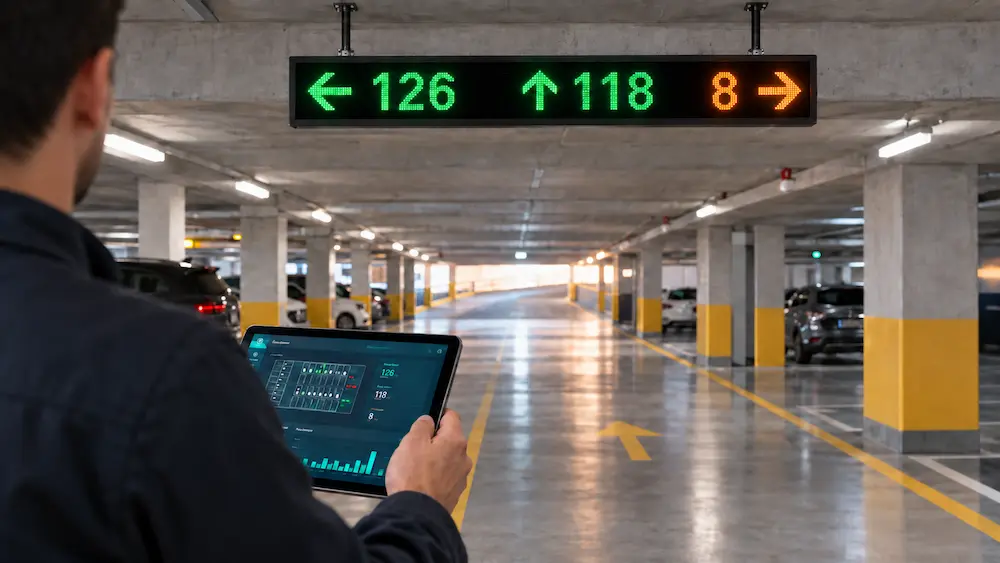
A smart parking system costs roughly $8,000 to $25,000 for a single guided entrance, $250 to $800 per space installed for a per-space guided garage, and into the millions for a district or city rollout. Scope, not any single per-space figure, sets the number. Trenching and power runs, rather than the devices themselves, are what most often push a project over budget.
If you ask ten vendors how much does a smart parking system cost, you will get ten different answers, and most of them will end in “contact us.” That is frustrating when you are building a budget or a business case, because you cannot defend a number you were never given.
So let us fix that. A smart parking system cost is driven far more by scope than by any single per-space figure. One guided entrance is a few thousand dollars. A fully sensored multi-level garage is a few hundred thousand. A city-wide rollout runs into the millions. The rest of this guide breaks down exactly where the money goes, what the defensible per-space ranges actually are, and how the four ROI channels pay it back.
Above all, it separates the honest hardware prices from the two off-vertical products that pollute this search and pull budgets in the wrong direction.
Why Should You Price by Scope Instead of Per Space?
Price by scope because a per-space figure hides the fact that a guided entrance and a fully sensored garage are different projects, not the same product at different sizes. Each layer of the system scales on a different unit, so a single blended number cannot describe any of them accurately.
Per space is the number every buyer asks for first, and it is the least useful one to start with.
Every smart parking system runs the same three-step loop, and a budget is really just the cost of building each step: detect, decide, display. Data is the supporting fourth layer that the loop produces along the way.
Because these three steps scale on different units, sensors per bay, controllers per site, signs per decision point, the honest way to price a project is by scope. Where your site sits on the Parking Visibility Ladder, the climb from blind to guided to optimized, also sets your budget: moving from blind to guided costs far less than reaching a fully optimized per-space deployment.
Next, let us look at what moves the cost inside each step.
What Drives the Price of a Smart Parking System?
Four factors set the price: how many points you detect, installation and civil works, how many signs you deploy and where, and your recurring software and data costs. Of these, the detection choice and the civil works swing the budget hardest.
They matter in this order.
- Points detected. Counting cars at an entrance is cheap because you install a handful of sensors. Sensing every individual bay is expensive because you install one device per space, which can swing the budget by ten times.
- Installation and civil works. Trenching, conduit, mounting, and power runs frequently cost more than the devices themselves, especially outdoors and at the curb.
- Signs, and where. A full-color indoor LED panel and a rugged solar curb sign sit at very different price points, so this is rarely the place to cut.
- Recurring costs. Software subscriptions, cloud data fees, and maintenance add up every year, so a system you own outright has a very different total cost of ownership than one you rent by the space per month.
Keep those four levers in mind, because every quote you receive is really just a different combination of them.
What Does Each Deployment Scope Actually Cost?
A single guided entrance runs roughly $8,000 to $25,000 in total. A per-space guided garage runs roughly $250 to $800 per space installed, so a 500-space garage lands near $250,000 to $500,000. A district or city rollout runs into the millions, budgeted per facility and per curb zone.
Public US federal deployment data serves as the benchmark here, so we anchor to it and note that the underlying studies are older directional figures, not fresh 2026 quotes.
| Scope | What it is | Realistic budget | What sets the number |
|---|---|---|---|
| One guided entrance | Count in and out of a single enclosed lot, one or two displays | $8,000 to $25,000 total | Lanes, indoor vs outdoor signs, power availability |
| Multi-level garage, per-space | A sensor over every bay plus aisle and level signs | $250 to $800 per space installed | Sensor count, trenching, cabling, sign density |
| District or city rollout | Many facilities plus on-street sensing, one platform | Millions, per facility and curb zone | Scale, civil works, integration, operations |
The per-space band above is the useful anchor. The US DOT ITS Deployment Evaluation cites advanced parking management systems at roughly $250 to $800 per space to install, drawn from a Federal Highway Administration study of six parking facilities, and single-space ultrasonic occupancy sensors at roughly $300 to $500 per space, depending on local labor costs. Industry write-ups put full over-the-space sensor systems even higher, around $500 to $1,000 per space once signage and infrastructure are included, which is why a mid-size garage guidance install commonly lands between $250,000 and $500,000.
Meanwhile, lane counting sits far lower per space, because you are not buying one device per bay. Trade estimates for entry-level counting land near $20,000 per lane, which spreads to a low double-digit dollar figure per space in a large lot. That gap between counting and per-space is the single biggest budget decision in the whole project.
Which Line Item Blows Up Smart Parking Budgets?
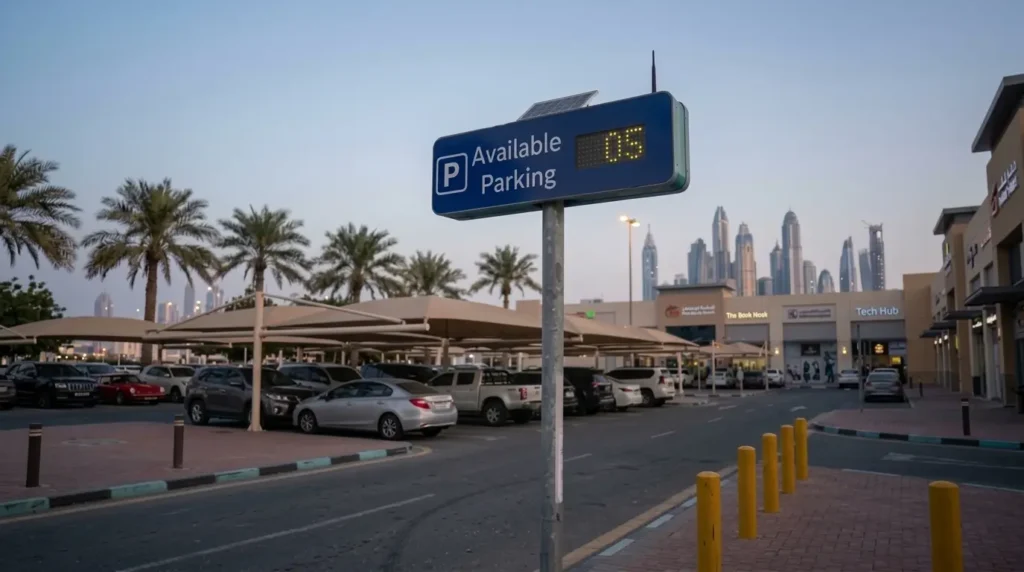
Trenching and power runs blow up more smart parking budgets than any other line item. Cutting through concrete or asphalt, laying conduit, and reinstating the surface can cost more than the sign that work serves, and outdoor or curb-side projects feel it worst because there is rarely power where you want the display.
Here is the trap that turns a tidy hardware estimate into a project overrun: the civil works.
Getting power and a data run to a curb-side sign often means trenching through concrete or asphalt, laying conduit, and reinstating the surface. That work can quietly cost more than the sign it serves. Outdoor and on-street projects feel this most, because there is rarely a convenient power point where you want the display.
Therefore, two design choices protect a budget more than any discount:
- Count instead of sensing every bay wherever the layout allows it, because fewer devices means far less cabling.
- Go off-grid at the curb with solar and battery signage, because that removes the trenching and the power run entirely.
How Does Your Detection Choice Change the Budget?
Detection is the single biggest budget lever. Lane counting places a handful of sensors at the entrance and exit, so it costs far less per space. Per-space sensing puts a detector over every bay, which is the most accurate and the most expensive. A hybrid, counting at the lanes plus per-space sensing only on high-value bays, is the pragmatic middle for most garages.
Lane counting places a small number of sensors at the entrance and exit and keeps a running tally of cars in versus cars out. Because you buy a handful of devices rather than one per bay, it is by far the cheapest way to know how full an enclosed lot is. The honest caveat: counting accumulates error over time, so it needs a periodic reset, typically a nightly or scheduled recount when the lot empties. It also needs an enclosed lot with narrow, well-defined entrances so nothing sneaks past the count.
Per-space sensing puts a detector over or in every bay. It is the most accurate and the most expensive, and it is the only way to guide a driver to the exact open space rather than just a level. Reserve it for the bays where precision earns its cost: EV chargers, accessible bays, and premium or reserved spots.
Hybrid is the pragmatic answer for many garages: count at the lanes for the whole-lot number, and add per-space sensing only on the high-value bays. You get the cheap headline count plus precise guidance exactly where it matters.
One honesty note for planning: individual bay occupancy sensors with red and green over-bay lights are on the IoTize roadmap, not yet on the store, so budget them as a future phase rather than a purchasable line today. For a deeper walk-through of this detection decision, including error accumulation and reset schedules, see the earlier post in this cluster on choosing between counting and per-space sensors.
What Is Not a Smart Parking Cost?
Mechanical car stackers and parking app development are not smart parking guidance costs, yet both dominate this search. Stackers run $9,000 to $50,000 per space because they are structural machinery. Custom booking or payment apps run $20,000 to $120,000 because they are software projects. Neither figure belongs in a guidance budget.
- Mechanical car stackers and automated garages run roughly $9,000 to $50,000 per space, because you are buying structural machinery that physically moves and stores cars. If a smart parking cost article quotes tens of thousands per space, it is pricing car lifts, and you should discard the number.
- Parking app and software development runs roughly $20,000 to $120,000 for a custom booking, payment, or reservation platform. That is software engineering, not parking hardware.
IoTize sells neither. IoTize sells the layer that makes occupancy visible and actionable: lane counting, edge control, and guidance signage. It does not sell barriers, PARCS gates, payment or booking apps, ANPR enforcement software, mechanical stackers, or concrete. You cannot fill a lot you cannot see, so guidance is the honest first step. Capacity expansion, pricing, enforcement, and staffing are the operator’s follow-on decisions, informed by the data the guidance layer finally gives them.
Is a Subscription or an Owned Deployment Cheaper?
An owned deployment is usually cheaper over five to ten years. Subscription models lower the up-front cost but bill a recurring fee, often per space per month, that never stops and can exceed the hardware you would have simply bought. Ownership also keeps your occupancy data on your own systems.
Subscription (parking-as-a-service). You pay a lower amount up front and then a recurring fee, often billed per space per month, plus cloud and data charges. That smooths the initial budget. However, it never stops, and over a multi-year life the recurring line can exceed the hardware you would have simply bought.
Owned deployment. You buy the hardware, run it on your own network or a modest cloud, and keep the data. The up-front number is higher, yet the recurring cost is small, and the total cost of ownership over five to ten years is usually lower.
There is also a data question hiding inside the pricing model. When the platform is rented, your occupancy history often lives on the vendor’s servers, and leaving means leaving your data behind. IoTize’s position is deliberately the opposite: your data is yours, and the hardware speaks open protocols so it can feed your own dashboard, your SCADA, or your building system rather than locking you into one company’s cloud.
How Does a Smart Parking System Pay for Itself?
A guidance system pays back through four channels: recovered turn-aways once you can fill the last stretch of a lot, lower labor as signs replace attendants directing traffic, faster throughput as cars stop circling, and planning data that sizes your staffing and capacity decisions. Many guidance projects land inside a one to three year payback. None of these requires payment or enforcement hardware IoTize does not sell. They all flow from simply making occupancy visible.
- Recovered turn-aways. Operators have long treated a garage as full at around 85 percent occupancy, because drivers give up circling before the last spaces fill. Guidance recovers that last stretch by pointing drivers straight to the open bays. Parking Today reports that guidance-equipped facilities typically see revenue increases of 5 to 20 percent from better space utilization, and that filling the final 15 percent can mean thousands of dollars a day. Treat that as an industry-reported range, not a guarantee.
- Labor. When signs direct traffic, you need fewer attendants waving drivers around and fewer manual counts. Those hours come straight off the operating budget.
- Throughput. Cars that find a space fast leave the aisles fast. Higher turnover means the same concrete serves more paying visits per day, and it cuts the queue and tailpipe idling at the entrance.
- Planning value. Continuous occupancy data tells you which levels fill first, when your peaks really hit, and whether you need more capacity or just better guidance. That evidence sizes your staffing, your pricing, and even your next construction decision.
Smart parking cost and payback, at a glance
Sources: US DOT ITS Deployment Evaluation (itskrs.its.dot.gov), Parking Today. Industry ranges, not a guarantee at your site.
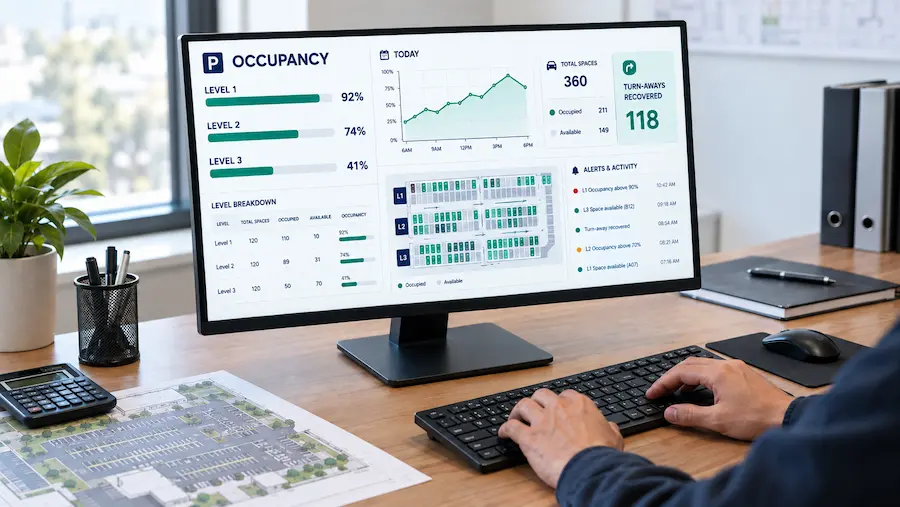
Put those together and the payback math is simple to run: total annual benefit divided into total installed cost gives you the payback period. Many guidance projects land inside one to three years, and the honest ones show you that math instead of asking you to trust a slide.
What Does IoTize Parking Hardware Cost?
IoTize publishes a starting price for all four parking products, in an industry that hides almost everything behind “contact us.” Every product goes through Add To Quote, because signage is available in custom sizes as well as the standard size the listed price covers, and the counter and gateway scale with your lane count and layout.
Display layer, starting prices published
- IoT Indoor LED Signage Display, 1000 by 200 mm, full color, animated arrows, text and logos, from $999. This is the indoor decision-point sign: mount it at the entrance and on each level to show a live count and a directional arrow. The listed price covers the standard size, and larger or custom dimensions are quoted on request.
- Smart Parking Flip-Dot Guidance Signage, 7 by 20, wireless, solar and battery powered, IP65, from $1,600. This is the off-grid curb sign. Because it holds its image on almost no power and stays readable in direct sun, it removes the trenching and power run that blows up most curb budgets. Custom sizes are available.
Detect and decide layer, quoted by layout
- IoT Entry/Exit Vehicle Counter, from $249. The detect device for lane counting: it tallies cars in and out of an enclosed lot for the whole-lot number, the affordable path that avoids one device per bay. The base controller starts here; sensors and a solar add-on price separately.
- Parking Guidance Gateway, from $449. The decide brain: it turns raw counts into the availability number, drives the signs, and keeps guidance alive through an internet outage thanks to local edge processing. The base Ethernet and Wi-Fi unit starts here, with an optional 4G add-on.
IoT Entry/Exit Vehicle Counter
Lane-level detect device for count-in, count-out occupancy.
Add To Quote →Parking Guidance Gateway
The edge controller that decides occupancy and drives every sign.
Add To Quote →IoT Indoor LED Signage Display
Full-color indoor display for decision points inside a garage.
Add To Quote →Smart Parking Flip-Dot Guidance Signage
Solar, off-grid sign for curbs and lots with no power run.
Add To Quote →That mix is the point. You get a published starting price on every product, so you can build a budget before you ever speak to anyone, and an honest per-layout quote confirms the final figure for your site. For how these four products map onto a specific building type, from a single clinic to a multi-level mall deck, see parking guidance for malls, hospitals, airports and campuses.
What Should You Demand in a Smart Parking Quote?
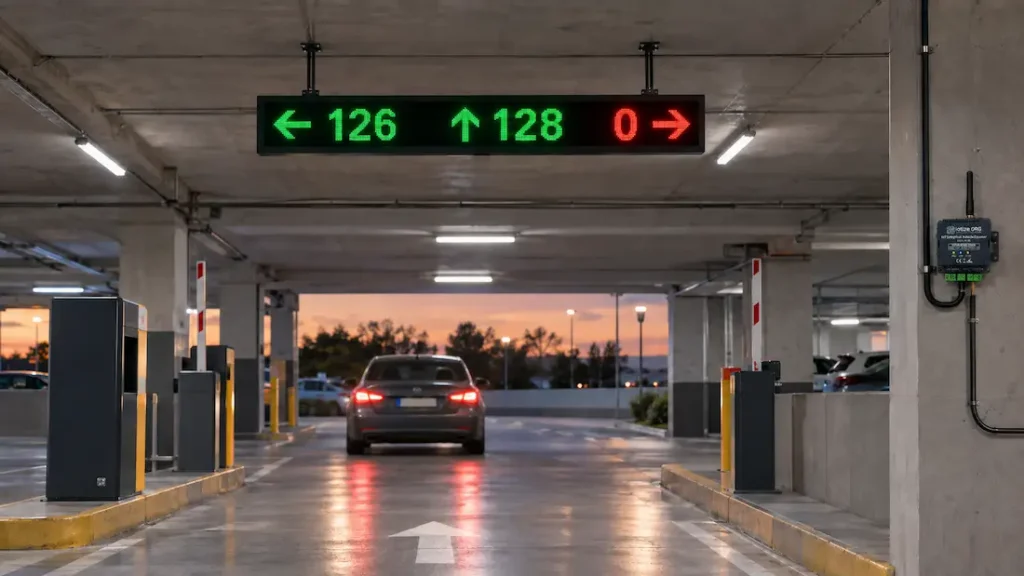
Demand six things in writing: hardware separated from installation, a clear per-space or per-lane basis, all recurring costs, data ownership and exit terms, the payback math using your own numbers, and what the system does during an internet outage. If a vendor cannot answer one of these, the missing number is where your budget risk lives.
- Hardware separated from installation. If they are blended, the trenching and civil works are hidden.
- Per-space or per-lane, stated clearly. These are different products, so a blended per-space figure that includes lane counting is meaningless.
- Recurring costs in writing. Subscription, cloud, data, and maintenance, per year, for the full expected life.
- Data ownership and exit terms. Who holds your occupancy history, and what happens to it if you leave.
- The payback math with your numbers. Recovered turn-aways, labor, throughput, and planning value, applied to your lot, not a generic slide.
- Outage behavior. Whether guidance keeps running locally when the internet drops.
What Does Smart Parking Cost in Pakistan and the Gulf?
The US federal ranges above are benchmarks, not local quotes. In Pakistan, the binding constraints are import duty, freight, and grid reliability, so off-grid signage and lane counting usually win on cost. In the Gulf, budgets are closer to the US figures and the constraint is heat, dust, and sunlight readability rather than power availability. The two markets need different specs, not just different currencies.
Pakistan. Import duties, freight, and lead times add heavily to any device shipped in from abroad, and load-shedding makes mains-dependent signage a liability. Solar flip-dot signage sidesteps both, since it holds its display without grid power and needs no trenching to a power source. Lane counting also suits the typical enclosed plaza layout at a fraction of per-space cost. IoTize designs, assembles, and ships its parking hardware in-house in Pakistan, which removes import lead time entirely for local buyers and puts support in the same time zone.
The Gulf. UAE, Saudi and Qatari operators generally budget closer to the international per-space figures, and public deployments there are already running sensor-based systems. The cost drivers shift accordingly: ambient temperature and dust set enclosure and IP requirements, and direct sunlight sets the readability spec, which is where reflective flip-dot displays hold an advantage because their contrast improves in bright sun rather than washing out. Export from Pakistan also avoids the longer lead times of sourcing from Europe or East Asia.
For what the 2026 Lahore, Karachi, and Islamabad projects signal about procurement direction, and how guidance retrofits onto existing plazas without waiting for new construction, read the next post in this cluster.
Key Takeaways
- Scope sets the price, not a per-space number. A guided entrance is roughly $8,000 to $25,000, a per-space garage lands near $250 to $800 per space installed, and a district rollout runs into the millions.
- Detection is the biggest lever. Lane counting costs far less than per-space sensing, at the cost of drift that needs a periodic reset. Hybrid gives you the cheap headline count plus precision on the bays that matter.
- Trenching and power runs blow up budgets, not the devices. Solar signage removes that line item entirely at the curb.
- Ownership usually beats subscription over five to ten years, and it keeps your occupancy data on your own systems.
- Four ROI channels pay it back: recovered turn-aways, labor, throughput, and planning data.
- Car stackers and app development are not guidance costs. Discard any per-space figure in the tens of thousands.
- Pakistan and the Gulf need different specs, driven by duty and load-shedding in one and by heat, dust and sunlight in the other.
Where to Go Next
- Still deciding how to detect? Start with vehicle counting versus per-space sensors.
- Speccing the displays themselves? See LED, flip-dot and solar signage compared.
- Want your building type costed? See malls, hospitals, airports and campuses.
- Buying in Pakistan or the Gulf? Read the 2026 Pakistan smart parking projects.
Price Your Own Smart Parking System
Four live products, a published starting price on each, and a quote confirmed to your layout.
Frequently Asked Questions
How much does a parking guidance system cost per space?
For per-space sensing that guides a driver to the exact open bay, budget roughly $250 to $800 per space installed, and up to $500 to $1,000 per space once signage and infrastructure are included. Lane counting costs far less per space because you install a handful of sensors instead of one per bay.
Why do smart parking quotes always say contact us?
Because installation and layout genuinely vary, and because many vendors prefer not to anchor you to a public number. IoTize publishes starting prices for all four parking products so you can build a budget immediately, then confirms the final figure on a quote, since sign sizes, lane counts and gateway points all depend on your site.
Is smart parking worth the investment?
For a busy lot, usually yes. The return comes from four channels: recovered turn-aways once you can fill the last 15 percent, lower labor, faster throughput, and occupancy data that sizes your staffing and capacity. Many guidance projects pay back within one to three years when the math uses your real numbers.
What is the cheapest way to add smart parking?
Lane counting at a single enclosed entrance, paired with one or two displays. It avoids one device per bay and, when you use solar signage at the curb, it avoids trenching and power runs too. The trade-off is that counting drifts over time and needs a periodic reset.
Why is a car stacker so much more expensive than a guidance system?
Because a mechanical car stacker or automated garage, at $9,000 to $50,000 per space, is structural machinery that physically moves and stores vehicles. A guidance system only detects, decides, and displays. They solve different problems, so never compare their per-space numbers directly.
Does a smart parking system have recurring costs?
It can. Subscription models bill a recurring fee, often per space per month, plus cloud and data charges, which never stop. An owned deployment has a higher up-front cost but a much smaller recurring line, and it keeps your data on your own systems, which usually lowers total cost of ownership over five to ten years.
How long is the payback on a parking guidance system?
Divide the total installed cost by the total annual benefit from the four ROI channels. Many guidance deployments land inside one to three years. A trustworthy vendor shows you that calculation with your figures rather than a generic estimate.
Products: Vehicle Counter · Guidance Gateway · Indoor LED Display · Flip-Dot Signage
Smart Parking Solutions: Full architecture and product selector
Read next: Smart parking in Pakistan, 2026 projects
From the blog: Visit the IoTize blog →