

Technical Reviewer: Zia ur Rehman
15+ years in embedded systems and industrial IoT · Reviewed
Your electricity bill is probably the second or third largest line item in your factory’s monthly costs, right behind raw material and labour. Yet most Pakistani plants still treat it as a fixed number that arrives, gets paid, and gets forgotten. It is not fixed. So if you are building a shortlist of the best energy monitoring solutions for factories, this guide walks you through the real options in 2026, from six-figure enterprise software down to a device you can bolt onto one machine this week.
Because the market is noisy, we will keep this practical. First, we will look at why energy monitoring solutions in Pakistan carry extra weight in 2026, thanks to the way tariffs, fuel adjustments, and power factor penalties now stack up. Then we will separate a plain energy meter from a real monitoring system, spell out what to look for in an industrial energy monitor, and run an honest energy monitoring system vendor comparison. Finally, we will get to prices, including where IoTize’s own single-phase and three-phase devices fit.

Why energy monitoring matters more in Pakistani factories in 2026
The case for monitoring starts with the tariff, and the 2026 tariff is a moving target. NEPRA set the national average at Rs 33.38 per unit for 2026, and in February the government notified industrial relief of up to Rs 4.58 per unit, effective across all distribution companies including K-Electric through the end of December 2026. That relief is real, but it does not make your bill predictable. Instead, it resets the base that everything else stacks on top of.
Here is what stacks on top. The Fuel Cost Adjustment, or FCA, is a monthly line that moves with the actual cost of fuel used to generate power. It swings hard. In mid-2026, for example, the power purchasing agency asked NEPRA to recover roughly Rs 2.52 per unit through the fuel adjustment for a single month, on top of a further quarterly adjustment of around Rs 1.52 per unit. So a factory that budgets on the base tariff alone gets surprised every billing cycle. A K-Electric FCA surcharge can quietly add tens of rupees per unit across a month of heavy running, and you only see it after the fact.
Then there is the power factor penalty, which almost nobody watches until it bites. Pakistani DISCOs bill industrial customers on both real power (kWh) and maximum demand (kVA). When your power factor falls below the usual 0.90 lagging threshold, the utility adds a surcharge to the demand portion of the bill that grows as your power factor drops. Below 0.75, that penalty can climb toward 25 to 30 percent of the total bill. Most plant managers cannot say what their power factor was last Tuesday at 3pm, which means they cannot tell whether they are paying that penalty at all.
Load shedding adds the final twist. Every unplanned outage forces a restart, and restarts spike current, stress motors, and distort your demand profile. A factory running on generators during load shedding also pays a completely different cost per unit, so blending grid and diesel without measuring each source hides where the money actually goes.
Put those four forces together, the shifting base tariff, the volatile FCA, the power factor penalty, and load shedding, and one thing becomes clear. You cannot reduce an electricity bill you cannot see. The Carbon Trust reports that even low-cost and no-cost actions typically cut energy costs by at least 10 percent, with quick returns, and it offers a framing worth taking to your finance team: for many businesses, a 20 percent cut in energy costs delivers the same bottom-line benefit as a 5 percent increase in sales (https://www.carbontrust.com/news-and-insights/news/making-the-business-case-for-energy-efficiency). In a year when margins are tight, that is a far cheaper way to find profit than winning new orders.
However, be clear about what the hardware actually does. The Carbon Trust puts it bluntly in its guidance on automatic monitoring equipment: monitoring gear does not save energy by itself, it lets you pinpoint waste so the savings come from the remedial action you then take. The International Energy Agency makes the same point at grid scale, noting that real-time data is what lets operators genuinely track and cut consumption rather than estimate it after the fact (https://www.iea.org/commentaries/real-time-data-can-help-to-track-and-reduce-emissions-from-electricity-sector). So measurement is the honest first step. The fixes come after, and they come from your own decisions.
Energy meter vs energy monitoring system: what is the difference?
People often ask for an energy meter when they actually want an energy monitoring system, so let us draw the line clearly. A meter tells you a number. A monitoring system tells you a story.
A basic energy meter, including the utility meter on your wall, records cumulative units consumed. You read it, you get a total, and that is all. A submeter for a factory does the same job on a single feeder or machine, which is useful for splitting a bill between departments. However, a plain meter still leaves you reading numbers by hand and reacting after the month closes.
An energy monitoring system, by contrast, streams live data continuously and turns it into insight. It logs consumption second by second, tracks demand (kVA) alongside energy (kWh), watches power factor, flags peak-hour usage, and alerts you the moment something drifts. So the difference is not the sensor. The difference is whether the data reaches you in time to act.
This also answers a related question, energy audit vs energy monitoring. An energy audit is a one-time snapshot, valuable but frozen the day the auditor leaves. Monitoring is the continuous version of that audit, running every day, so you catch the waste an annual audit would miss and you prove that last month’s fix actually stuck.
If you are still getting your bearings on the basics, start with our plain-English guide: What Is Energy Monitoring? A Guide for Factory Managers.
What to look for in an industrial energy monitor
Before you compare brands, get your requirements straight. Here is a practical energy monitoring system selection guide, ordered by what actually moves the needle in a Pakistani plant.
- Three-phase capability. Most factory loads are three-phase. So confirm the device measures all three phases, not just one, and reports true power, apparent power, and power factor per phase. Single-phase monitoring is fine for a light circuit or a small line, but your main incomer needs three-phase energy monitoring.
- Power quality visibility. Beyond kWh, you want power factor, demand (kVA), and voltage and current per phase. That is what exposes the power factor penalty and the peak-demand charges. Power quality monitoring at industrial scale is where the savings hide.
- Real-time data and alerts. A real-time energy monitoring device in Pakistan earns its keep during load shedding and peak hours, when a delayed reading is a missed decision. Look for instant streaming and threshold alerts, not daily summaries.
- Open protocols. Insist on standard protocols such as HTTP, MQTT, and Modbus TCP. Open protocols mean the device talks to your existing dashboard, SCADA, or ERP instead of trapping your data.
- Retrofit friendliness. You should be able to clamp onto an existing panel without rewiring the plant or shutting a line. DIN-rail mounting and clip-on CT clamps make that possible.
- Data ownership. Confirm you can keep your data on-premise or route it to your own platform. If a vendor forces everything through their cloud, you are renting access to your own numbers.
- Total cost, not sticker price. Add the software licence, the per-point fees, the integration, and the annual subscription. A cheap sensor behind an expensive platform is not cheap.
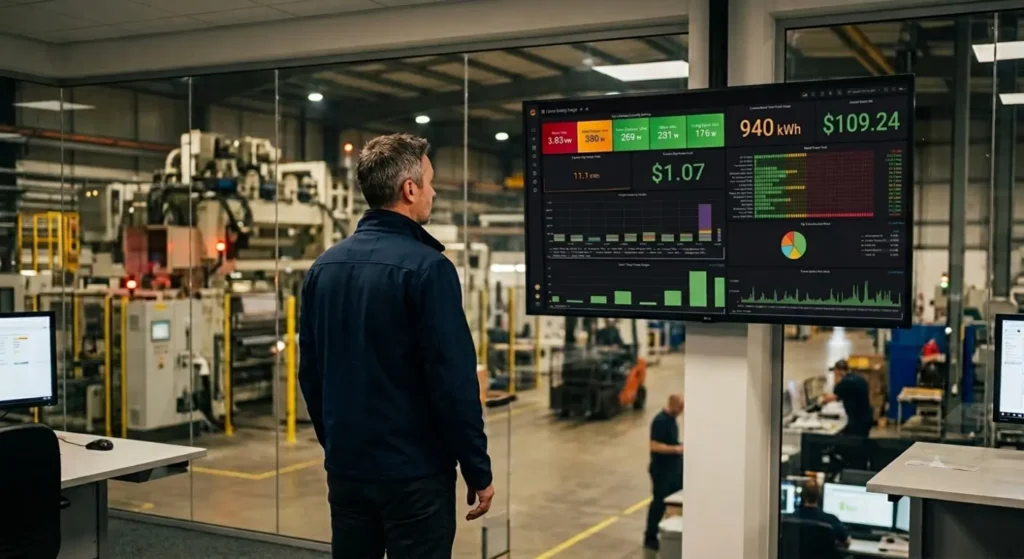
Energy monitoring system vendor comparison: enterprise platforms vs device-first
Now the part you came for. When you search for the best energy monitoring system for industrial use, the top results are dominated by enterprise software platforms: Schneider Electric EcoStruxure, Siemens SIMATIC Energy Manager, ABB Ability, and Honeywell Forge. These are genuinely powerful products. However, they solve a different problem than most Pakistani factories have, so let us be fair about who each one is for.
Enterprise energy platforms are software-first suites built for large, multi-site enterprises with dedicated energy teams. They excel at rolling up dozens of plants, running advanced analytics, and tying energy into corporate sustainability reporting. That power comes at a cost. Licences, per-point fees, integrators, and annual subscriptions push total spend into six figures quickly, and much of your data lives inside the vendor’s ecosystem. For a single mid-sized plant, that is a heavy tool for the job.
SCADA energy add-ons are the next option. If you already run SCADA, bolting an energy module onto it is tempting, and it can work. Yet SCADA add-ons often need custom integration, licensed tags per point, and an engineer who knows the system, which turns a simple energy question into a project. IoT energy monitoring versus a SCADA energy add-on usually comes down to speed: a purpose-built IoT device is measuring within a day, while the add-on route is measuring after a procurement cycle.
Local-market panel meters deserve an honest mention, because this is the option most Pakistani buyers price first. You can buy a digital panel meter or an imported multifunction meter cheaply from the local market, and for a pure kWh reading it works. The limits show up fast, though. Most are display-only, so somebody has to walk the panel and write the number down. Few log history, fewer still alert you, and connecting them to anything usually means adding a separate gateway. So they answer “how many units” but not “when, which machine, and at what power factor,” which are the questions that actually save money. Treat them as meters rather than monitoring, and check whether an imported unit has local support before you commit.
Device-first IoT monitoring is the IoTize approach. Here the sensor is the product, and you own it outright rather than licensing it. You clamp a device onto the panel, it streams over HTTP, MQTT, or Modbus TCP into whatever dashboard you already use, and there is no platform to subscribe to. So you trade the deep multi-site analytics of an enterprise suite for something most factories value more: fast deployment, low cost, open data, and no lock-in.
| Enterprise software platforms | SCADA energy add-on | Local-market panel meters | Device-first IoT (IoTize) | |
|---|---|---|---|---|
| Best for | Large multi-site enterprises | Plants already deep in SCADA | A basic units reading on one panel | Single plants and SMEs, fast wins |
| Typical cost | Six figures, ongoing | Mid, plus integration | Lowest upfront | From $99 to $250, one-time |
| Time to first data | Weeks to months | Weeks | Immediate, but manual | Days |
| Live remote data | Yes | Yes | n/a, display only | Yes |
| Power factor and demand | Yes | Yes | Varies, often not logged | Yes |
| Alerts | Yes | Yes | n/a | Yes |
| Data ownership | Mostly vendor cloud | On your SCADA | Nothing stored | Yours, on-prem or your cloud |
| Lock-in | High | Medium | None | Low, open protocols |
| Retrofit onto old panels | Varies | Varies | Yes | Yes, clamp-on |
That trade is the whole point. The honest positioning is not that device-first beats enterprise software everywhere. It is that a single Pakistani factory rarely needs, and rarely can justify, a six-figure platform to answer questions like “what is my power factor” and “which line wastes the most at peak.” A device you own answers those today.
This same logic settles the best energy monitoring software vs hardware debate. Software is where analysis happens, and it matters. But you cannot analyse data you never captured. So the hardware, the sensor that actually reads the current, is the non-negotiable first purchase. Buy a device that measures well and speaks open protocols, and you can point it at cheap or free software later. Buy into a platform first, and you will still need the sensors, now on the vendor’s terms.
Energy monitoring for small vs large factories
Size changes the right answer, so match the tool to the plant. Large factories and groups with many sites, a full energy team, and sustainability reporting obligations get real value from an enterprise platform’s roll-up analytics. If that is you, the six-figure spend can pay back. Even then, many large plants start device-first on a few problem lines to prove the savings before committing to a platform.
Small and medium factories are the sweet spot for device-first monitoring. An energy monitoring system for SMEs in Pakistan needs to be cheap, fast, and self-contained, because there is no dedicated energy engineer to babysit a platform. So the winning move is to instrument the main incomer plus the two or three heaviest machines, watch power factor and peak demand, and act on what you see. That is a few devices and a dashboard, not a project.
In short, small versus large is less about capability and more about overhead. Big operations can absorb platform overhead. Smaller ones should avoid it and put the money into more measurement points instead.
How much does an energy monitoring system cost in Pakistan?
Cost is where the shortlist gets real, so here is the honest range for 2026. Enterprise software platforms commonly run into six figures once you add licences, per-point fees, integration, and annual subscription, and they are quoted per project. A SCADA energy add-on sits mid-range, plus integration labour and per-tag licensing. Device-first IoT sensors are a one-time device cost instead, low enough that a single machine can be instrumented for the price of a rounding error on your monthly bill.
The reason device-first wins on ROI is simple arithmetic, so let us actually do it. The worked example below uses stated assumptions rather than a vendor promise. Assume a mid-sized plant drawing 100,000 units (kWh) per month, billed near the NEPRA 2026 national average of Rs 33.38 per unit. Swap in your own numbers, because the point is the ratio rather than the exact rupees.
What energy monitoring is worth to a Pakistani factory
Worked on 100,000 units per month at the NEPRA 2026 national average of Rs 33.38 per unit.
Sources: NEPRA 2026 tariff via dawn.com and profit.pakistantoday.com.pk; savings potential via carbontrust.com; power factor penalty range via industry PFI guidance, confirm tiers against your own DISCO schedule. Industry ranges, not a guarantee.
Look at the ratio rather than the rupees. The monitoring hardware needed to instrument a main incomer plus a few heavy machines is a one-time cost that a plant of this size can recover well inside the first billing cycle, because the monthly saving is measured in hundreds of thousands of rupees while the devices are not. Convert the device prices at the current rate before quoting this to anyone.
That is before the bigger levers. Catch a low power factor and correct it, and you strip a penalty that can run 25 to 30 percent of the demand charge. Shift heavy work out of peak hours once you can see the peak-versus-off-peak split, and you save again on time-of-use rates. Neither of those savings is delivered by the device. The device tells you they exist and quantifies them, which is precisely the value of an energy audit that never stops running.
One caution on the arithmetic. The 10 percent figure describes what plants typically achieve by acting on what they find, not what appears automatically once a sensor is fitted. If nobody reviews the data and changes anything, the saving is zero. So budget for the follow-through, not just the hardware. For the practical side of that follow-through, read our complete guide on How to Reduce Energy Consumption in a Factory.

IoTize energy monitoring devices
If you want a device-first shortlist you can act on, IoTize builds energy monitors in two tiers, all speaking HTTP, MQTT, and Modbus TCP so your data stays yours. The affordable single-phase device is the entry point: an affordable IoT energy monitor for factories that reads a single-phase line or a specific machine, logs energy and runtime hours, and streams live data. It is the natural choice for instrumenting one heavy machine, a lighting circuit, or a small line without a big commitment.
For the main incomer, step up to the enterprise sensors. The single-phase enterprise sensor covers critical single-phase feeders with a rugged build, Wi-Fi and Ethernet, and Modbus TCP for direct SCADA and MES integration. The three-phase sensor is the one most factories actually need: three CT clamps deliver true three-phase energy monitoring, per-phase power and power factor, plus demand and phase imbalance, on a DIN-rail energy monitoring sensor built for the factory panel. To see how the full range fits together, read the IoTize Industrial Energy Efficiency Solution.
Smart Energy & Hour Monitoring IoT Device, Single-Phase
The most affordable IoT energy monitor for factories. Reads voltage, current, power, power factor and energy, and tracks runtime and idle hours on one single-phase machine.
View Product →IoT Smart Energy Monitoring Sensor, Single-Phase
The specialist for a critical single-phase feeder. Full electrical monitoring with demand, on a rugged enterprise build with Modbus TCP for direct SCADA and MES integration.
View Product →IoT Smart Energy Monitoring Sensor, Three-Phase
The workhorse for real factories. Three clamps read all phases at once for full three-phase energy monitoring, including per-phase power factor and imbalance. Meter a machine, a feeder, or the main incomer.
View Product →So the practical pattern is simple. Start with the $99 single-phase device on your worst machine to prove the value this week. Then put the three-phase sensor on the main incomer to watch the whole plant, power factor and all. Because everything speaks open protocols, both tiers feed the same dashboard, SCADA, or ERP, and you never hand over ownership of your data.

The bottom line for 2026
The best energy monitoring solution for your factory is the one that gets real data in front of you fastest, keeps that data yours, and costs less than the waste it uncovers. For large multi-site groups, an enterprise platform can justify itself. For the vast majority of Pakistani factories, a device-first approach wins on every axis that matters: cost, speed, openness, and control.
So do not wait for the next FCA surprise or the next power factor penalty to remind you that the bill was never fixed. Start measuring. If you want the deeper technical picture of how the sensors themselves work, read our guide to How IoT Energy Sensors Measure Machine and Plant-Level Energy Use.
Stop paying for electricity you cannot see
Start with one machine. Real-time energy monitoring for Pakistani factories, on devices you own outright, with your data on your own terms.
Frequently asked questions
How much does an energy monitoring system cost in Pakistan?
It ranges widely. Enterprise software platforms often run into six figures once licences, per-point fees, integration, and annual subscriptions are added, and they are quoted per project. Device-first IoT monitors are a one-time cost instead, starting at $99 for the affordable single-phase device and rising through the enterprise single-phase and three-phase sensors. Verify current prices on the store before you buy.
Can energy monitoring reduce electricity bills?
Yes, indirectly but reliably. Monitoring itself does not lower a bill; it shows you where to. The Carbon Trust notes that low-cost and no-cost actions typically cut energy costs by at least 10 percent, and monitoring is how you find those actions. On top of that, spotting a low power factor lets you correct a penalty that can reach 25 to 30 percent of the demand charge, and seeing your peak-versus-off-peak split lets you shift heavy loads to cheaper hours.
Is energy monitoring worth it for small factories?
Very much so. Small and medium factories are the ideal fit for device-first monitoring because it is cheap, fast, and needs no dedicated energy team. Instrument the main incomer and your two or three heaviest machines, and the savings from one corrected power factor or one shifted peak load typically cover the device cost within the first billing cycles.
Which energy meter is best for a factory in Pakistan?
For a factory, you want a monitoring system rather than a plain meter, and for the main incomer that means a three-phase device that also reports power factor and demand. A basic meter only shows total units after the fact. A three-phase IoT energy monitor streams live data, exposes the penalties and peak charges that a meter hides, and feeds your existing dashboard through open protocols.
How does FCA affect industrial electricity bills?
The Fuel Cost Adjustment is a monthly charge that moves with the actual cost of generating power, added on top of your base tariff. It is volatile: in mid-2026, for instance, a fuel adjustment of roughly Rs 2.52 per unit was under review for a single month. Because it lands after consumption, a factory that budgets on the base tariff alone gets surprised every cycle. Real-time monitoring lets you see your true cost per unit as it accrues, not weeks later.
What is the difference between an energy audit and energy monitoring?
An energy audit is a one-time assessment that goes stale the day it ends. Energy monitoring is the continuous version: it runs every day, catches waste an annual audit would miss, and proves whether last month’s fix actually held. Think of monitoring as an audit that never stops.
Do I need a three-phase or a single-phase energy monitoring device?
Match the device to the supply. Your main incomer and most heavy machinery run on three-phase, so that panel needs a three-phase device reading all three phases with per-phase current, voltage, and power factor. Single-phase devices suit smaller loads: one machine, a lighting circuit, or a light production line. Many factories run both, using a three-phase sensor on the incomer and cheaper single-phase units on individual problem machines.
Can I add energy monitoring to old machines without replacing them?
Yes, and this is the usual case in Pakistani plants. Clamp-on current transformers fit around existing conductors in the panel, so the device reads the load without rewiring the machine or modifying it in any way. A DIN-rail unit mounts in the panel you already have. Retrofit monitoring works on legacy and even hand-operated equipment, which means you get visibility without any capital spend on new machinery.
Energy products: Smart Energy and Hour Monitor · Enterprise Single-Phase · Enterprise Three-Phase
Solution: Industrial Energy Efficiency Solutions
Read next: What Is Energy Monitoring? · How to Reduce Energy Consumption in a Factory · How IoT Energy Sensors Measure Energy Use
From the blog: Visit the IoTize blog →