

Technical Reviewer: Zia ur Rehman
15+ years in embedded systems and industrial IoT · Reviewed
Energy is one of the few large costs on a Pakistani factory’s books that you can shrink without slowing a single line. Yet most plants, from the textile mills of Faisalabad to the steel re-rolling units of Karachi and Lahore, treat the power bill as fixed overhead, something that simply arrives each month from K-Electric or the local DISCO. It is not fixed. In fact, a large share of what a typical plant pays for is waste: air hissing out of a leaking fitting, motors running flat out when they could throttle back, lights burning over an empty aisle.
So if you already suspect there is waste on your floor and you are ready to act, this guide is built for you. Below, we walk through every major lever for reducing energy consumption in a factory, each as its own section, so you can start with the cheapest wins and work toward the structural ones. Along the way, we show why real-time visibility, not guesswork, is what separates a one-off saving from lasting energy efficiency in factories across Pakistan and beyond.
Let’s start with where the energy actually goes, because you cannot cut what you have not found.

What Uses the Most Energy in a Factory?
Before you spend a single rupee on efficiency, you need to know your top consumers. Fortunately, the pattern is consistent across most Pakistani and global plants.
Electric motors dominate. According to the International Energy Agency (IEA), electric motor-driven systems account for roughly 70 percent of industrial electricity use, powering pumps, fans, conveyors, and compressors (source). That single fact reshapes your whole strategy: if motors are the elephant, then anything that makes motors run leaner beats almost every other measure.
The rest of the bill usually breaks down like this:
- Compressed air for tools, actuators, and cleaning. The US Department of Energy (DOE) notes that compressed air is one of the most expensive utilities in a plant, since only a small fraction of the electricity input reaches the tool.
- Process heating and cooling, including ovens, dryers, boilers, and chillers, a major consumer in Pakistan’s steel, textile, and ceramics sectors.
- HVAC and cooling, particularly significant in Karachi, Lahore, and Faisalabad where summer temperatures push cooling loads high.
- Lighting, which is smaller than most managers expect but among the easiest to fix.
In short, a handful of systems drive most industrial energy waste. Therefore, your job is not to chase every socket. Instead, you attack the big consumers in order, starting with a proper audit.
Step 1: Run an Energy Audit of Your Manufacturing Plant
An industrial energy audit is simply a structured survey of where energy enters your plant and where it goes. Moreover, it is the highest-return first move you can make, because every later decision depends on the map it produces.
A good energy audit of a manufacturing plant does three things. First, it measures baseline consumption, ideally down to the machine or line, not just the utility meter. Second, it ranks losses by cost, so you fix the expensive problems first. Third, it estimates the payback for each fix, which turns a vague “we should save energy” into a funded project list.
The benefits of an industrial energy audit are practical, not academic. You stop guessing, you get an evidence-based priority list, and you gain a baseline to measure results against. That baseline matters, because energy audit ROI is only provable when you can compare “before” and “after” with real numbers.
Here is the catch, though. A one-day walk-through audit is a snapshot. Consumption changes by shift, by product, and by season, and for Pakistani factories dealing with summer peak tariffs and load-shedding schedules, these swings can be dramatic. That is exactly why continuous, sub-metered monitoring, which we cover later, turns a one-time audit into a living picture.
Fix Compressed Air Leaks
If your plant runs compressed air, start here, because the waste is enormous and the fix is cheap.
The DOE reports that leaks commonly waste 20 to 30 percent of a compressor’s output. Read that again: up to a third of the electricity you spend making compressed air can escape through fittings, couplings, and worn hoses before it ever reaches a tool. Because compressed air is so inefficient to produce, every leak you close pays back quickly. In Pakistan, where industrial tariffs from K-Electric or DISCOs already strain margins, plugging leaks is one of the fastest-paying energy saving tips for manufacturing plants.
Improving compressed air efficiency in manufacturing usually follows a simple sequence:
- Find the leaks. Use an ultrasonic detector, or during a quiet shift, listen for the hiss.
- Tag and repair couplings, regulators, condensate traps, and shut-off valves, which are the usual culprits.
- Lower the pressure. Many systems run higher than any tool needs, and every extra unit of pressure costs energy.
- Turn it off when a line is idle, rather than leaving compressors loaded around the clock.
Above all, compressed air waste is invisible until you measure it. Monitoring the compressor’s current draw shows you the difference between a healthy system and one bleeding air, which is why energy monitoring belongs on the compressor room too.
Add Variable Frequency Drives (VFDs) to Cut Motor Energy
A huge amount of motor energy is wasted by machines running at full speed when the job needs less. Pumps and fans are the classic offenders, because they are often controlled by throttling a valve or damper while the motor keeps spinning at 100 percent.
A variable frequency drive, or VFD, fixes this by matching motor speed to actual demand. On pumps and fans especially, the savings compound, since the power a fan or pump draws falls sharply as you reduce its speed. As a result, variable frequency drive energy savings on high-runtime, variable-load motors are among the most reliable wins in any plant.
The IEA estimates that the efficiency of industrial motor systems can be improved cost-effectively by 20 to 30 percent using existing technology, and variable speed drives are a central part of that opportunity. VFD energy savings in industrial settings are largest where three conditions overlap: long running hours, a variable load, and a motor that currently runs wide open.
The honest caveat is targeting. A VFD on a constant-load motor that runs at full speed all day saves little. Consequently, you want to identify the right candidates first, and the only way to do that confidently is to measure each motor’s real load profile over time. For Pakistani factories running 16 to 24 hour shifts, this targeting step is especially important, because a well-placed VFD on a high-runtime pump can pay back within a single year at current tariff rates.
Upgrade to High-Efficiency IE3 and IE4 Motors
When a motor reaches the end of its life, replacing it with a premium-efficiency unit is one of the simplest structural upgrades available. Modern efficiency classes, commonly labelled IE3 (premium) and IE4 (super-premium), waste less energy as heat than the older IE1 and IE2 motors many legacy plants in Pakistan still run.
Because motors are such a large slice of the bill, even a few percentage points of efficiency, multiplied across every running hour, add up over the motor’s life. Therefore, motor efficiency in manufacturing is a long game worth playing on every rewind-or-replace decision.
An IE3 or IE4 motor upgrade makes the most sense in two moments. First, when a motor fails and you are replacing it anyway, since the incremental cost of the efficient model is small. Second, on high-runtime motors, where the extra efficiency runs up real savings quickly. To rank your fleet, you again need load and runtime data, which points back to monitoring.
Switch to LED Lighting for Fast Factory Energy Savings
Lighting is rarely the biggest consumer, but it is often the easiest to cut, which makes it a great early confidence-builder.
Older factories across Pakistan still run fluorescent tubes and high-intensity discharge (HID) high-bay lamps that are dim, hot, and hungry. Switching to LED changes all three. According to the US Department of Energy’s Better Buildings lighting work, replacing inefficient fixtures with LEDs can cut lighting energy by up to 60 percent on a one-for-one basis, and up to 75 percent when paired with controls.
Those controls are the underrated part. Adding occupancy sensors and daylight dimming means aisles, warehouses, and break areas light up only when someone is there. As a result, LED lighting factory energy savings come from two places at once: better lamps and smarter switching.
Best of all, LED retrofits usually pay back fast and improve visibility on the floor, which is a safety win on top of the energy win.
Optimize HVAC and Space Conditioning
Heating, ventilation, and air conditioning quietly consume a lot of power, especially in Pakistani plants where summer temperatures in Karachi, Lahore, and Faisalabad push cooling loads high for months. HVAC optimization in manufacturing rarely requires new equipment. Instead, it rewards better control.
Practical moves include the following:
- Right-size setpoints and stop conditioning space that does not need it, such as unmanned storage.
- Seal the envelope, since open doors and gaps force your system to fight the weather.
- Schedule heating and cooling to occupancy and shift patterns rather than running constantly.
- Recover and reuse warm exhaust air where it is safe to do so.
Because HVAC load swings with weather and occupancy, it is another system where continuous data beats a fixed schedule. Monitoring reveals when the system is working hard for no reason.
Recover Waste Heat
Every furnace, oven, compressor, and boiler throws off heat that usually vanishes up a stack or out a vent. Waste heat recovery in industry captures some of that energy and puts it back to work, for example by preheating boiler feed water, warming incoming process air, or heating the building.
The logic is simple. You have already paid to generate that heat, so recovering even part of it is pure upside. While the engineering varies by process, the principle holds across plants: a stream of hot exhaust is a stream of paid-for energy you are currently throwing away.
Waste heat projects are more involved than a lighting swap, so they belong later in your roadmap. Still, on heat-intensive processes common in Pakistan’s steel, ceramics, and glass sectors, they can be among the largest single savings available.
Correct Your Power Factor
This lever is invisible on the floor but very visible on the invoice. Power factor measures how effectively your plant turns supplied power into useful work. Inductive loads, chiefly motors and transformers, drag it down, which forces the grid to deliver more apparent power than you actually use.
In Pakistan, utilities such as K-Electric and the DISCOs penalize a low power factor with surcharges on the electricity bill. Consequently, power factor correction in a factory, typically by adding capacitor banks, can remove those penalties and reduce the current your system draws. In effect, you pay for cleaner power delivery rather than for waste.
The prerequisite, once more, is measurement. You need to see your power factor before you can decide whether correction is worth the investment, and metering at the panel is what surfaces the number.
Shift Load Off-Peak and Cut Demand Charges
Here is a saving that does not require using less energy at all, only using it at smarter times.
Many industrial tariffs, including Pakistan’s NEPRA-regulated time-of-use structures, include a demand charge, billed on your single highest peak of power draw during the period, plus higher rates during peak hours. Off-peak energy usage in manufacturing exploits this by moving flexible, energy-hungry tasks, such as certain batch processes or charging, to cheaper night or off-peak windows.
Demand response in manufacturing goes a step further. By trimming or shifting load during grid peak events, sometimes in coordination with the utility, you avoid setting an expensive new peak. Effective demand charge management in industrial plants therefore depends on one thing above all: interval data that shows exactly when your peaks occur. Without that visibility, you are shifting load blind.
Tie Energy to Process and Maintenance
Energy efficiency is not only an electrical problem. Often, it is a process and maintenance problem wearing an electrical disguise.
Lean manufacturing and energy efficiency pull in the same direction. When you cut scrap, rework, and idle running, you cut the energy embedded in all of it. Similarly, process optimization for energy reduction means running lines at their most efficient speed and load, not their fastest, and switching machines off between jobs instead of leaving them warm.
Maintenance matters just as much. A worn bearing, a misaligned shaft, or a fouled heat exchanger all force a machine to draw more current for the same output. This is where predictive maintenance and energy savings meet: a motor whose vibration and current are trending upward is often a motor quietly wasting energy. Catching that early protects both uptime and the power bill. IoTize machine-health devices measure vibration, temperature, and current together for exactly this reason, which ties condition monitoring directly to energy performance. View the Affordable Machine Health Monitor →
Add Real-Time Energy Monitoring to Your Factory
Every lever above shares one dependency. You cannot audit, target VFDs, rank motors, size power-factor correction, or manage demand charges without data. This is the lever that unlocks all the others.
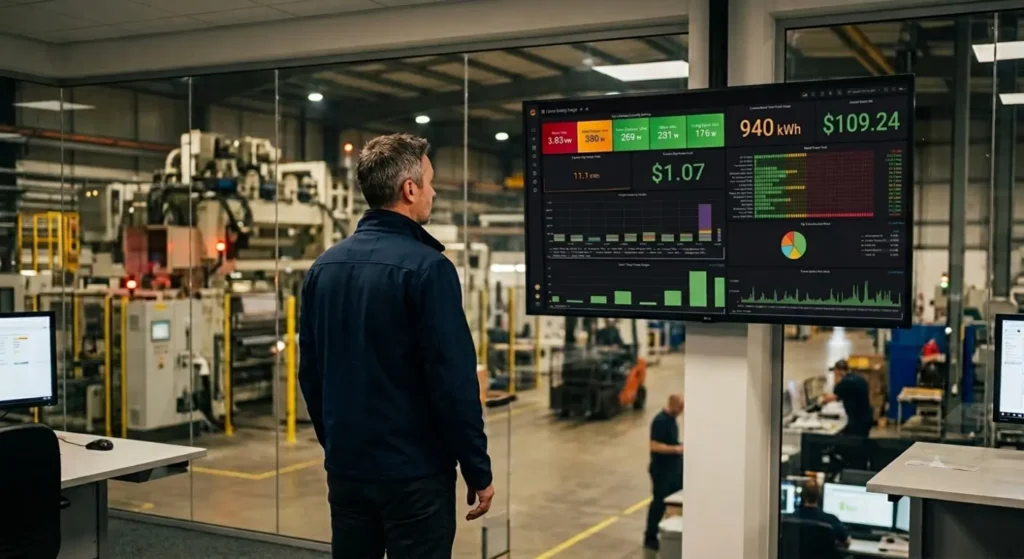
Real-time energy monitoring in a factory means placing sensors on circuits and machines so you see consumption continuously, not once a month on a bill. Instead of a single plant total, you get sub-metering: energy broken down by line, by machine, by shift. Suddenly the invisible becomes obvious. You can see the compressor that never turns off, the oven left on overnight, the motor drawing more than its neighbours.
IoT energy monitoring in manufacturing makes this affordable and retrofittable. Modern sensors clamp onto existing wiring and stream data over standard protocols, so you gain visibility without rewiring the plant or replacing machines. Because the devices are non-invasive, you can add them to old and new equipment alike, which is the whole point of a retrofit energy monitoring approach. For Pakistani factories running legacy machinery from the 1980s or 1990s, this is often the most practical path to visibility.
Crucially, monitoring is where a project stops being a one-time saving and becomes a habit. A fix you cannot see decays. A fix you monitor stays fixed, because the dashboard tells you the moment consumption drifts back up. To understand exactly how these sensors capture energy use at both the machine and plant level, read our next guide: How IoT Energy Sensors Measure Machine and Plant-Level Energy Use →

Wrap It in an Energy Management System
Individual fixes save money. A system keeps it saved. An energy management system (EMS) for a factory is the framework that turns scattered projects into continuous improvement.
At its simplest, EMS in manufacturing means collecting your metering data in one place, setting targets, tracking performance against them, and acting when you drift. The international standard for this discipline is ISO 50001 energy management, which gives plants a formal, auditable structure for setting an energy baseline, defining performance indicators, and improving year over year. A growing number of Pakistani exporters are pursuing ISO 50001 as part of compliance requirements from international buyers.
Two habits make an EMS work. First, energy benchmarking in manufacturing, meaning you compare energy per unit of output across lines, shifts, and sites, so good and bad performers stand out. Second, review, meaning someone owns the numbers and acts on them. Neither habit is possible without the real-time data from the previous section, which is why monitoring and management belong together.
Consider On-Site Renewables
Once you have cut demand, it is cheaper to supply what remains. On-site renewable energy in manufacturing, most commonly solar panels on a factory roof, can offset a meaningful share of daytime load, particularly for plants that run during daylight hours. In Pakistan, where solar irradiance is among the highest globally and net-metering policies continue to evolve, rooftop solar has become a popular option for industrial facilities.
The sequence matters here, though. Efficiency comes first, generation second. Sizing a solar array to an inflated, wasteful load means paying to generate power you should not be using in the first place. So reduce consumption with the levers above, then size renewables to the leaner baseline that remains.
To be clear about our own role: IoTize does not sell solar panels, capacitor banks, or VFDs. We provide the measurement layer that tells you whether any of these investments are justified and whether they are working after you install them.
The IoTize Energy Monitoring Devices
Because visibility underpins every lever in this guide, real-time energy monitoring is the part IoTize equips directly. Our energy sensors retrofit onto your existing wiring, stream data over HTTP, MQTT, and Modbus TCP, and feed the dashboards, SCADA, or MES you already use. In other words, they give you the per-machine and per-line numbers that make every other decision on this page provable.
Smart Energy & Hour Monitoring IoT Device | Single-Phase
Budget-friendly entry point for single-phase machines. Bring energy and runtime visibility to a legacy factory for under $100.
View Product →IoT Smart Energy Monitoring Sensor | Single-Phase
Enterprise-grade single-phase sensor for continuous monitoring and tighter integration via HTTP, MQTT, and Modbus TCP.
View Product →IoT Smart Energy Monitoring Sensor | Three-Phase
Built for three-phase loads using three CT clamps. Ideal for main feeds, large motors, and line-level sub-metering across the plant.
View Product →All three are non-invasive and retrofit-friendly, so you add them to old or new equipment without rewiring. Together, they turn “we think we have waste” into “here is exactly where it is, and here is how much we cut.” For the complete monitoring approach, from a single machine to the whole plant, see our Energy Efficiency solution page →
How Much Can a Factory Save on Energy?
Sources: IEA Electric Motor Systems (iea-4e.org/emsa), US DOE Compressed Air Tip Sheet, US DOE Better Buildings Lighting Campaign. Industry ranges, not a guarantee.
Energy efficiency ROI in manufacturing usually stacks in this order. The cheapest, fastest paybacks come from finding and fixing compressed air leaks, LED retrofits, and switching off idle equipment. Medium-term returns come from VFDs on the right motors, HVAC controls, and power factor correction. The longer, structural projects, such as waste heat recovery and on-site renewables, deliver larger absolute savings over more years.
What ties every one of these to real, bankable ROI is the same thing: measurement before and after. When you ask “how much can a factory save on energy,” the truthful reply is that you can only prove the answer once you can see the meter. That is why monitoring is not one lever among many. It is the lever that makes all the others count.
Your Practical Energy Reduction Plan for 2026
You do not have to do everything at once. In fact, you should not. Work in this order:
- See it. Install real-time energy monitoring and sub-meter your biggest loads, so you have a live baseline instead of a monthly guess.
- Audit it. Use that data to run or refine an energy audit and rank losses by cost.
- Grab the cheap wins. Fix compressed air leaks, retrofit LED lighting, and switch off idle machines.
- Fund the medium projects. Add VFDs to the right motors, tighten HVAC control, and correct power factor.
- Systematize. Wrap it all in an energy management system so the savings stick and keep improving.
Notice that step one is visibility, and it stays with you through every other step. Reducing energy consumption in a factory is not a single heroic project. Rather, it is a disciplined loop of measure, fix, and verify, running continuously.
Ready to See Where Your Energy Really Goes?
Start with IoTize energy sensors on your biggest loads. See per-machine kWh in real time, target the levers that matter, and prove every saving.
Frequently Asked Questions
How can a factory reduce energy consumption?
A factory reduces energy consumption by attacking its biggest loads in order: fixing compressed air leaks, adding variable frequency drives to variable-load motors, upgrading to high-efficiency motors and LED lighting, optimizing HVAC, correcting power factor, shifting load off-peak, and, underpinning all of it, monitoring energy in real time so every fix is targeted and verified.
What uses the most energy in a factory?
Electric motors are almost always the largest consumer. The IEA estimates motor-driven systems account for roughly 70 percent of industrial electricity use, covering pumps, fans, conveyors, and compressors. Process heating, HVAC, and lighting make up most of the rest.
How much energy do compressed air leaks waste?
According to the US Department of Energy, leaks commonly waste 20 to 30 percent of a compressor’s output. Because compressed air is expensive to produce, finding and repairing leaks is one of the fastest-paying energy fixes in any plant.
How do variable frequency drives save energy?
A VFD matches a motor’s speed to actual demand instead of running it flat out. On pumps and fans, the power drawn falls sharply as speed drops, so VFDs deliver large savings on high-runtime, variable-load motors. They save little on constant, full-load motors, which is why targeting matters.
What is an industrial energy audit?
An industrial energy audit is a structured survey of where energy enters a plant and where it is lost. It establishes a baseline, ranks losses by cost, and estimates the payback of each fix, turning a vague goal into a funded, prioritized project list.
How does IoT reduce energy costs in manufacturing?
IoT energy sensors clamp onto existing wiring and stream consumption data continuously, giving per-machine and per-line visibility. That visibility lets you find waste, target investments like VFDs, manage demand charges, and confirm that each fix keeps working, which is how monitoring turns one-time savings into lasting reductions.
How can I reduce peak demand charges in manufacturing?
Demand charges are billed on your highest peak of power draw, so you reduce them by shifting flexible loads to off-peak windows and trimming load during grid peaks. Doing this reliably requires interval energy data that shows exactly when your peaks occur.
What is a VFD payback period?
It varies with the motor’s running hours, load profile, and electricity tariff. Payback is shortest on high-runtime pumps and fans with variable load, and much longer on constant, full-load motors. Measuring each motor’s real load profile first is the only way to know which VFDs will pay back quickly.
Products: Affordable Energy Monitor $99 · Enterprise Single-Phase · Enterprise Three-Phase
Read next: How IoT Energy Sensors Measure Machine and Plant-Level Energy Use
From the blog: Visit the IoTize blog →