

Technical Reviewer: Zia ur Rehman
15+ years in embedded systems and industrial IoT · Reviewed
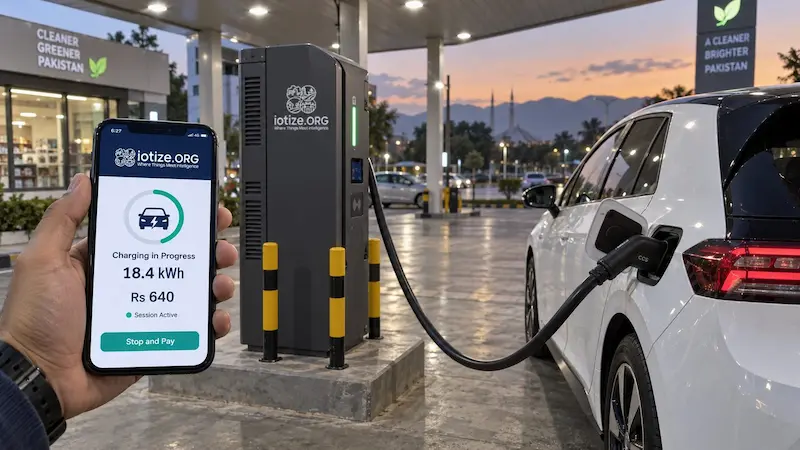
A working charger is only half a charging business. EV charging payment integration turns metered energy into a bill, takes payment through a gateway, and records where the money settles. In Pakistan, operators also need payment options drivers recognize, including Easypaisa and JazzCash.
This guide follows a session from plug-in to payout. It explains charge detail records, tariff models, local wallets and settlement. For the wider system, see the white-label charging platform.
In short: A driver starts a session, the charger reports meter readings, the platform closes a charge detail record, applies your tariff and sends the amount to a payment gateway. The gateway collects payment, and funds settle under your merchant arrangement. On the IoTize model, the operator uses its own gateway account.
What does EV charging payment integration mean?
EV charging payment integration links the charger, charging platform and payment gateway. The charger measures usage. The platform records the session and applies your tariff. Then the gateway handles the payment and settlement.
A charge detail record (CDR) is the platform’s billing record for a completed session. OCPP carries messages between charger and platform; a CDR uses those events and meter readings for billing. In roaming networks, OCPI defines a way to exchange CDRs between parties.
How does a charging session become a billable transaction?
A billable session follows six steps. In practice, operators need both an accurate meter record and a matching payment reference to reconcile each charge.
The charger reports usage; the platform does the billing. It creates the CDR, applies the tariff and passes the amount to the gateway. Then the operator matches the receipt, CDR and settled payment.
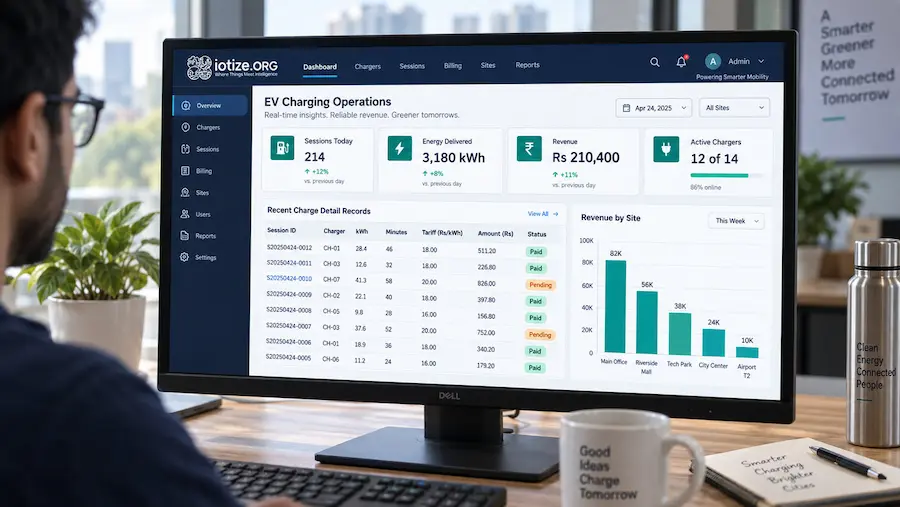
For example, the CDR can include energy, duration, timestamps, connector and customer reference. This record supports receipts and dispute handling. It also helps an operator calculate any agreed site-host share.
What tariff models can you bill on?
Your tariff is the formula the platform applies to the session. Choose a model that fits your site, charger and commercial agreement.
| Tariff model | Calculation | Typical use |
|---|---|---|
| Per kWh | Energy delivered × unit rate | Energy-based billing |
| Per minute | Connected time × minute rate | Time-based pricing |
| Flat session fee | Fixed amount for each session | Simple top-ups |
| Membership | Account fee or discounted rate | Regular users and fleets |
| Idle fee | Time after charging ends | Busy bays |
| Time of use | Rates by time period | Peak and off-peak pricing |
Electricity input cost and the driver’s retail price are different numbers. The tariff engine sets the amount you charge for a session; it does not determine what the utility bills you. Review the applicable tariff and permissions for your site before setting a retail rate.
For example, a per-kWh tariff multiplies delivered energy by the configured rate. Additional session or idle fees require clear driver-facing disclosure so the receipt makes sense.
How do Easypaisa and JazzCash work for charging?
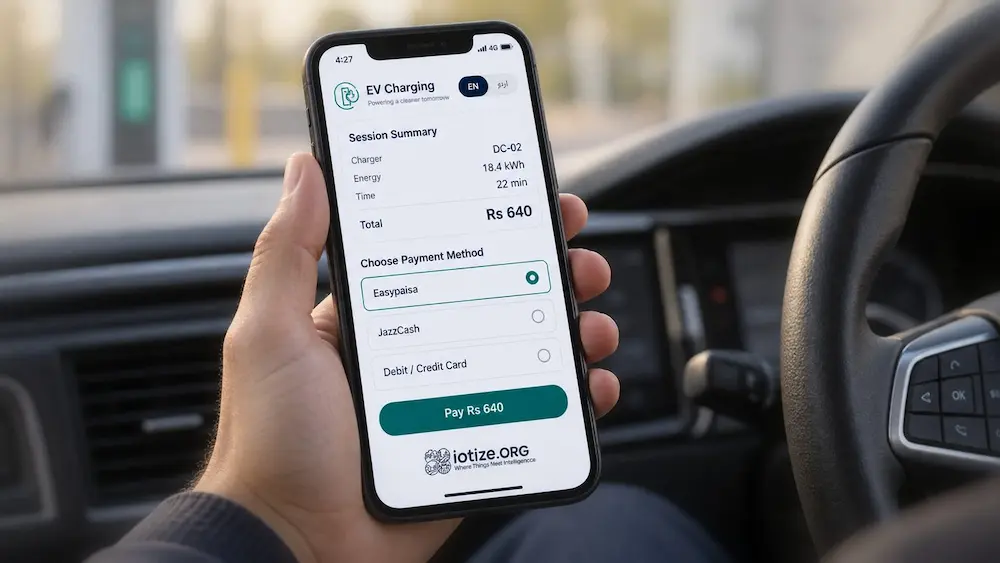
For a wallet payment, the charging platform sends the calculated amount to a payment gateway. The gateway handles authorization and returns a result that the platform associates with the session. The exact capture and failure flow depends on the chosen gateway and configuration.
According to the State Bank’s FY25 payments release, digital channels accounted for 88% of retail transactions, while accounts and wallets represented 93% of online transactions. These are national payment figures, not EV charging market shares. They explain why local payment options deserve attention.
IoTize describes support for Easypaisa and JazzCash on its white-label solution page. Confirm the merchant gateway, enabled methods and settlement setup during onboarding.
Where does the money go?
Under IoTize’s stated model, charging revenue settles through your payment gateway account into your business account. IoTize says it does not hold operator funds. The gateway and merchant agreement determine settlement timing and fees.
At a multi-site network, operators can show hosts their own sessions and agreed revenue share through limited access. Then the operator reconciles gateway settlements against CDRs and settles with hosts under its own agreement. See the platform and deployment options.
What does the driver see?
A driver needs to find an available charger, start a session, see its progress, choose a payment method and receive a clear receipt. The IoTize branded driver app is described for iOS, Android and web, with Urdu and English support.
Meanwhile, the operator dashboard shows sessions, tariffs and revenue. Clear session IDs across the app, billing record and gateway make payment questions easier to resolve.
What do you need before taking payments?
Before taking payments, line up these five pieces:
- A merchant gateway account: Set it up in the operator’s business name and enable the payment methods you plan to offer.
- Compatible chargers: Confirm OCPP version, metering and network connection for each model.
- A published tariff: Decide how to calculate and display charges before a driver starts.
- A charging platform: Connect authentication, charger events, CDRs, app and gateway.
- A reconciliation routine: Match session records, payment status, settlement and any host share.
Once those steps work, the next decision is software cost. The next article, What EV Charging Software Costs: The Factors That Set Your Price, will cover what affects the quote.
What does the IoTize platform handle?
IoTize presents a white-label platform for operators who want their own app, charger monitoring, tariffs and local payment gateway integration. Its EV charging software solution describes OCPP 1.6 and 2.0.1 support, AC and DC chargers, operator and host views, and deployment options.
- Keep your brand: Use branded driver and operator views.
- Set your tariffs: Price sessions using the models offered for your deployment.
- Use local payments: Connect available wallet, card and account methods through the selected gateway.
- Review the records: Track sessions, CDRs and revenue from the operator dashboard.
- Plan your deployment: Discuss managed cloud, private cloud or on-premises options.
The solution page describes per-charger monthly licensing plus a one-time setup fee, with a quote based on the network. Share your charger models and sites when you contact the IoTize team.
Ready to Map Payments for Your Charging Sites?
Bring your charger models, sites and preferred payment gateway. We can scope the software and integration together.
Frequently asked questions
What if a payment fails after the charging session?
The platform should retain the completed charging record and mark payment status separately. The available retry or recovery method depends on the gateway and the operator’s configured flow.
What is a charge detail record?
A CDR is the billing record for a completed charge. It brings together session identifiers, meter values, timing and the amount calculated by the platform.
Is a CDR the same as an OCPP transaction?
No. OCPP carries charger events and meter readings to the platform. The platform uses them to prepare a billing record; roaming networks can exchange CDR data through OCPI.
Can I charge per kWh in Pakistan?
A charging platform can calculate a per-kWh price from metered energy. Check the rules, meter requirements and tariff that apply to your site before offering a specific retail billing model.
What is the difference between an electricity tariff and a charging tariff?
Your electricity tariff is an input cost billed by the utility. Your charging tariff is the price you present to the driver and calculate for each session.
Do drivers need to register to pay?
That depends on the app and gateway flow you deploy. Discuss guest payments and account-based charging during onboarding so the checkout fits your customers.
Do I need my own payment gateway account?
For the IoTize settlement model described here, yes. Your gateway account handles collection and settlement into your business account.
Solution: White-label EV charging software
Read next: What EV Charging Software Costs: The Factors That Set Your Price
From the blog: Visit the IoTize blog →