

Technical Reviewer: Zia ur Rehman
15+ years in embedded systems and industrial IoT · Reviewed
At the end of a shift, your production total may exist in three places: a machine display, a supervisor’s clipboard, and a spreadsheet in the office. If those numbers disagree, which one determines the next shift’s target? Production monitoring for Pakistani factories starts by capturing a signal from the machine and agreeing on what that signal means.
For a Karachi packaging line, a Faisalabad textile machine, or a small fabrication workshop, the first goal is usually practical: know how many units were made, when the machine was running, and when it stopped. A useful production tracking system in Pakistan should answer those questions before it promises a sophisticated plant-wide OEE score.
Short answer: Production monitoring records machine output, runtime and stoppages so a factory can compare actual production with its shift plan. Start with one machine and validate what each pulse counts. A basic counter suits repeatable motion; encoder-based counting helps when direction and resolution matter. Full overall equipment effectiveness (OEE) also needs quality data.
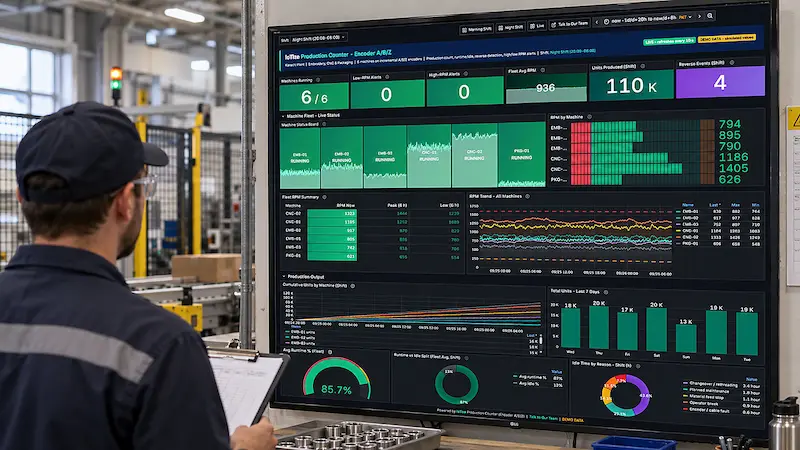
What a useful production monitoring system must capture
Factory output monitoring is more than a number climbing on a screen. Before buying hardware, write down the five fields your supervisor actually needs:
- A defined unit: one finished piece, one machine cycle, one length increment, or one completed batch? A shaft revolution does not automatically equal a sellable unit.
- A reliable count point: a sensor at the finished-product exit, a repeatable machine motion, or an existing encoder. Count at the place least likely to double count rework or empty cycles.
- Planned time and shift boundaries: distinguish a scheduled break from an unplanned stop. Include the shift name and the clock used for handover.
- Runtime and idle time: agree on the motion threshold and how long a pause must last before it becomes an idle event. Motion-derived runtime can include setup, jogging and empty cycles; it does not automatically mean productive time.
- Quality and reasons where needed: a machine counter alone does not know which pieces passed inspection or why an operator stopped the line. Add first-pass good/reject data and an agreed reason-entry process where needed.
Therefore, compare a proposed dashboard against actual production records, not an attractive demo screen. The IoTize production monitoring solution is built around machine motion, runtime, idle time and output, with options to bring the readings into a dashboard or an existing system. The suitability of each signal and integration should be checked on your particular machine before a quote is finalized.
From clipboard totals to a trustworthy shift handover
A clipboard is useful for context. Operators can record a thread break, a material shortage, or a product changeover that a basic motion sensor cannot identify. However, a paper total entered at shift end cannot show precisely when output slowed or which short stops accumulated.
Consider an illustrative eight-hour shift on a packing machine. The operator reports 1,000 cartons. The counter sees 1,060 exit events. That difference is not proof that the operator was wrong: some events could be test runs, damaged cartons, or double triggers. Investigate the count point, confirm the definition of a carton, and reconcile samples by hour. A dashboard becomes useful when the team trusts the count and knows its exceptions.
At handover, use a simple view: shift target, total events, confirmed good units if available, runtime, idle intervals, and a short list of manually assigned stop reasons. That gives the incoming supervisor a concrete starting point. NIST’s manufacturing performance work likewise emphasizes defining and collecting operational data so performance measures have a useful frame of reference.

Can you monitor an old machine without replacing its controls?
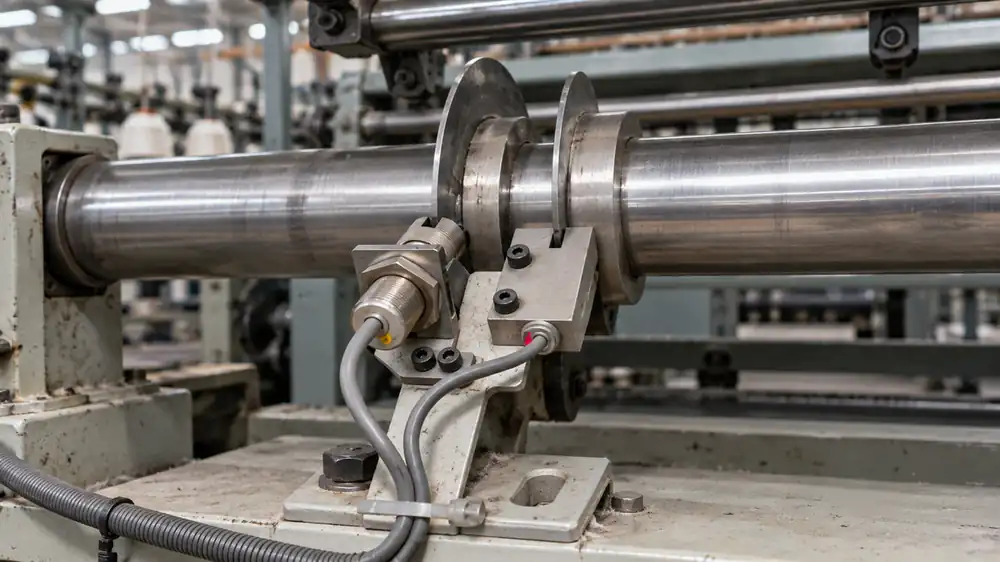
Often, yes. For a legacy machine retrofit, first identify a repeatable physical event. An inductive proximity sensor can count a suitable metal flag or tooth as it passes the sensing face. A Hall sensor can count a compatible magnetic target. Each needs a distinct change at the sensing point; a painted mark on a uniform shaft is not enough. OMRON’s proximity sensor guide explains the different sensing principles.
For cartons or other non-metal products, a photoelectric sensor may provide a better finished-item count. However, that does not establish compatibility with an IoTize counter. Check the sensor’s output type, voltage, pulse duration and maximum rate against the selected counter input.
An incremental encoder is another option. A and B provide direction information; Z is usually a once-per-revolution reference. The effective resolution depends on the encoder’s pulses per revolution and the counter’s decoding mode. Encoder Products Company’s signal guide explains these distinctions.
Next, validate the conversion. If a shaft gives ten pulses per product, program and test that relationship across normal speed, slow speed, stoppages, and changeovers. If reverse motion occurs, a single-channel counter may count events in both directions. A/B direction data can help, but the process determines whether reverse motion subtracts progress or represents rework. Do not subtract finished products automatically or infer good units solely from revolutions per minute (RPM).
Finally, check the installation with the machine technician: sensor clearance, guard integrity, electrical noise, power and network reach. Before sharing an existing encoder signal, check its voltage, output type, receiver loading, maximum frequency and any need for buffering or isolation. Do not simply parallel wires into the controller. A retrofit should leave the machine’s safety system and controls intact. The production monitoring solution page explains the sensing and counting approach in more detail.
Which IoTize counter fits your factory?
The two counters solve different measurement problems. The product pages describe these capabilities; confirm final hardware configuration, installation scope, availability and delivery terms directly with IoTize for your proposed pilot.
| IoT Production Counter Device | Enterprise IoT Production Counter Device | |
|---|---|---|
| Best starting point | A single machine with a repeatable shaft or motion signal | A machine with an incremental encoder or a need to distinguish forward and reverse motion |
| Input on the product page | Hall or proximity | Encoder A/B/Z |
| Core observations | Count derived from configured motion, runtime, idle time, RPM alerts | Higher-resolution count, runtime, idle time, reverse detection, RPM alerts |
| Listed connectivity | HTTP and MQTT | HTTP, MQTT and Modbus TCP |
| Commercial next step | Listed at $80 on the current store page; confirm the complete installed cost and availability | Request a scoped quote for the encoder, installation and integration; the product page shows a starting price, which is not a complete project quote |
Choose the affordable counter if a simple motion input can be calibrated to useful output and the pilot only needs a modest first step. Ask about the Enterprise counter if direction, encoder resolution, or the listed Modbus TCP path matters. In either case, specify whether the counter should report cycles, estimated units, or independently verified good units.
For broader visibility, you can assess the same machine from other angles. Predictive maintenance addresses condition signals such as vibration and temperature, while industrial energy monitoring addresses electrical use. Neither replaces an actual output count.
IoT Production Counter Device
Hall or proximity input for repeatable motion. Define units and confirm the installed scope.
View Product →Enterprise IoT Production Counter Device
Encoder A/B/Z, direction detection and listed Modbus TCP support. Confirm configuration and integration.
View Product →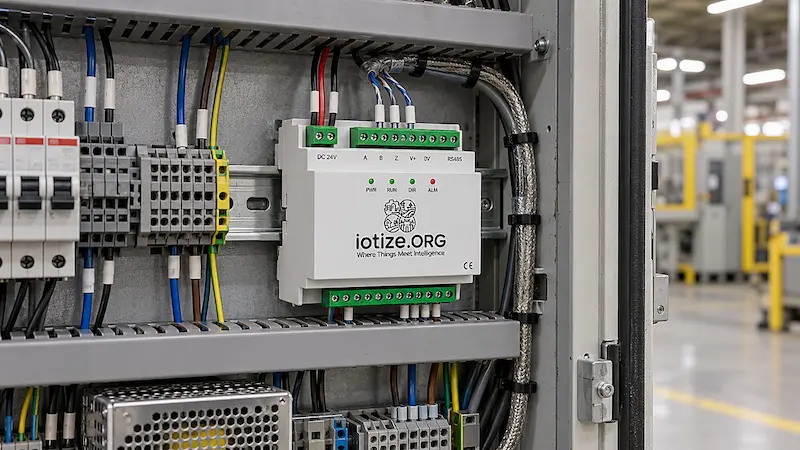
What should a one-machine pilot and quote include?
The production monitoring cost in Pakistan is more than a device price. An honest quote states what must be sensed, fitted, connected, tested and supported. Ask IoTize for a one-machine proposal with:
- A written counting definition: the product, event, pulses-per-unit rule, and how rejects or rework are handled.
- A site survey: sensor or encoder source, safe mounting location, power, network, panel space and machine access window.
- The exact scope: counter model, any additional sensor or encoder, mounting, cabling, installation, dashboard setup and integration.
- Data and ownership terms: where readings go, how long history remains available, who can export it, and what happens during a network outage.
- Acceptance test: manual sample counts at several speeds, shift rollover, stops and restarts, and reverse cycles where relevant.
- Commercial terms: currency and exchange basis, taxes, delivery, warranty, support, recurring charges and payment milestones.
For example, run a pilot across several representative shifts, including a changeover, and compare its hourly output against a witnessed tally. Agree in advance what discrepancy is acceptable for your process and how to correct it. Then decide whether to add more machines.
For a Pakistani factory, also put billing currency, any PKR conversion basis, taxes, delivery location and on-site support scope in writing. Test Wi-Fi at the actual machine if the selected configuration uses it. Include a controlled network-disconnection and power-restart test: confirm count retention, timestamps, resynchronization and any unrecorded intervals. These are acceptance requirements, not promises about a specific model.
To assess value, compare the full installed and recurring cost with a measurable loss you can act on, such as time spent reconciling shift totals or repeat stoppages at a bottleneck. Avoid treating all idle minutes as recoverable production or multiplying them by sales revenue. Use realistic incremental good output and contribution margin, and label any estimate as a forecast.
Make the first count useful, then scale
The purchase decision is simple when the measurement question is precise. Pick one bottleneck machine, define a finished unit, test the signal, and give the shift supervisor a dashboard that can be checked against reality. That is a credible path from clipboard counting to shop floor monitoring in Pakistan.
Request a one-machine production monitoring quote. Send your machine make/model, the output you want to count, normal operating speed, available sensor or encoder details, factory location, and a photo of the proposed sensing point. Ask for a scope covering hardware, installation, dashboard access, acceptance testing and support.
For a repeatable motion signal, review the affordable production counter. For encoder direction or finer resolution, review the Enterprise production counter and use its Add To Quote option. IoTize should confirm fit, availability and delivery terms before you commit.
Start with one machine and a count you can trust
Send your machine model, output definition, speed, factory location and sensing-point photo. Ask for hardware, installation, dashboard and acceptance testing in one scope.
Frequently asked questions
What is the difference between production monitoring and production tracking?
Both terms cover visibility into factory output. In this article, monitoring emphasizes live machine data such as count, runtime and idle intervals; tracking also includes assigning that data to shifts, orders or batches. Define the fields you need before comparing products.
Can a production counter measure good units automatically?
Only if the count comes after a valid quality decision or a separate quality result is connected. A shaft pulse or machine cycle alone cannot identify a rejected product. For OEE, use first-pass good units, not reworked pieces silently reclassified as first-pass success.
Can I calculate OEE from a production counter?
Yes, as part of a complete measurement setup. OEE = Availability × Performance × Quality. Define planned production time, stop rules, ideal cycle time and total output, then supply first-pass good or reject counts for quality. Vorne’s OEE calculation guide explains these inputs.
A separate counter at a reject chute can supply reject events if each rejected item passes once and both counters cover the same production population. Account for inspection delays and rework. This is a possible system design, not a claim that the two IoTize devices automatically calculate OEE together.
Can an old machine be monitored without changing its PLC?
Often, yes. A separate sensor may read a repeatable motion without changing the programmable logic controller (PLC). An existing encoder may also be usable after electrical and mechanical checks. Confirm the target, input compatibility and counting rule on the actual machine.
What happens when the internet goes down?
Ask for the specific device and deployment design: local operation, buffering, reconnection behavior and data retention should appear in the pilot scope. Do not assume that a disconnected dashboard continues to show live data.
How much does production monitoring cost in Pakistan?
IoTize’s affordable production counter is listed at $80 for the device, checked on 1 October 2026. That is not a complete installed-system price. Sensors, installation, dashboard access, taxes and support can change the total. Request an itemized quote for your machine and factory location.
When should I choose the Enterprise counter?
Choose it for evaluation when an A/B/Z encoder, higher-resolution motion measurement, direction detection or the listed Modbus TCP interface is relevant. Ask IoTize to confirm the proposed encoder connection and how raw pulses become your actual product count.
How do we start without disrupting production?
Choose one machine, schedule a safe installation window, document a manual baseline and test counts through normal runs, stops and changeovers. Scale after the team accepts the numbers.
Products: Affordable counter · Enterprise counter
Solutions: Production monitoring · Predictive maintenance · Energy monitoring
From the blog: Visit the IoTize blog →