

Technical Reviewer: Zia ur Rehman
15+ years in embedded systems and industrial IoT · Reviewed
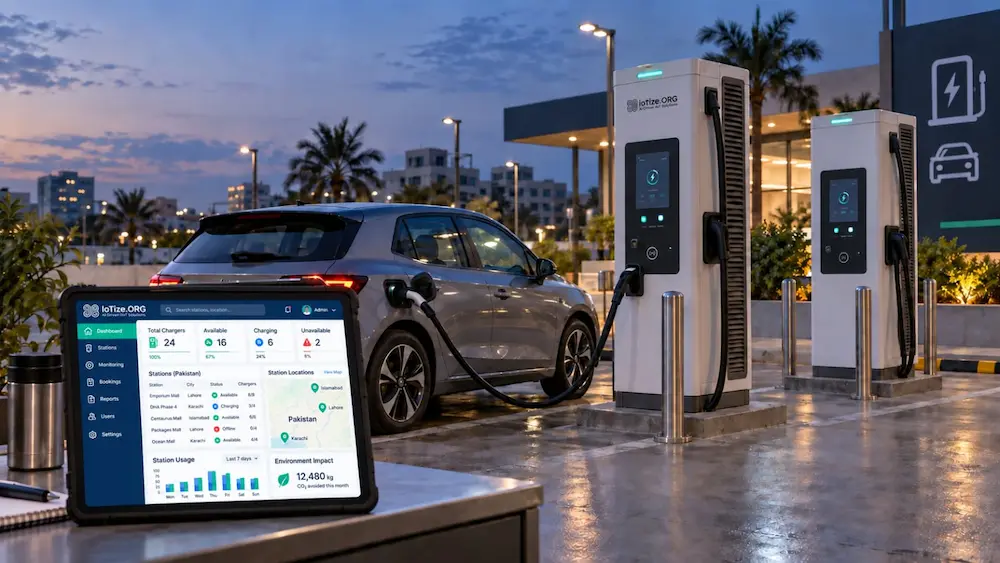
In short: OCPP is the open protocol that lets a compliant EV charger communicate with compatible EV charging software. It helps operators avoid hardware lock-in, manage mixed charger brands, and keep control of their data and credentials. Most Pakistani networks will start with OCPP 1.6J, while the management platform should also support OCPP 2.0.1 for newer hardware.
Pakistan is building its EV charging network one licence and one site at a time. However, chargers are only the visible endpoints. The software behind them decides whether each site can authorise users, collect payments, report faults, and stay manageable as the network grows.
This guide explains OCPP integration in plain language for charge point operators, charger makers and sellers, fleet depots, malls, fuel stations, and housing societies. It also shows how IoTize’s white label EV charging software can run compliant chargers under your own brand.
Why does Pakistan need EV charging software now?
Because chargers are arriving faster than the systems needed to operate them. Pakistan’s New Energy Vehicle Policy 2025 to 2030 targets 30 percent of new vehicle sales as electric by 2030 and plans 3,000 charging stations nationwide. It also says EVs on Pakistani roads rose from 567 in 2021 to more than 80,000 by June 2025, led mainly by two-wheelers and three-wheelers, according to Arab News.
In addition, the policy set a national commercial charging tariff of Rs 39.7 per kWh and requires oil marketing companies to convert 10 percent of their filling stations into EV charging sites. Therefore, policy is shaping the demand curve alongside early adopters.
However, a licence and a tariff only put a charger on the ground. The moment an operator owns more than one charger, software must authorise users, meter energy, collect payments, monitor uptime, push firmware, and produce reports. The charging software becomes the operating system of the business.
What does EV charging software actually do?
EV charging software turns a box of hardware into a managed service. Operators often call the backend a Charge Point Management System (CPMS) or Charging Station Management System (CSMS). The names differ, but both describe the software where an operator manages chargers day to day.
- Authorisation and access: Decide who can charge through an app, RFID card, QR code, or account.
- Sessions and billing: Start and stop charging, meter energy, apply a tariff, collect payment, and produce a receipt.
- Live monitoring: View every connector as available, charging, faulted, or offline.
- Remote operations: Reset a charger, run diagnostics, unlock a connector, or change settings without a site visit.
- Firmware management: Push approved updates across a charger fleet.
- Smart charging: Limit or schedule power to protect a site’s sanctioned load and shift demand away from peaks.
- Reporting: Track utilisation, revenue, energy, uptime, and faults by charger and site.
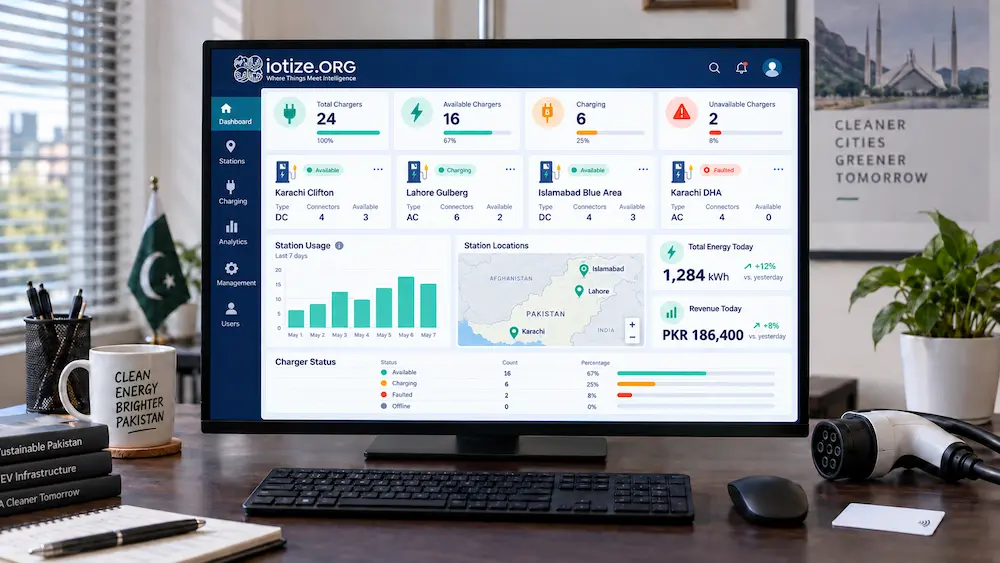
The question is not whether a commercial network needs management software. It does. Instead, the key question is how that software communicates with different charger brands. That is where OCPP comes in.
What is OCPP?
OCPP stands for Open Charge Point Protocol. It is the open, vendor-neutral language that an EV charger uses to communicate with charging management software. The Open Charge Alliance describes OCPP as the global open protocol between charging stations and charging management systems, designed to support interoperable, scalable infrastructure with less dependence on proprietary systems.
The protocol started in 2009 through ElaadNL, a Dutch non-profit founded by distribution system operators. It emerged because hardware brands used separate private communication methods. Today, the Open Charge Alliance oversees OCPP with input from charger makers, software providers, and network operators.
As a result, compatible hardware and software can come from different suppliers. For a Pakistani operator, that flexibility matters because the charger brands available this year may not be the brands available next year.
How does OCPP integration work?
OCPP integration connects an EV charger to a charge point management system so both sides can exchange messages about authorisation, sessions, metering, faults, and remote control. In practice, the charger opens a persistent WebSocket connection to the backend and keeps exchanging structured messages while it remains online.
Crucially, OCPP 1.6 deployments sometimes use an unencrypted `ws://` connection. Operators should insist on TLS through `wss://` so the link between charger and backend stays encrypted.
The backend can also send remote reset, unlock, firmware, and charging-profile commands.
First, the charger announces itself and sends regular heartbeats. Next, the backend checks whether a driver can start a session. Then, the charger reports energy readings while the session runs. Finally, the backend closes the session, calculates billing, and stores the record.
OCPP 2.0.1 changes some message names. For example, it combines transaction activity into a `TransactionEvent` message with Started, Updated, or Ended states. However, the overall conversation still follows the same operating logic.
OCPP 1.6 vs 2.0.1 vs 2.1: which version do you need?
| Version | Released | Key capabilities | Practical fit |
|---|---|---|---|
| OCPP 1.6 | 2015 | JSON over WebSocket, smart charging, diagnostics, firmware management | Widely available and a practical launch choice |
| OCPP 2.0.1 | 2020 | Stronger security, device model, improved transactions, ISO 15118 support | Forward-looking choice for new hardware |
| OCPP 2.1 | 2025 | V2X, ISO 15118-20, DER controls, battery swapping, expanded payments | Emerging requirement for advanced networks |
The buying decision turns on compatibility. OCPP 1.6 and OCPP 2.0.1 are not compatible, according to the Open Charge Alliance. Therefore, a 1.6 charger cannot simply communicate with a backend that supports only 2.0.1.
Most Pakistani operators can start with OCPP 1.6J because many affordable chargers support it. However, the management platform should support both OCPP 1.6J and OCPP 2.0.1 so newer hardware can join the same network later. OCPP 2.1 builds on 2.0.1 and keeps its application logic compatible, but most local operators can treat it as a future requirement for now.
Why does OCPP matter for a Pakistani operator?
- Avoid vendor lock-in: An open connection lets you change management software or add another compliant hardware brand without replacing the whole network.
- Match hardware to local supply: Charger availability can change. OCPP gives operators more freedom to buy quality hardware from different sources.
- Keep operational control: Your business should hold its data, payment relationship, and charger credentials.
- Prepare for regulation and audits: Open interfaces make reporting, integration, and future compliance work easier than a closed black box.
What is the difference between OCPP and OCPI?
| Question | OCPP | OCPI |
|---|---|---|
| What does it connect? | Charger to management software | One operator backend to another |
| What does it enable? | Mixed hardware and software choice | Roaming between networks |
| Who maintains it? | Open Charge Alliance | EV Roaming Foundation |
| When is it needed? | From the first managed charger | When networks need roaming |
Put simply, OCPP connects hardware to software, while OCPI connects charging businesses to one another. Therefore, roaming is not an OCPP feature. A mature operator may eventually use both protocols, but most new Pakistani networks need OCPP first.
What does OCPP not guarantee?
OCPP does not guarantee that every charger will work perfectly with every backend on the first attempt. Instead, real interoperability depends on matching versions, implemented features, secure configuration, and commissioning tests.
- Versions must match: OCPP 1.6 and 2.0.1 cannot communicate directly.
- Required functions must exist: A charger may support OCPP but omit an optional smart-charging or billing feature you need.
- Certification is a baseline: Ask for Open Charge Alliance certification, then test the real charger and backend together.
- Credentials must stay under your control: Whoever controls the connection credentials controls where the charger reports.
- Offline behaviour must be tested: Confirm that a charger can continue an authorised session, queue records, and resynchronise after connectivity returns.
Consequently, operators should commission one real charger before buying a fleet. Test authorisation, metering, billing, fault reporting, remote reset, firmware, smart charging, and recovery after an internet outage.
How do you choose EV charging software in Pakistan?
- Confirm OCPP versions: Require OCPP 1.6J at minimum and preferably OCPP 2.0.1 support as well.
- Test your actual charger: Commission the hardware model and every function your business depends on.
- Choose deployment control: Ask whether the platform can run as managed SaaS, private cloud, or on-premises when needed.
- Protect data ownership: Make sure session, user, energy, and reporting data remain exportable.
- Check Pakistani billing fit: Confirm local tariffs, invoices, and payment gateway integration.
- Keep your own brand: Decide whether drivers will see your name or the software vendor’s network.
- Demand useful support: Confirm response times, timezone coverage, and who handles a live charger fault.
- Plan for growth: The platform should scale from a pilot to a larger network without a rebuild.
For a practical walkthrough of charger selection, tariffs, and first-site planning, download the free IoTize EV Charging Operator’s Guide.
What is white label EV charging software?
White label EV charging software runs under the operator’s brand instead of the platform provider’s brand. You own or source the charger, while the software manages the service. Therefore, the operator keeps the customer relationship, pricing, data, and business identity.
IoTize’s platform supports OCPP 1.6 and 2.0.1 chargers across AC and DC hardware. It combines a branded driver experience, operator dashboard, role-limited host access, local payment integration, and flexible deployment. Most importantly, the platform keeps the network hardware-agnostic so operators can mix compatible charger brands.
Your charger, your brand, one open platform
Connect OCPP 1.6 and 2.0.1 chargers to a branded driver app, operator dashboard, host logins, and local payment integration.
Explore the EV charging solution →- Branded driver app: Help drivers find an available charger, navigate, start a session, monitor progress, and pay under your name.
- Operator dashboard: Watch charger status, pricing, sessions, energy, revenue, uptime, and faults across sites.
- Host access: Give each mall, forecourt, workplace, or housing society a limited view of its own chargers and results.
- Open charger support: Run mixed OCPP 1.6 and 2.0.1 hardware from one platform.
- Local payment integration: Let charging revenue settle through your own gateway account.
- Deployment choice: Use managed SaaS as standard, with private cloud or on-premises options available for suitable projects.
The bottom line
EV charging software is part of the core business, not an optional add-on. OCPP keeps that business flexible by connecting chargers to management software through an open protocol. Therefore, operators can mix compatible hardware, manage sites centrally, and reduce dependence on one supplier.
Start with the OCPP version your hardware supports today, but choose software that can also support the next generation of chargers. Above all, keep control of your data, payments, branding, and charger credentials.
Ready to run OCPP chargers under your own brand?
Explore IoTize white label EV charging software or talk to our team about your chargers, sites, and rollout plan.
Frequently asked questions
What is OCPP in EV charging?
OCPP is the Open Charge Point Protocol, an open communication standard between an EV charger and its management software. It lets compatible hardware and software from different suppliers work together and helps operators avoid vendor lock-in.
Is OCPP free to use?
Yes. The OCPP specification is available at no cost after registration. However, operators still pay for their chargers, management software, integrations, hosting, and support.
What is the difference between OCPP 1.6 and OCPP 2.0.1?
OCPP 2.0.1 adds stronger security and richer management features, including a structured device model, improved transaction handling, richer smart charging, and ISO 15118 support. It is not compatible with OCPP 1.6, so the charger and backend must support the same version.
What is the difference between OCPP and OCPI?
OCPP connects a charger to management software. OCPI connects charging networks for roaming. They solve different problems and can work together in a mature network.
Is OCPP 2.0.1 backward compatible with OCPP 1.6?
No. OCPP 2.0.1 and OCPP 1.6 are not compatible. Choose management software that supports both if your network may combine current 1.6 chargers with newer 2.0.1 hardware.
Which OCPP version should a Pakistani operator use?
Many operators can start with OCPP 1.6J because affordable chargers widely support it. However, the management platform should also support OCPP 2.0.1 so future hardware does not force a platform change.
What is OCPP 2.1, and do I need it yet?
OCPP 2.1 adds bidirectional charging and other advanced capabilities, including ISO 15118-20 support, distributed energy resource controls, battery swapping, and expanded payment options. Most new Pakistani operators can treat it as a future requirement unless a planned charger or grid service specifically needs it.
Does OCPP guarantee that any charger works with any software?
No. OCPP makes interoperability possible, but it does not guarantee it. Both sides must support the same version and the specific functions you need. Certification helps, but operators should still commission and test the real charger, backend, network connection, billing flow, and offline recovery.
What happens if the internet connection drops during charging?
A well-implemented charger can continue operating during a connection loss. It can use a local authorisation list or cache, continue the session, store transaction messages, and send them after connectivity returns. However, behaviour varies by charger model, so test this scenario before deployment.
Do I need OCPP if I only have one or two chargers?
Yes, if you need billing, monitoring, remote control, or software choice. Even a small pilot benefits from OCPP-compliant hardware because it keeps future platform choices open.
EV charging solution: White Label EV Charging Software
Free guide: EV Charging Operator’s Guide
More from IoTize: Visit the IoTize blog →