

Technical Reviewer: Zia ur Rehman
15+ years in embedded systems and industrial IoT · Reviewed
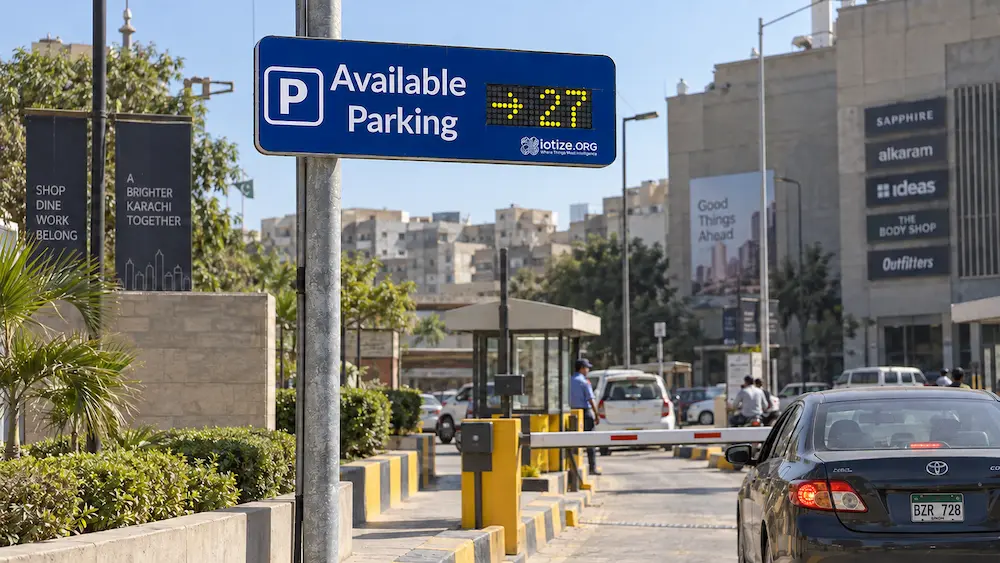
Smart parking in Pakistan is arriving in three cities at once. Across 2025 and 2026, Lahore, Karachi and Islamabad have each moved on digital parking, from new plazas to app-based payment and dashboard-monitored city lots. If you run a mall, hospital, housing scheme or municipal facility, these projects are more than news. They set the direction against which customers and public bodies will judge your site.
So what should an operator take from this activity? Below, we examine what each city is building, what those choices signal about procurement, and why the guidance layer drivers notice most can fit an existing plaza now, without waiting for new concrete.
The 2026 parking wave, city by city
The fastest way to read the market is to examine what each city has actually chosen to build. The pattern is consistent, and it reveals what buyers now expect from smart parking in Pakistan.
| City | Heavy build | Digital layer | Signal for operators |
|---|---|---|---|
| Lahore and Punjab | Underground and smart parking plans, including Bhati Gate | LePARK pilot at four commercial sites with app and QR payment | Civil works and digital systems move on separate tracks |
| Karachi | Bolton Market vertical facility for more than 200 cars and 250 motorcycles | KMC pilot planned for designated lots with digital tickets and cashless payment | Revenue transparency drives the business case |
| Islamabad | Existing lots at seven planned locations | Time-based electronic parking with digital stay records and dashboard tracking | Dashboard monitoring is becoming the baseline |
Lahore and Punjab: underground plazas plus a digital pilot
Punjab is pursuing large parking infrastructure alongside a faster digital layer. In May 2026, plans reported by The Nation covered modern underground and smart parking systems for inner Lahore, the Walled City and busy commercial zones. The report said more than twenty parking plazas could enter the next annual development programme, while agencies including TEPA, LDA and the Walled City of Lahore Authority would divide construction, design, land identification and feasibility work.
Meanwhile, the Punjab government launched a digital parking pilot through the Lahore Parking Company at MM Alam Road, Liberty Market, Mall One and Ittefaq Hospital. The system uses a mobile app and QR payments, routes fees directly to LePARK, and gives the company a dedicated monitoring dashboard.
The two tracks matter together. New plazas are the slow, heavy build, while digital parking Lahore is the fast layer that operators can deploy first.
Karachi: a vertical plaza and a KMC digital parking pilot
Karachi shows the same split. On the heavy side, KMC opened a vertical parking facility at Bolton Market in July 2025, with capacity for more than 200 cars and 250 motorcycles. According to Dawn, the project took 49 years to reach the public after a long legal delay.
On the digital side, Mayor Murtaza Wahab said in early September 2026 that a smart parking Karachi pilot at designated KMC lots was nearing completion. The planned system includes digital tickets, cashless payments, automated transaction records, real-time availability and improved monitoring. Importantly, parking fees remain abolished on KMC roads, so the automated system applies only to designated lots.
Therefore, the clearest motive is revenue transparency. KMC wants to reduce leakage and protect drivers from unauthorised charges while giving operators a live view of covered facilities.
Islamabad: time-based electronic parking and dashboard monitoring
Islamabad is moving in the same direction. In August 2026, reports said the Capital Development Authority was developing a time-based electronic parking system for seven locations. The planned system records how long each vehicle stays and tracks charges through an electronic dashboard.
Across all three cities, the same three ideas keep appearing: record the stay digitally, take payment transparently, and monitor the site through a dashboard.
What the projects signal for smart parking operators
You do not need to wait for a public tender to see where the market is going. The public sector is setting a baseline for smart city parking Pakistan, and private operators will increasingly be measured against it.
- Manual booths are on the way out. Each digital project replaces cash-in-a-drawer collection with digital records or cashless payment. Therefore, the main business case is capturing revenue that previously leaked.
- Dashboards are becoming standard. Lahore, Karachi and Islamabad all expect an operator to watch parking activity and revenue digitally. A site with no live view now looks a step behind.
- Real-time availability is becoming expected. Drivers increasingly want to know how many spaces are free now, not whether an attendant thinks a level has room.
- The heavy build and smart layer are separate purchases. Plazas can take years, but sensing, guidance and dashboard systems can fit an existing facility far sooner.
The commercial effect reaches beyond parking fees. An INRIX study found that 40 percent of surveyed UK motorists had avoided driving to shops because they could not find parking. The research covers the UK rather than Pakistan, so treat the figure as directional. However, the mechanism travels: a facility that looks full can turn away business even when spaces remain hidden inside.
That brings us to the point many private operators miss.
Why smart parking in Pakistan does not require new construction
Here is the good news for anyone who already runs a plaza, basement or surface lot: the layer drivers actually experience is a retrofit, not a rebuild.
A smart parking system is not one machine. Instead, it completes three linked jobs, and each job maps to hardware that can fit an existing facility.
- Detect. Count vehicles entering and leaving, or sense occupancy by zone, so the system knows how many bays are free.
- Decide. Aggregate that data at the edge, apply the site rules, and calculate what each sign should display.
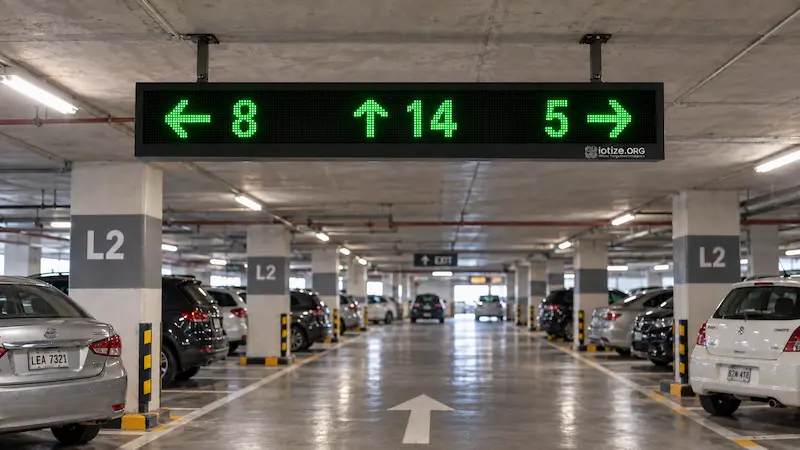
- Display. Show drivers a live number and a clear arrow, so they move toward available capacity instead of circling.
The data layer sits beneath all three jobs and turns each count into a reportable record. This detect, decide and display loop needs no new structure. You mount sensing at entries or zones, position signs where drivers can see them, and connect everything to a gateway. The concrete stays exactly as it is.
This is also how a site climbs the Parking Visibility Ladder, from blind to guided to optimized. The smart parking overview explains those stages in full. For this article, the point is simpler: public projects are pushing serious facilities off the blind rung, while a retrofit lets a private operator move without a construction budget.
The Pakistani reality: power and connectivity
A parking guidance system in Pakistan must account for load-shedding and uneven connectivity from day one. Otherwise, a system that looks convincing in a brochure can fail during the conditions when drivers need it most.
Two constraints shape every practical deployment.
Power is not guaranteed. A guidance sign that goes dark during load-shedding quickly loses driver trust. Therefore, outdoor signage should run on solar and battery wherever a reliable grid connection is unavailable. Flip-dot technology suits this job because its bistable discs hold a message without continuous power and draw energy mainly when the display changes. With solar power, battery backup and an IP65 enclosure, the sign can work off-grid without trenching for a power run.
Connectivity should not depend on new cabling. Many Pakistani sites will not trench fresh data cable across a working plaza. Therefore, GSM or 4G can provide practical backhaul, while HTTP, MQTT and Modbus TCP support integration. Edge processing matters too because guidance should continue locally when the internet connection drops.
Design for these two realities at the start. As a result, the system keeps guiding drivers through the exact conditions that break a grid-dependent or cloud-only installation.
The IoTize smart parking Pakistan stack
This is where sourcing becomes concrete. IoTize builds a Custom Series smart parking stack that maps directly onto the detect, decide and display loop. Each product is configured to the site, so the starting price scales with the lanes, levels and decision points covered.
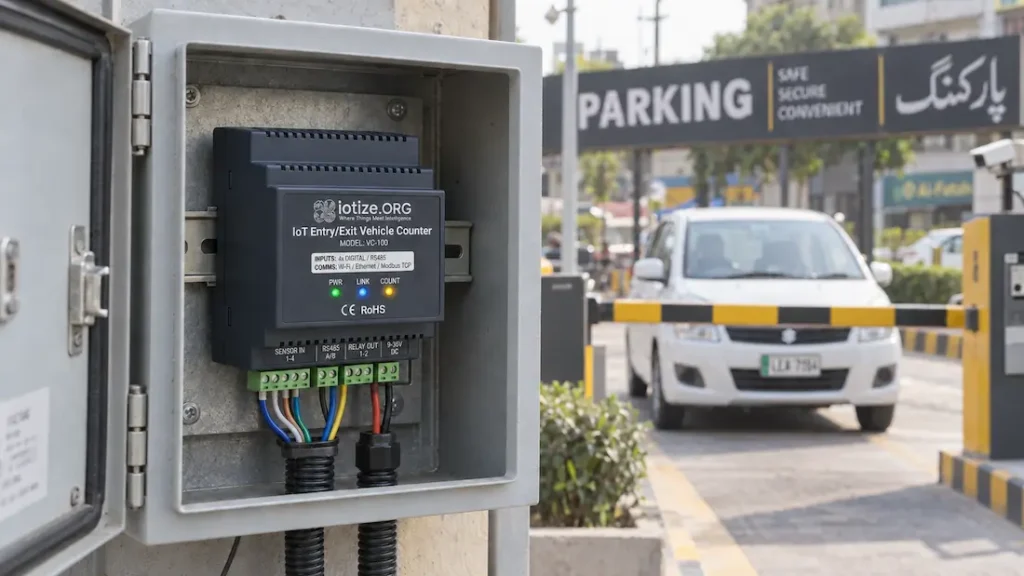
Detect: IoT Entry/Exit Vehicle Counter, from $249. Mounted near a controlled lane, it registers vehicles entering and leaving and reports live occupancy. Counting at a choke point rather than every bay can provide a spaces-free figure with far less hardware.
Decide: Parking Guidance Gateway, from $449. This on-site edge controller collects counter and sensor data, applies zone rules locally, updates connected signs, and sends occupancy to a dashboard or third-party platform. The base unit uses Ethernet and Wi-Fi, while GSM or 4G is an available add-on.
Display outdoors: Solar Flip-Dot Signage, from $1,600. The 7 by 20 flip-dot matrix is wireless, cloud-controlled, solar and battery powered, and IP65 rated. Therefore, it suits a curb or entrance where grid power is difficult.
Display indoors: IoT Indoor LED Signage, from $999. The full-colour 1000 by 200 mm panel can show live counts, animated arrows, text and a logo at decision points inside a garage.
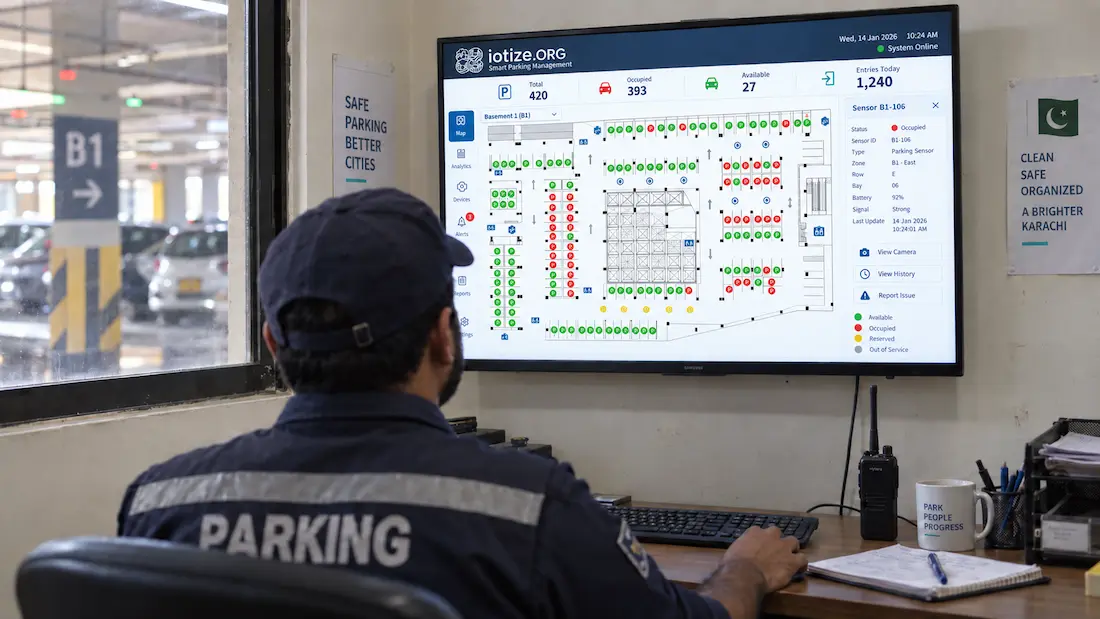
Under all four products sits the data layer, which turns occupancy events into a live operational view and reportable history. For the complete system picture, visit the Smart Parking Solutions page.
Why sourcing locally is the operator’s advantage
IoTize designs, assembles and tests its devices in Pakistan and ships worldwide. For a buyer in Lahore, Karachi or Islamabad, that local production changes the practical economics of smart parking in Pakistan in four ways.
- Shorter local lead time. A locally built system reduces dependence on an overseas shipment and customs queue before installation can begin.
- Support in your timezone. When a sign needs reconfiguration or a gateway needs a firmware update, the technical team works in the same local hours.
- Hardware designed around local conditions. Solar, off-grid flip-dot signage directly addresses load-shedding, strong sunlight and outdoor installation constraints.
- A custom fit for the site. The Custom Series stack can match the counter, gateway and signs to the actual lanes, levels and zones rather than forcing a fixed package.
For a mall or hospital competing for footfall, a developer marketing a new scheme, or a municipal body accountable to citizens, speed, local support and grid-appropriate hardware create a practical advantage.
A practical smart parking rollout path
You do not have to deploy every layer at once. A sensible sequence for a Pakistani parking operator looks like this.
- Count first. Put vehicle counters on controlled entries and exits to create a live occupancy figure. This first step gives the operator a dashboard and replaces guesswork with data.
- Guide next. Add the gateway and signs at the decisions where drivers hesitate, such as the entrance or level splits. Use solar flip-dot signs outdoors and full-colour LED signs indoors.
- Optimize over time. Use the accumulated data to adjust staffing, layout and operating rules, then assess whether selected zones justify per-bay sensing later.
Each step creates value on its own. Therefore, the operator can improve the site without committing to one large capital event like a new plaza build.
IoTize products for a smart parking setup
Entry/Exit Vehicle Counter
Lane-level counting for live parking occupancy and spaces-free data.
View Product →Parking Guidance Gateway
Edge logic for counters, sensors, zones, dashboards and guidance signs.
View Product →Solar Flip-Dot Signage
Wireless, sunlight-readable guidance for off-grid entrances and curbs.
View Product →Indoor LED Signage
Full-colour live counts, arrows, messages and branding inside garages.
View Product →The takeaway for operators
The 2026 projects in Lahore, Karachi and Islamabad point in the same direction: parking is becoming digital, dashboard-monitored and cashless. At the same time, drivers are learning to expect a live number and a clear direction.
Public construction can take years. However, the layer drivers judge most, including sensing, guidance and live visibility, can fit an existing site now. If you run a plaza, hospital, housing scheme or municipal facility, the fastest route is a stack built locally, designed around local power conditions, and configured for your lanes.
Ready to Scope Smart Parking for Your Site?
Map the right counters, gateway and signs to your entrances, levels and power conditions.
Frequently asked questions
What is driving the 2026 smart parking push in Pakistan?
Cities want to reduce parking revenue leakage, support transparent cashless collection, and gain a live view of their facilities. Lahore, Karachi and Islamabad have all moved toward digital parking in 2025 or 2026, which raises the standard private operators will face.
Do I need to build a new plaza to offer smart parking?
No. Heavy civil work and the smart layer are separate investments. Counters, gateways, guidance signs and dashboards can retrofit existing entries, zones and lanes without new construction.
How does a parking guidance system in Pakistan work?
It runs a detect, decide and display loop. Counters or sensors detect occupancy, a gateway calculates what each sign should show, and signage gives drivers a live number and direction. Meanwhile, the dashboard records the data for operators.
Will the signage keep working during load-shedding?
Solar flip-dot signage can work off-grid with battery backup. Because the bistable display holds its message without continuous power, it uses very little energy between updates and suits outdoor sites with unreliable grid power.
What connectivity does a smart parking system need in Pakistan?
The exact connection depends on the site. The gateway supports Ethernet and Wi-Fi, while GSM or 4G is available where new data cabling is impractical. Edge logic also keeps local guidance running during an internet interruption.
Why buy from a Pakistani manufacturer instead of importing?
Local production can shorten lead times, align technical support with local working hours, and produce hardware around Pakistani power and outdoor conditions. IoTize designs, assembles and tests its devices in Pakistan while supporting international delivery.
How much does a smart parking system cost in Pakistan?
Cost follows the site scope. The IoTize Vehicle Counter starts from $249, the Parking Guidance Gateway from $449, the Indoor LED Signage Display from $999, and the Solar Flip-Dot Guidance Signage from $1,600. Final pricing depends on configuration, sensor choice, quantity and the number of lanes or signs.
Which IoTize products make up a smart parking setup?
The core setup combines an Entry/Exit Vehicle Counter for detection with a Parking Guidance Gateway for local decision logic. For display, use Solar Flip-Dot Signage outdoors or Indoor LED Signage in covered facilities.
Products: Vehicle Counter · Guidance Gateway · Flip-Dot Signage · Indoor LED Signage
Read next: Counting vs Sensors · LED vs Flip-Dot Signs
Start here: What Is Smart Parking? · How Guidance Systems Work
From the blog: Visit the IoTize blog →