

Technical Reviewer: Zia ur Rehman
15+ years in embedded systems and industrial IoT · Reviewed
Vehicle counting or per-space sensors? Every smart parking project eventually reaches this fork, and the answer sets the budget for everything that follows. Choose well and the rest of the build gets easier. Choose badly and a facility either overspends by a wide margin or installs a system drivers stop trusting inside a month.
The confusion is fair, because both approaches promise the same headline: a live count of free spaces. Yet the two methods work differently, cost differently, and fail differently. So this guide compares vehicle counting vs per-space sensors honestly, caveats included, so a facility manager can pick the architecture that actually suits the site.
A quick anchor before the detail. Any parking guidance system runs on four layers: detect, decide, direct, and data, as broken down in Parking Guidance Systems Explained: How an APGS Gets a Driver to an Open Space. This post lives entirely inside the first layer. Detection is where the money goes and where the accuracy is won or lost.
What Is Parking Occupancy Detection?
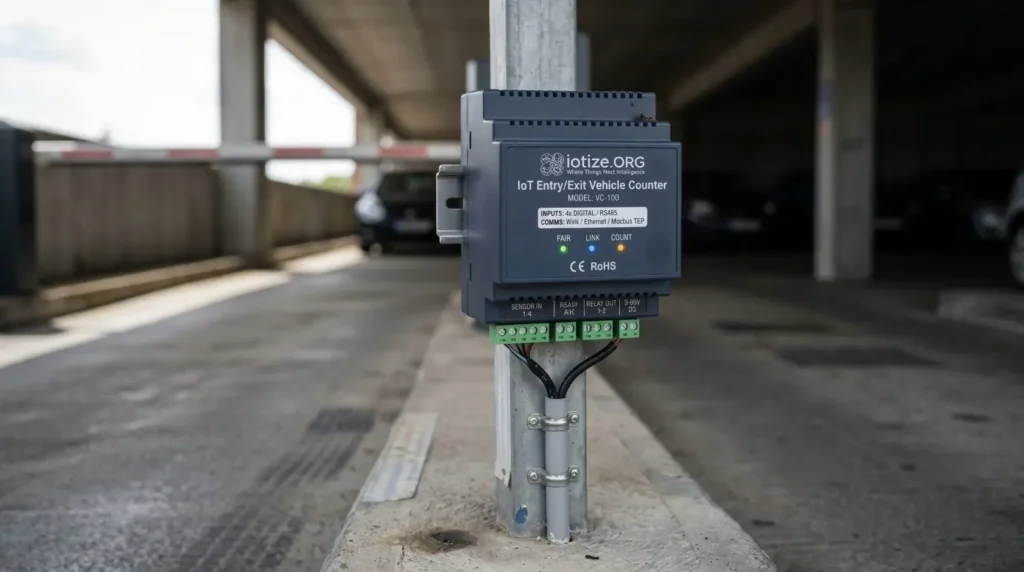
Parking occupancy detection is the sensing layer that tells a parking facility which spaces are free, in real time. Parking occupancy detection works one of two ways: by counting vehicles crossing entry and exit points to keep a running total, or by placing a dedicated sensor on every individual bay. Everything a guidance system displays traces back to this layer.
Both methods feed the same downstream stack. The difference is what they can say. Counting reports a number for the whole facility or a level. Per-space detection reports the state of each individual bay, which means it can point at a specific open space.
That distinction sounds small on a spec sheet. In practice, the distinction decides the hardware count, the install effort, the long-term accuracy, and the invoice.
Why Is the Detection Choice the One That Sets Your Budget?
The detection choice sets the budget because it determines how many devices a facility buys. Counting needs a handful of detectors, one per traffic lane. Per-space detection needs one per bay. A site with four lanes and 600 bays therefore faces either four detection points or six hundred, and that ratio drives the entire capital cost.
Almost every other component sits downstream of the decision. Signage, app feeds, dashboards, and the wiring plan all depend on whether a facility counts cars at the boundary or watches each space.
So the useful question is not “which technology is best.” The better question is “which method fits this site, this budget, and what the operator actually plans to do with the data.” That reframing produces far better decisions than any vendor comparison chart.
What Is Vehicle Counting?
Vehicle counting, also called entry and exit counting or in-motion counting, places a detector at each entrance and exit lane. Vehicle counting adds one to the total when a car drives in, subtracts one when a car drives out, and subtracts the running tally from total capacity to produce live availability for the facility or for a level.
The sensing method varies. Older sites used inductive loops buried in the lane, or infrared and ultrasonic beams across it. Newer sites use compact IoT devices that watch each lane and report over the network. Whatever the hardware, the principle holds: detect motion through a chokepoint, keep a tally.
The appeal is scope. A facility with two entrances and two exits needs roughly four detection points, not six hundred. Hardware and installation costs stay low, retrofit is quick, and an enclosed lot with one way in and one way out is close to the ideal case.
What Are Per-Space Sensors?
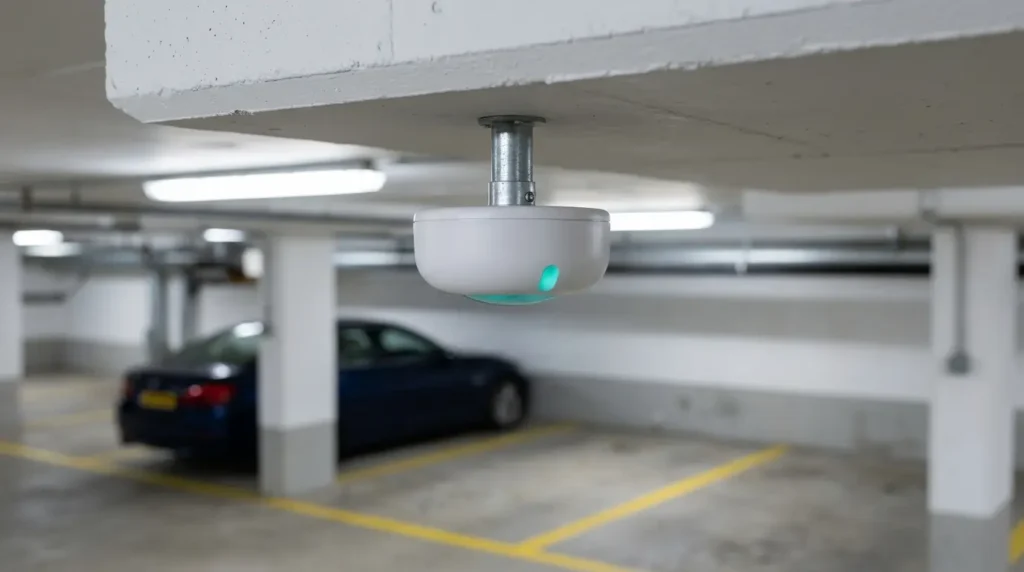
Per-space sensors, also called single space detection, put a dedicated detector on every bay. Each per-space sensor watches one space and reports occupied or vacant in real time, so the system knows both how many spaces are free and exactly which ones. That granularity is what enables a green or red light above each bay.
Several sensor types compete inside this category:
- Ultrasonic ceiling sensors mount above each bay in covered garages and bounce sound off whatever sits below. Ultrasonic units are reliable indoors and commonly cited at around 97 percent accuracy or better.
- Magnetometer sensors, in-ground or surface-mounted, detect the change a parked car makes in the local magnetic field. Magnetometers suit outdoor lots and all-weather sites, and wireless battery units avoid trenching, though large metal vehicles in neighbouring bays can confuse them.
- Camera-based space monitoring uses one camera to watch several bays at once, trading per-sensor cost for more software, careful mounting, and adequate lighting at night.
Because every space reports for itself, per-space detection unlocks the one thing counting can never do. Per-space detection can send a driver to a specific open bay rather than merely into the building.
Vehicle Counting vs Per-Space Sensors: What Is the Real Difference?
The real difference is granularity versus cost. Vehicle counting reports an aggregate number cheaply, using a few lane detectors, but cannot locate an individual free bay. Per-space sensors report each bay’s status precisely and hold accuracy longer, but require hardware on every space and therefore cost far more to deploy.
The table below sets out the trade-offs without the marketing gloss.
| Factor | Vehicle counting (entry/exit) | Per-space sensors (single space) |
|---|---|---|
| What you learn | How many spaces are free (aggregate count) | How many AND exactly which spaces are free |
| Hardware scope | A few detection points per lane | One sensor per space |
| Install cost | Low, scales with lanes | High, scales with spaces |
| Best-fit site | Enclosed lot with defined entries and exits | Large garages, mixed lots, or anywhere drivers need directing to a bay |
| Accuracy pattern | Good per pass, but error accumulates over many vehicles | Very high per space, stable at rest |
| Upkeep | Periodic count resets or recalibration | Sensor health checks, battery swaps on wireless units |
| Drives bay-level lights | n/a | Yes |
| Supports stage 3 optimization | Partially, at zone level | Yes, at bay level |
One pattern jumps out of that table. Counting wins on cost and simplicity. Per-space wins on granularity and stability. Neither method is universally better, which is exactly why the facility, not the brochure, should decide.
How Accurate Is Vehicle Counting, and Why Does the Count Drift?
Vehicle counting is usually accurate per pass, often 98 percent or better, but the errors accumulate. Because counting maintains a running tally, every missed or double-counted vehicle stays in the total until someone resets it. Across a thousand vehicles, a 98 percent per-pass rate can leave the facility count roughly twenty cars adrift, and the gap keeps widening through the day.
This is the section most vendors skip, so this is where honesty earns the most credibility.
Misses happen for ordinary reasons: a motorcycle, two cars nose to tail, a pedestrian walking the lane, or a vehicle straddling two lanes at the barrier. The U.S. DOT ITS Joint Program Office notes exactly this weakness, observing that loop detectors installed at entry and exit points can be cheaper than per-space systems, yet their accuracy suffers when vehicles follow each other closely at peak periods . Each individual miss is trivial. The accumulation is not.
Independent parking engineers describe the same pattern at facility scale. Walker Consultants reports that even a system where each count point exceeds 99 percent accuracy can drift toward roughly 85 percent facility accuracy over a 30-day period without a manual recount, in their accuracy assessment guidance. Drift is not a defect in one product. Drift is the physics of counting a flow.
The fix is simple but real, and it belongs in the specification rather than the footnotes. Counting systems need periodic resets, either scheduled overnight when the site empties or triggered on demand. That requirement explains why counting suits an enclosed lot: a facility that empties or reaches a known state regularly re-anchors its count to reality, so drift never compounds for long. An open lot that never fully clears gives the count nothing to reset against, and the error simply stacks.
Per-space sensors avoid the problem structurally. Because each sensor reports one stationary vehicle at rest, no running tally exists to drift, and detecting a parked car is inherently easier than catching a moving one at speed. That is the core reason single space systems hold higher long-term accuracy, and why they earn their cost at facilities where trust in the number is non-negotiable.
The takeaway is not that counting is bad. The takeaway is to choose counting with open eyes about resets and enclosure, or choose per-space and pay knowingly for the granularity.
What Does Parking Occupancy Detection Cost Per Space?
Per-space detection typically costs a few hundred dollars per bay, while vehicle counting concentrates spend at the lanes and therefore costs far less per space at scale. The U.S. DOT ITS Joint Program Office cites $300 to $500 per space to install an ultrasonic single-space system with red and green bay indicators, depending on local labour rates. Vendor estimates for complete over-the-space systems including signage run higher, up to $750 or more per space.
Counting concentrates the spend somewhere else entirely. Industry write-ups place a basic entry and exit count-and-guidance setup in the region of $20,000 per lane, covering sensors, counting software, and a simple open or full sign. Spread across several hundred bays, the per-space equivalent is small.
Run the arithmetic on a 600-bay facility and the gap becomes concrete. Per-space detection at $300 to $500 per bay lands somewhere between $180,000 and $300,000 before maintenance. Counting four lanes at roughly $20,000 each lands near $80,000, and often well below that with modern IoT devices replacing loop-and-panel installations. Wireless magnetometers can trim per-space installation by avoiding trenching, yet the per-bay hardware count remains the cost driver.
Parking Occupancy Detection Costs at a Glance
Sources: U.S. DOT ITS Joint Program Office (itskrs.its.dot.gov), Walker Consultants (walkerconsultants.com). Industry ranges, not a guarantee.
Which Detection Method Fits Your Facility?
Use the framework below instead of a gut call.
Choose vehicle counting when:
- The lot is enclosed with clearly defined entry and exit lanes.
- The facility empties or reaches a known state regularly, so counts can re-anchor.
- Drivers mainly need a spaces-available number at the entrance, not turn-by-turn bay guidance.
- Budget is tight and the priority is the fastest route to a trustworthy live occupancy figure.
Choose per-space sensors when:
- The facility is large or maze-like, and circling drivers waste real time.
- The plan includes green and red lights over bays, or an app showing exact open spots.
- Long-term count accuracy without daily intervention is a hard requirement.
- The revenue or experience upside justifies per-bay investment, and stage three optimization is the destination.
Mature sites frequently run both: counting at the perimeter for the headline number, and per-space detection on the levels where guidance genuinely pays. No operator has to commit to a purist position on day one.
What Does This Mean for Pakistan and Gulf Facilities?
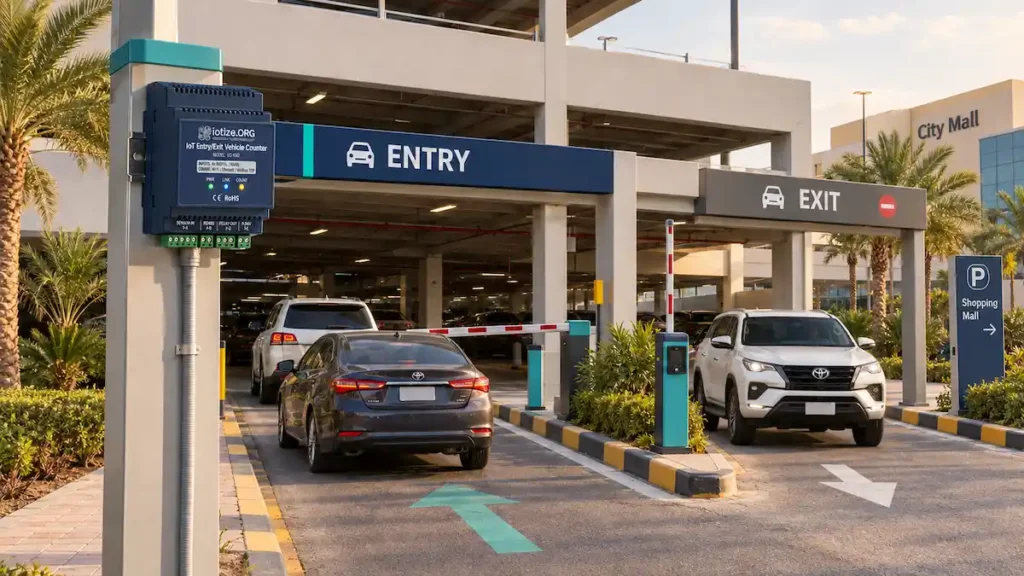
For most Pakistani and Gulf sites, counting is the right first rung, because the typical facility has a handful of controlled lanes and several hundred bays. A mall in Karachi or Lahore, a private hospital, or a corporate tower can put a trustworthy live number at the gate for a fraction of what sensing every bay would cost, and climb further later.
The regional picture splits in a useful way. Pakistani facilities sit overwhelmingly at the blind rung, so the jump from no data to a reliable entry count is the single largest gain available, and it needs no municipal mandate to happen. A private operator can install counters and a gate sign on their own timeline.
Gulf facilities span a wider range. Flagship malls, airports, and public zones in cities such as Dubai already operate at the guided rung with per-space guidance, which raises the bar for adjacent developments and makes bay-level detection easier to justify commercially. So a Gulf export project is far more likely to specify per-space detection from the start than a comparable Pakistani one.
Both markets share one practical constraint that shapes hardware choice: heat, dust, and open-air surface lots. Overhead ultrasonic units expect a covered structure, and open uncovered lots in either region favour threshold counting or weather-sealed in-ground units over ceiling-mounted sensors. Enclosure rating deserves as much attention in the specification as accuracy.
Where Does IoTize Fit?
IoTize builds the detect and decide layers, so a facility can start where it actually sits today and climb the ladder later. The honest map follows.
For counting, the IoT Entry/Exit Vehicle Counter is live now. The Vehicle Counter mounts at entry and exit lanes, registers vehicles in and out, and reports live facility occupancy over the network. Two caveats stay explicit, because pretending otherwise would not serve a buyer. First, like every counting approach, the count is subject to error accumulation, so the device is designed to reset on a schedule or on demand, keeping drift from compounding. Second, the Vehicle Counter performs best in an enclosed lot with defined lanes, where regular re-anchoring keeps the number honest. Deployed inside those conditions, the Vehicle Counter is a fast, cost-effective way to put a trustworthy spaces-available figure at the gate.
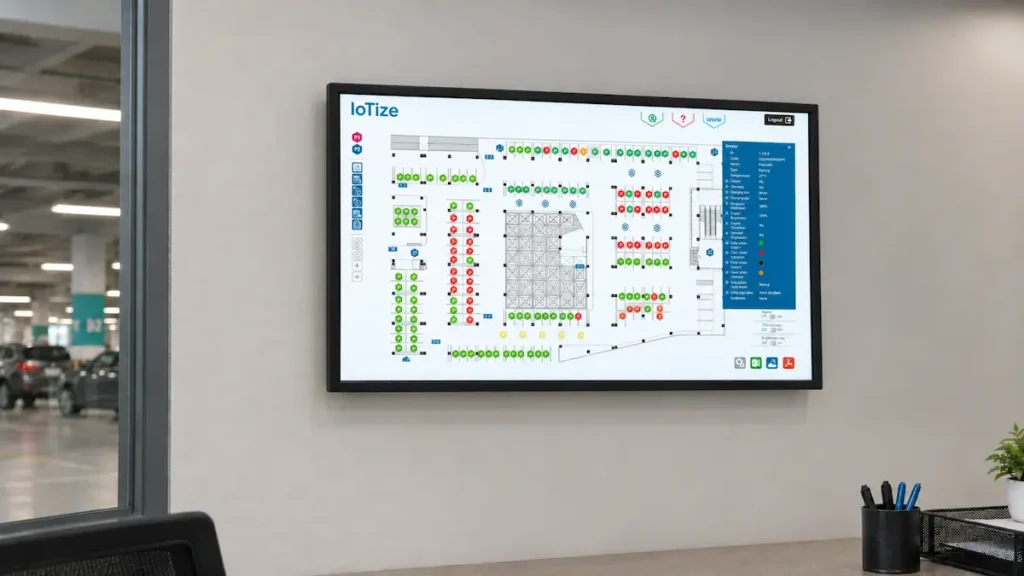
For aggregation, the Parking Guidance Gateway and Edge Controller collects detection data, computes availability by level or zone at the edge, and feeds signage, dashboards, or a third-party platform. The Gateway is the decide layer from Post 2, and it is quote-based, so pricing follows the site design rather than a shelf price.
For per-space detection, note the current state plainly. A dedicated IoTize per-space bay sensor sits on the product roadmap and is not yet live. So a facility that genuinely needs bay-level granularity today should raise that at the first conversation. Our team would rather scope it accurately, including how third-party per-space hardware can feed the IoTize Gateway in the interim, than sell a counter dressed up as something it is not. That candour is the entire point of choosing detection deliberately.
IoT Entry/Exit Vehicle Counter
Lane-level vehicle counting for live parking occupancy detection.
View Product →Parking Guidance Gateway / Edge Controller
Aggregates detection data and computes live occupancy by level or zone.
View Product →Key Takeaways
- Parking occupancy detection is the detect layer, and the detect layer sets the budget for the whole guidance stack.
- Vehicle counting reports how many spaces are free. Per-space sensors report how many and exactly which ones.
- Counting accumulates error in proportion to vehicles passed, so counting requires scheduled resets and suits enclosed lots.
- Per-space sensors detect vehicles at rest, which is why per-space accuracy stays stable over time.
- The U.S. DOT ITS JPO puts ultrasonic single-space installation at $300 to $500 per space, while counting concentrates cost at roughly $20,000 per lane.
- Detection is the rung that lifts a facility from blind to guided on the Parking Visibility Ladder, and only per-space detection reaches bay-level optimization.
- Most Pakistani sites gain most from counting first. Gulf projects more often justify per-space detection from the start.
Where to Go Next
Detection settles what the system knows. The next question is what drivers actually see, because the finest occupancy data in the world is worthless behind an unreadable sign. Signage brings its own trade-offs across LED, flip-dot, and solar, and each suits a different mounting position, climate, and power situation.
Next in this series: Parking Guidance Signage: LED, Flip-Dot and Solar Signs Compared.
Ready to Scope Your Detect Layer?
Map counting, gateway, and future per-space detection onto your parking facility.
Frequently Asked Questions
How accurate is entry and exit vehicle counting?
Vehicle counting is usually 98 percent accurate or better per pass. The catch is that small misses accumulate in proportion to how many vehicles pass, so facility-level accuracy drifts over time without a reset. Walker Consultants reports drift toward roughly 85 percent over a 30-day period without a manual recount.
Do parking counters really drift over time?
Yes, and the drift is structural rather than a defect in one product. Because counting keeps a running tally, every missed or double-counted vehicle stays in the total until a reset clears it. Scheduled overnight resets in an enclosed lot, or on-demand resets, stop the drift from compounding.
Do I need a sensor in every parking space?
Only if the facility needs to know exactly which spaces are free, or plans to guide drivers to a specific bay with lights or an app. If drivers mainly need a spaces-available number at the entrance, counting a few lanes costs far less than sensing every bay.
Can vehicle counting tell me which space is free?
No. Vehicle counting produces an aggregate number for a facility or a level and cannot show where an open space sits. Only per-space detection can drive bay-level indicator lights and pinpoint exact vacancies.
What is the difference between counting and single space detection?
Counting detects vehicles in motion at entry and exit points and maintains a running total. Single space detection watches each stationary vehicle at rest, one sensor per bay. Counting is cheaper and coarser; single space detection costs more, delivers bay-level granularity, and holds accuracy longer.
Which is cheaper, vehicle counting or per-space sensors?
Vehicle counting, in almost every case, because a facility installs a few lane detectors rather than one device per bay. The U.S. DOT ITS JPO cites $300 to $500 per space for ultrasonic single-space systems, while counting concentrates cost at roughly $20,000 per lane. Across several hundred bays the gap is large.
Which detection method suits an open, uncovered surface lot?
Threshold vehicle counting or weather-sealed in-ground magnetometer sensors suit open lots best, because overhead ultrasonic units expect a covered structure. Heat, dust, and direct sun in Pakistan and the Gulf make enclosure rating as important as raw accuracy when specifying hardware.
Does IoTize offer per-space parking sensors?
The IoTize IoT Entry/Exit Vehicle Counter is live now for counting, and the Parking Guidance Gateway aggregates the data. A dedicated per-space bay sensor is on the roadmap and not yet live, so a facility needing bay-level granularity today should flag it early and our team will scope it honestly, including third-party sensors feeding the IoTize Gateway.
Products: IoT Entry/Exit Vehicle Counter · Parking Guidance Gateway
Read next: Parking Guidance Signage: LED, Flip-Dot and Solar Signs Compared
Also in this series: What Is Smart Parking? · Parking Guidance Systems Explained
From the blog: Visit the IoTize blog →