

Technical Reviewer: Zia ur Rehman
15+ years in embedded systems and industrial IoT · Reviewed
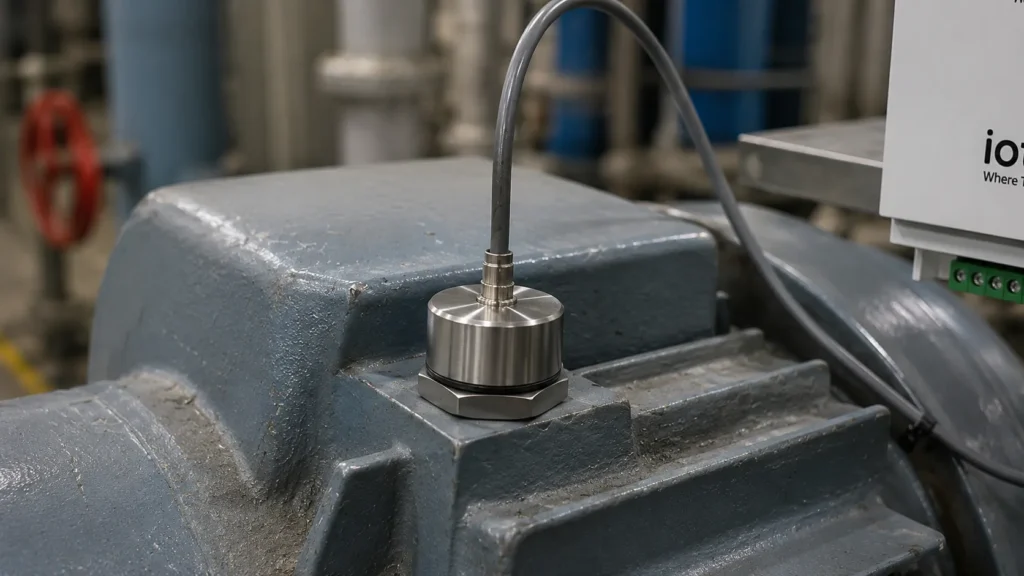
Every electric motor on your floor warns you before it dies. However, it speaks in a language you cannot hear over the plant noise: vibration. Long before a bearing seizes or a coupling shears, the motor starts to shake in a slightly different way, and that change is measurable weeks or even months ahead of the breakdown. So IoT vibration sensors for motor failure detection exist to read exactly that signal.
Below, we break down how these sensors work, which motor failures they catch, and how the analysis actually happens. First, we cover what the sensor measures. Next, we walk through every failure mode. Then, we open up the analysis math that names the fault. Finally, we map it all to real IoTize devices you can deploy today. You already know you need vibration monitoring for motors, so let us show you the mechanics.
What vibration monitoring actually is
Vibration monitoring measures how a machine moves and compares that motion against a healthy baseline. Because every rotating part produces a repeating pattern of tiny movements, any change in that pattern points straight at a mechanical problem. So what is vibration monitoring in practice? Essentially, it is condition monitoring for anything that spins, and it runs around the clock instead of once a week under a technician’s hand.
How do vibration sensors work? Inside a modern IoT sensor sits a MEMS accelerometer, a tiny chip that turns physical motion into an electrical signal. Then the device samples that signal thousands of times per second, runs the math locally, and streams the results to your dashboard. Therefore what does a vibration sensor detect? In short, it catches any repeating mechanical fault that changes how the machine shakes, which covers most motor and rotating-equipment failures.
First, the accelerometer senses motion. Next, the device digitizes the signal and runs an FFT on it. Then it compares the result against the machine’s healthy baseline. Finally, when a reading drifts out of range, the system raises an alert so your team plans the repair. As a result, you act on evidence rather than guesswork, and you catch the fault while it is still small.
What the sensor measures: acceleration, velocity, and displacement
A vibration signal appears three ways, and each one reveals a different frequency range. Together, they give a full picture of motor health.
- Acceleration highlights high-frequency events, so it catches early bearing defects and gear-mesh problems first.
- Velocity covers the mid range and maps onto overall machine severity, which is why the standards use it for pass or fail zones.
- Displacement captures low-frequency, large-amplitude motion, so it suits shaft and structural issues.
A quality IoT vibration sensor measures all three from a single accelerometer. Moreover, a wireless vibration sensor for motors does this without a control wire back to a cabinet, so you can bolt it onto machines that were never built to connect. That advantage matters most when you retrofit older equipment, which makes the IoTize devices a practical retrofit vibration sensor for existing motors.
The failure modes vibration monitoring catches
Here is where it gets concrete. Each motor fault leaves a distinct vibration fingerprint, so the sensor does not just say something is wrong. Instead, it points straight at the cause. First, scan the quick reference below. Then read the deeper notes on each mode underneath it.
| Failure mode | Vibration signature | Where it shows up |
|---|---|---|
| Bearing wear | Repetitive high-frequency impacts | Bearing fault frequencies (BPFO, BPFI, BSF, FTF) |
| Misalignment | Strong 2x running speed, often axial | Coupling and shaft ends |
| Imbalance | Smooth, dominant 1x running speed | Rotor and fan |
| Mechanical looseness | Multiple harmonics, rattly signature | Feet, mounts, brackets |
| Gear wear | Gear-mesh frequency with sidebands | Gearbox and gearmotor |
Bearing failure: the biggest cause
Bearings are the single most common motor failure, and widely cited motor reliability surveys from IEEE and EPRI attribute the largest share of failures to them. Consequently, motor bearing failure detection is where vibration monitoring pays for itself fastest. A failing bearing does not break all at once. Instead, a microscopic crack forms on the race, then it spreads, and each pass of a rolling element over that defect produces a tiny impact. Because those impacts repeat at specific frequencies, the sensor can name the failing part long before you hear a rumble. In practice, the early warning signs of motor bearing failure appear in the high-frequency band weeks to months ahead of the audible or thermal symptoms.
Misalignment
When the motor shaft and the driven load sit slightly out of line, the coupling loads unevenly on every rotation. As a result, misalignment detection with vibration keys on strong vibration at twice the running speed, often with an axial component. Left alone, misalignment chews through couplings, seals, and eventually the bearings themselves.
Imbalance
An imbalance vibration signature is one of the cleanest to read. A heavy spot on the rotor, whether from debris, wear, or a lost fan blade, produces a smooth, dominant vibration at exactly one times the running speed. Because it stands out so clearly, imbalance is often the first fault a new monitoring program catches.
Mechanical looseness
Loose feet, worn mounts, or a cracked bracket let the machine move more than it should. Therefore mechanical looseness detection appears as a series of harmonics, multiples of the running speed, sometimes with a chaotic, rattly signature. Above all, looseness amplifies every other fault, so catching it early protects the whole machine.
Gear wear
On gearmotors and gearboxes, worn or chipped teeth modulate the vibration signal. So gear wear vibration detection shows up at the gear-mesh frequency and its sidebands. Consequently, you plan a gearbox service in advance instead of suffering a sudden stall.
How the analysis actually works
Reading a vibration signal is not guesswork. Vibration analysis for motors follows a set of well-established techniques, and a good IoT device runs them on the edge so you receive answers, not raw noise. Below, we walk through the five that matter most.
FFT: turning shake into a spectrum
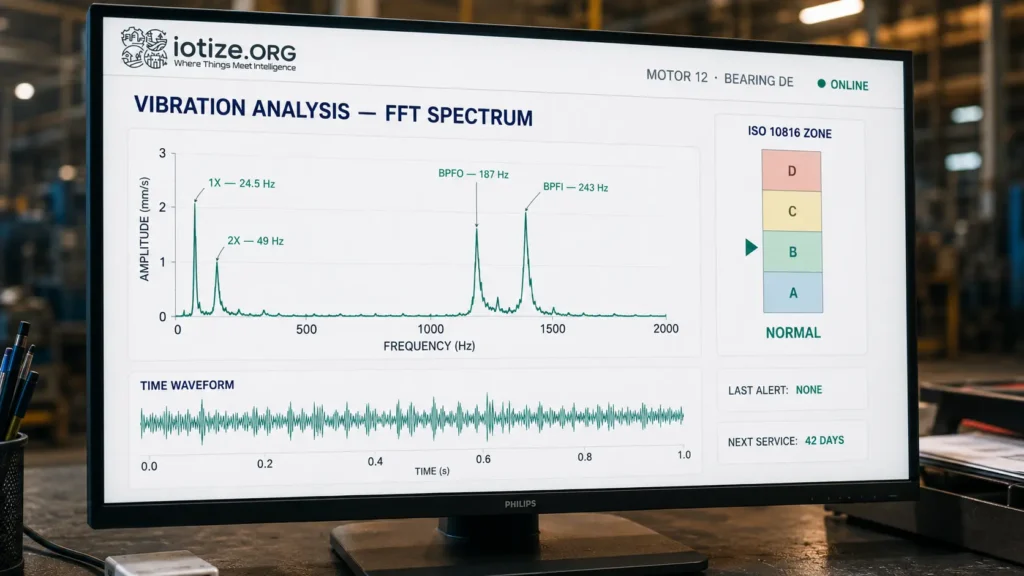
A raw vibration signal is a messy wave in time. The Fast Fourier Transform, or FFT, splits that wave into the individual frequencies that make it up. So the vibration analysis FFT spectrum turns “the motor is shaking” into “there is a peak at 1x, a peak at 2x, and a cluster up at 4 kHz.” Because each peak maps to a cause, the software reads the spectrum and names the fault.
Bearing fault frequencies
Bearings matter so much that the math around them has its own vocabulary. Depending on the bearing geometry and shaft speed, defects ring at calculable rates. When energy appears at one of these bearing fault frequencies, the system tells you not just that the bearing is failing, but which part of it.
- BPFO (Ball Pass Frequency Outer race): a defect on the outer race.
- BPFI (Ball Pass Frequency Inner race): a defect on the inner race.
- BSF (Ball Spin Frequency): a defect on a rolling element.
- FTF (Fundamental Train Frequency): a problem with the cage.
Envelope detection (demodulation)
Early bearing impacts are faint, so they hide under stronger vibration in a plain FFT. Envelope detection, also called demodulation, filters out the loud low-frequency motion and amplifies those tiny repetitive impacts. Consequently, envelope detection gives you the earliest possible bearing warning, which is the difference between a scheduled swap and a catastrophic seizure.
ISO 10816 severity zones
Once you can measure vibration, you still need a rule for “how bad is bad.” The ISO 10816 standard defines vibration severity zones, A through D, based on velocity. Zone A is a new, healthy machine, while Zone D means damage is likely. Therefore ISO 10816 vibration severity zones give your team an objective, defensible threshold instead of a gut feeling.
The P-F interval
All of this ties together on the P-F curve. “P” is the point where a fault first becomes detectable, and “F” is functional failure. So the P-F interval is the runway between them, and it is your window to act. Crucially, vibration monitoring detects the fault right at “P”, which gives you the longest possible P-F interval to plan the repair.
Beyond vibration: temperature and current together
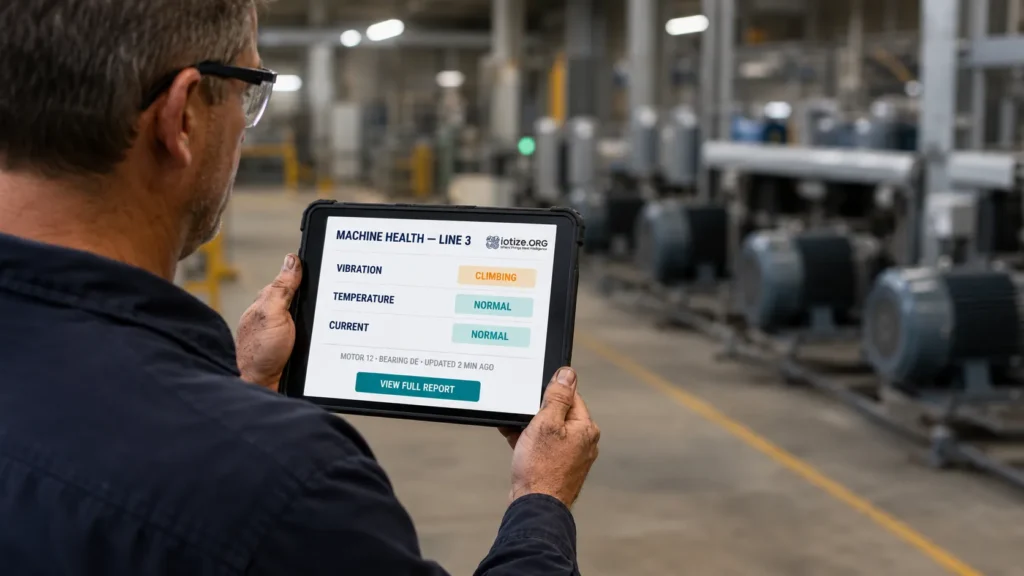
Vibration is the richest single signal, yet the best rotating equipment monitoring pairs it with others. For motors, two additions matter most. First, temperature. Because a rising bearing or winding temperature confirms and dates a developing fault, vibration and temperature monitoring together cut false alarms and sharpen your confidence before you commit a crew.
Second, current. Motor current signature analysis, or MCSA, reads the current the motor draws and finds faults that are partly electrical, such as broken rotor bars or air-gap eccentricity, which pure vibration can miss. So a device that combines vibration, temperature, and current watches the motor from three angles at once. That is exactly the design behind the IoTize dual-point health monitor, and the affordable single-unit version brings the same three signals to the wider floor.
The ROI case: why this pays off
The mechanics are elegant, but the reason you install these sensors is money and uptime. For a vendor-neutral view of how condition data drives those savings, IBM’s overview of predictive maintenance is a useful primer. Here is the practical case in four points.
What predictive maintenance returns
Source: IBM (ibm.com), predictive vs preventive maintenance. Industry ranges, not a guarantee.
- Reduce unplanned downtime: a stopped line costs far more than the motor itself, so catching faults early turns emergency stops into planned service.
- Prevent catastrophic motor failure: you replace a bearing, not a seized motor that took the coupling and shaft with it.
- Extend the maintenance window: you replace parts on evidence, not on a fixed calendar, which cuts needless work and spares.
- Build a clear ROI: add up avoided downtime, saved parts, and longer motor life, and the predictive maintenance ROI for motors on critical assets is usually fast.
The IoTize devices that do this
Understanding the theory is one thing. Deploying it on your floor is another. IoTize builds vibration and machine-health devices for exactly this job, and they split into enterprise-grade and affordable options. As a result, you match the device to the criticality of each asset: enterprise units on your most critical motors, affordable units everywhere else, all reporting into one view.
Enterprise IoT Vibration Monitoring Device
Deep vibration monitoring (RMS, peak, FFT) for critical rotating machinery, with real-time threshold alerts and SCADA-ready output.
View Product →Enterprise Smart Machine Health Monitor, Dual-Point
Vibration, temperature, and current at two points for the full picture on high-value and variable-speed motors.
View Product →Smart Machine Health Monitoring IoT Device
Vibration, temperature, and current in one affordable unit, so you extend predictive maintenance across the whole floor.
View Product →Turn your motors from silent to speaking
Motor failures are almost never silent. They announce themselves in vibration long before they stop the line, and IoT vibration sensors for motor failure detection are how you finally hear them. From bearing faults read through envelope detection, to misalignment and imbalance flagged by their signatures, to ISO 10816 zones that tell you exactly when to act, the technology turns a mechanical unknown into a planned task.
To see how this fits into a complete plant strategy, visit our predictive maintenance solution page, and if you want a Pakistan-specific device shortlist, read Best Predictive Maintenance Solutions for Pakistani Factories in 2026 next. So the choice is simple: you can keep replacing seized motors on someone else’s schedule, or you can catch the fault at “P” and fix it on yours.
Put vibration monitoring on your critical motors
See the full predictive maintenance approach, or request a quote for the Enterprise IoT Vibration Monitoring Device scoped to your floor.
Frequently asked questions
How do IoT vibration sensors detect motor failures?
An IoT vibration sensor uses a MEMS accelerometer to measure the motor’s motion thousands of times per second. It then runs an FFT and other analysis on the edge and compares the pattern against a healthy baseline. When a fault such as a bearing defect changes that pattern, the device recognises the signature and sends an alert, all before the failure becomes audible or catastrophic.
How early can vibration sensors detect bearing failure?
Bearing faults typically appear in the high-frequency band weeks to months before functional failure. Techniques like envelope detection surface these faint early impacts sooner than any other method. As a result, your team plans a bearing swap in advance instead of reacting to a seizure.
Can vibration sensors predict motor failure?
Yes, within limits. Vibration sensors do not predict a random event; instead, they detect a developing fault early and track how fast it progresses. Because most motor failures develop gradually and leave a clear vibration signature, monitoring reliably warns you in advance for the majority of mechanical faults.
What failures can vibration monitoring detect?
Vibration monitoring detects bearing wear, misalignment, imbalance, mechanical looseness, resonance, and gear wear, among others. Because each fault produces a distinct signature, the system often identifies not just that a fault exists, but which component is at fault.
How do you monitor motor vibration?
You mount a vibration sensor on the motor, usually near the bearing housing, and let it stream data continuously to a dashboard. Because a wireless IoT sensor needs no control wiring, this stays simple even on older motors. The software then applies thresholds such as ISO 10816 zones and alerts you when readings move out of the healthy range.
What is the difference between vibration monitoring and MCSA?
Vibration monitoring reads the motor’s mechanical motion and excels at bearing, alignment, and balance faults. By contrast, motor current signature analysis (MCSA) reads the current the motor draws and catches electrical faults like broken rotor bars that vibration can miss. Used together in a device that measures both, they give the most complete picture of motor health.
Products: Enterprise IoT Vibration Monitoring Device · Dual-Point Health Monitor · Affordable Health Monitor ($99)
Read next: Next post in the predictive maintenance series
From the blog: Visit the IoTize blog →