

Technical Reviewer: Zia ur Rehman
15+ years in embedded systems and industrial IoT · Reviewed
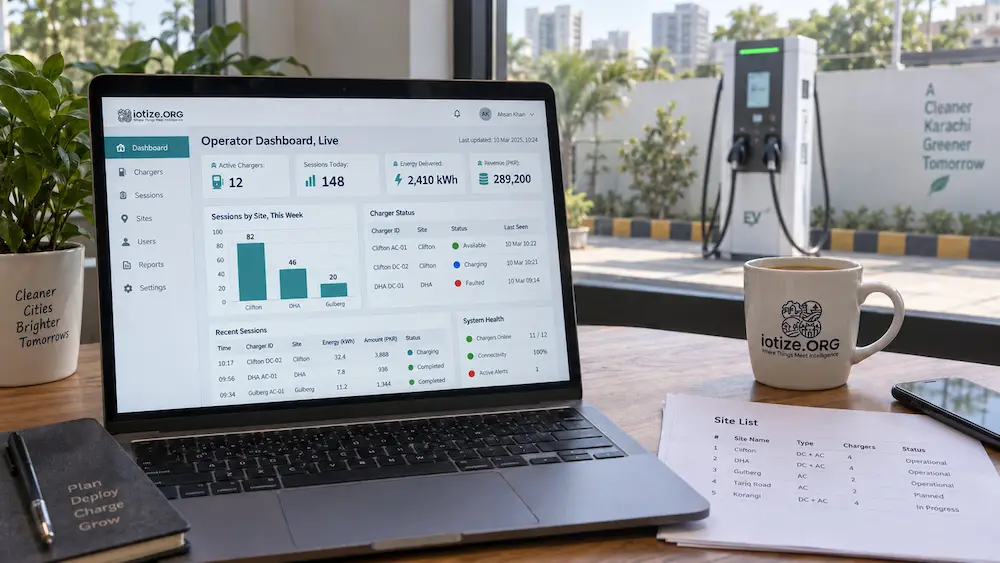
You have priced the chargers. You have a site, or a list of sites. Now you want the number nobody seems to publish: the ev charging software cost. Often, you find a quote form rather than a public price. The software behind a charging network is scoped to what you actually run, so CPMS pricing and the ev charging management software price move with your fleet, your sites, and how you want to deploy.
So let us make the quote easier to understand. Below is the real commercial model, the seven factors that move your quote up or down, and a straight answer on subscription versus revenue share. By the end you will be able to read any EV charging software quote, including ours, and know exactly what you are paying for.
The short answer: EV charging software is priced per connected charger, billed monthly, plus a one-time setup and onboarding fee. There is no single sticker price, because your total is set by seven things: how many chargers you run, whether they are AC or DC, how many sites and user roles you need, which payment gateways you integrate, how you deploy, and how much onboarding the launch takes. Each one is explained below.
Explore the white-label EV charging solution for the platform and quote route.
How is EV charging software actually priced?
The IoTize solution page describes this model: a fee per connected charger, billed monthly, plus a one-time setup and onboarding fee. That is the starting point for an IoTize quote. The solution page describes a subscription rather than a session-revenue share.
A quick note on vocabulary, since quotes use both terms. The backend that manages your chargers is called a CPMS (charge point management system) in the OCPP 1.6 era and a CSMS (charging station management system) under OCPP 2.0.1. Same system, different generation of the standard. IoTize supports both versions, so you may see either word in a proposal.
Think of it as two buckets. The one-time fee covers getting you live: connecting your chargers over OCPP, branding the driver app and portal, wiring your payment gateway, and training your team. The recurring fee keeps the platform running for each charger you have online: monitoring, billing, updates, and support.
Because it scales per charger, a two-charger pilot and a forty-charger network pay very different totals, which is the first reason a single published price would mislead more than it helps.
Another model is revenue share, where the provider takes a percentage of charging sales. Upfront and minimum fees depend on the contract. Below, we compare both models using the same forecast.
What factors set your EV charging software cost?
Seven variables move your quote, and every one of them is something only you can answer. Here they are in the order they usually matter.
How does charger count affect your EV charging software cost?
Charger count is the biggest single driver of your EV charging software cost, because the recurring fee is charged per connected charger. Two chargers is a pilot; twenty is a network.
As a result, the honest first question in any quote is not “which plan” but “how many charge points, today and in twelve months.” Give both numbers, since a quote built on your growth plan is more useful than one built on your first week.
Do AC or DC chargers cost more to run on the software?
AC and DC chargers behave differently, and that shows up in the software. A DC fast charger may require richer fault handling, different payment flows, and more commissioning work. Therefore, list your AC and DC models in the quote request so we can scope the integration accurately.
How does running multiple sites change the price?
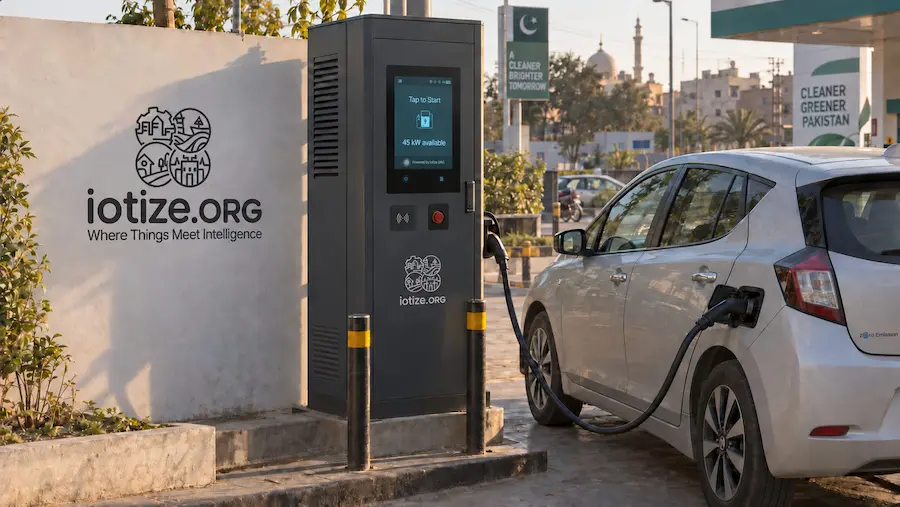
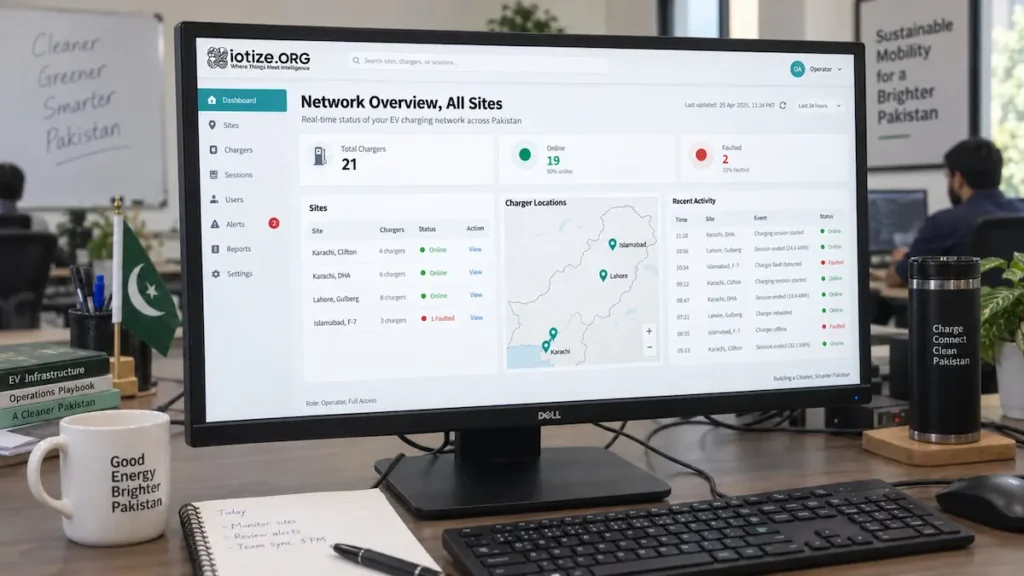
A single site is simpler than a portfolio. The moment you run two or more locations, the software has to keep each site’s chargers, tariffs, revenue, and reporting separate while still rolling them into one operator view. Multi-site management is standard in a serious platform, yet it adds configuration and, at a larger scale, more infrastructure.
In short, one entrance in DHA is not priced like ten sites across three cities, and it should not be.
Do extra user roles and tenants add to the cost?
Roles decide who sees what, and that structure has a cost. A simple deployment might have one operator login. A real business often has three audiences on one platform: the charger maker or head office watching the whole installed base, the site host seeing only its own location and revenue share, and the driver who finds, navigates, and pays. Role-based, multi-tenant access keeps those views walled off from each other cleanly.
Consequently, the more tenants and revenue-share partners you onboard, the more the platform is doing for you, so the quote should describe that configuration.
Do payment gateway integrations cost extra?
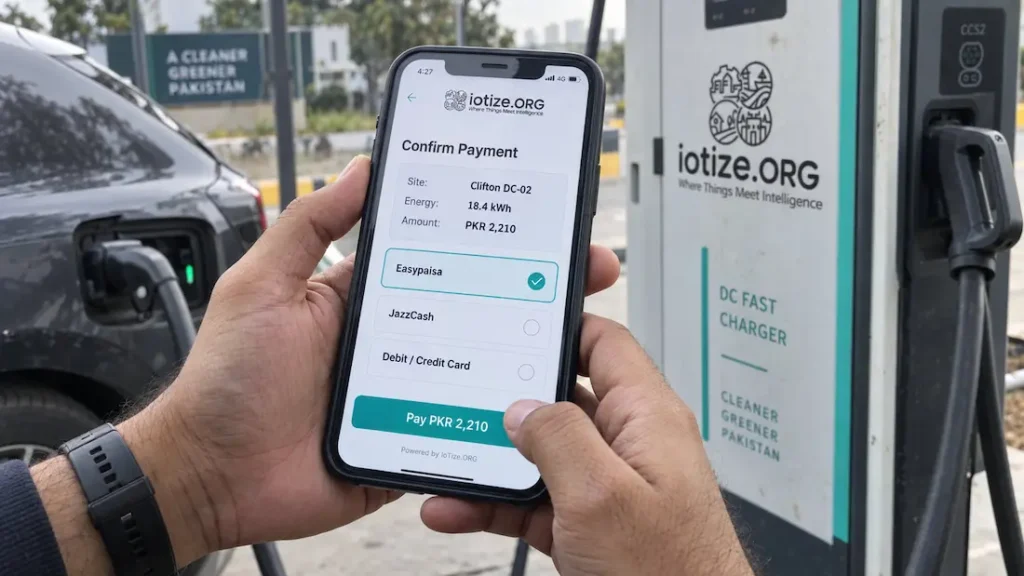
Payments are where local reality sets the price. A platform built for Pakistan has to settle real money through the rails your drivers use, which means Easypaisa, JazzCash, and card gateways, not just a foreign card processor bolted on. Each gateway you add is an integration to build, test, and maintain.
However, the payoff is direct: sessions get paid for automatically, and with IoTize the revenue settles into your own account, because we never hold your funds. The number of gateways belongs in the project scope, and it is worth getting right before launch.
Does SaaS, private cloud, or on-premise cost more?
Deployment choice changes the scope. Managed SaaS is the default and the lightest to start: we host it, you log in. Private cloud and on-premise are described as available on request, putting the platform in your own cloud tenancy or on hardware you control, which some operators need for data ownership or procurement reasons.
Naturally, the more you move hosting toward your own infrastructure, the more setup and support it involves, so deployment choice is a genuine cost lever rather than a checkbox. Raise it at quote stage, because it changes both the setup fee and the recurring figure.
What does the onboarding scope cover?
Onboarding is the one-time fee, and its size depends on how much launching you actually need. A small scope is a couple of charger models to connect and a lightly branded app. A large scope adds many charger types, deep custom branding across the app and driver portal, several payment gateways, staff training, and data migration from whatever you use now.
In other words, the onboarding fee is not a fixed toll; it is scoped to the work in front of us, which is why we quote it against your real charger list and sites.
Why don’t we publish a tier table?
Because a tier table would price the plan, not your business, and those are rarely the same thing. Two operators can both run “ten chargers” and need wildly different things: one is ten AC boxes on a single mall rooftop with one payment gateway, the other is ten DC fast chargers across four cities with three revenue-share partners and an on-premise deployment.
A published Bronze, Silver, Gold table forces both into the wrong box, and someone overpays.
We would rather quote you the real number than sell you a shelf. So instead of a price list, we use the model you have just read, per charger per month plus a one-time setup and onboarding fee, and we build the quote around your actual charger count, charger types, sites, roles, payment gateways, and deployment choice. It takes one conversation, and you get a figure you can defend to whoever signs off.
Subscription or revenue share: which costs more?
| Cost item | Per-charger subscription | Revenue share |
|---|---|---|
| Recurring fee | Quoted amount per connected charger | Percentage of eligible session sales |
| As utilization rises | Base subscription stays predictable | Share grows with sales |
| Also compare | Setup, support, gateways, term | Minimum fees, exclusions, settlement, term |
Neither model is automatically cheaper. Compare the fixed fee with the expected share of your charging revenue over the same period.
A fixed per-charger subscription gives you a predictable software line item. A revenue-share fee rises with session sales. For example, compare a quoted monthly subscription against the proposed revenue percentage at low, expected, and high charger utilization.
Compare total cost, not just the advertised rate. Include setup, gateways, support, contract terms, and any payment processor fees. Then calculate each model over at least a year using your own forecast. Policy and electricity tariffs affect your charging business, but they do not determine which software contract costs less.
What’s included, and what costs extra?
The white-label solution describes these platform capabilities; your proposal should state the exact modules and integrations included: OCPP 1.6 and 2.0.1 support, AC and DC OCPP-compliant chargers, a branded iOS and Android app plus a driver web portal and an operator dashboard, reservations, smart charging and load balancing, over-the-air firmware updates, role-based multi-tenant access, and Urdu and English support.
Because the platform is hardware-agnostic over OCPP, the open standard maintained by the Open Charge Alliance, you are not locked to one charger brand, which gives you more hardware choice.
What varies is everything in the seven factors above: how many chargers, AC or DC, how many sites and tenants, which payment gateways, and how you deploy. That is the part we quote. If you want to understand the whole picture of launching, not just the software line, your launch budget should include hardware, electrical work, approvals, and site operations alongside software.
What does the IoTize white-label platform include?
Everything above describes how our White Label EV Charging Software is priced, because we would rather you see the model than a marketing number. The idea is simple, and it is the opposite of Charging as a Service: you own the charger, you license only the software, and so you keep the asset, the brand, the pricing, the customer, and the data. Your charger, our application.
That ownership is the point. The driver opens an app with your name on it, pays through Easypaisa, JazzCash, or a card, and the site says revenue settles through your own gateway account. You see every session across every site on one dashboard. Your site hosts see only their own. And because it is hardware-agnostic over OCPP, you can mix charger brands now and swap them later without re-platforming.
If OCPP and charger compatibility are new to you, start with the OCPP standard, and for the money side, ask us how gateway settlement works for your account.
How do you get an accurate EV charging software quote?
You do not need a procurement team to get a real number. You need four things in front of you.
- Your charger list. How many chargers, and which models, split by AC and DC.
- Your sites. One location, or a portfolio, and roughly how many chargers per site.
- Your roles. Just you, or site hosts and revenue-share partners who each need their own view.
- Your payments and deployment. Which gateways you need (Easypaisa, JazzCash, cards) and whether you want SaaS, private cloud, or on-premise.
Bring those, and we will map the fastest route to launch and give you a figure built on your business, not a plan off a shelf.
So what will your EV charging software cost?
EV charging software cost is not a mystery; it is a set of decisions. Charger count and charger type set the base, sites and roles set the shape, payments and deployment set the edges, and onboarding sets the one-time fee. Once you can see those seven levers, no quote can surprise you. Therefore, compare the full contract against your utilization forecast, then request a quote for your actual charger list and sites.
Ready to turn your charger list into a real number? Talk to Our Team. Bring your charger list and sites so the team can scope the platform.
White Label EV Charging Software
Review the platform, supported workflows, and quote process for your own sites and chargers.
Explore the solution →Price your actual charging network
Share your chargers, sites, gateway needs, and deployment preference for a scoped software quote.
See the white-label solution →Frequently asked questions
Does a DC fast charger cost more to run on the software than an AC charger?
It may. DC charger models can add commissioning, monitoring, or integration scope. List each model and connector configuration so the quote reflects your actual mix.
Is there a per-session or per-kilowatt fee on top of the subscription?
The published model is a monthly per-charger subscription plus a one-time setup fee. Ask for the written proposal to itemize any usage, payment processor, or gateway charges.
Does adding a second site increase the price?
It can. A second site may add chargers, tariffs, staff roles, and configuration. Ask for the incremental cost in the written quote.
What does the one-time onboarding fee actually pay for?
It covers getting you live: connecting your chargers over OCPP, branding the driver app and portal, integrating your payment gateways, migrating any existing data, and training your team. Its size is scoped to how much of that you need, which is why we quote it against your real charger list.
What deployment options are available, and do they change the price?
Managed SaaS is the default and the quickest to launch. Private cloud and on-premise are available on request for operators with data-ownership or procurement requirements. Deployment affects both the one-time setup fee and the recurring figure, so raise it at quote stage.
Do Easypaisa and JazzCash integrations cost extra?
Local payment rails are integrations we build, test, and maintain, so the gateways you need are a real part of the scope. The upside is automatic session payments that settle straight into your own account, since IoTize never holds your funds.
Who owns the charging revenue and the customer data?
You do. You own the charger, license only the software, and keep the brand, pricing, customer relationship, and data. Revenue settles into your account, and the solution page says your data is exportable.
Solution: White-label EV charging software
Next step: Ask for a scoped quote