

Technical Reviewer: Zia ur Rehman
15+ years in embedded systems and industrial IoT · Reviewed
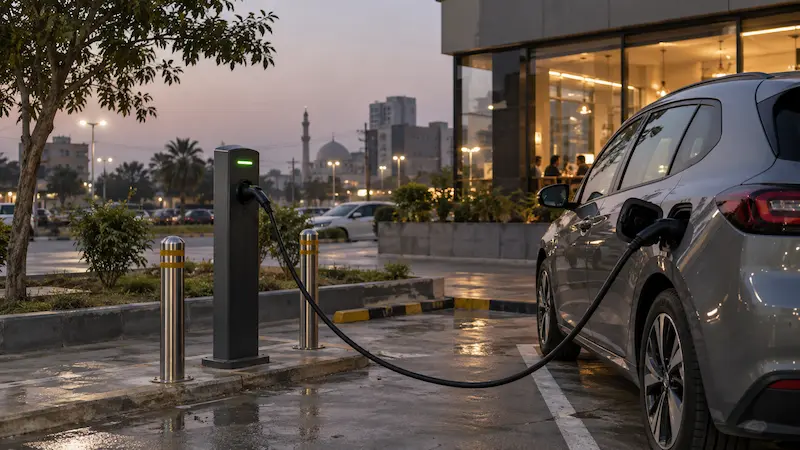
If you own EV chargers, or you plan to buy some, one acronym quietly decides how much freedom you keep: OCPP. Open Charge Point Protocol, or OCPP, is the open standard that lets an EV charger talk to charging management software, no matter who built either one. In plain English, OCPP is the shared language between the hardware on the wall and the software that runs it.
So why should a charger owner care about a communication protocol? Because it shapes what hardware you can buy, what software you can pair it with, and whether you keep your options open later. This guide walks through what OCPP is, why it matters, how OCPP 1.6 and 2.0.1 differ, and what people really mean when they say CPMS vs CSMS and EVSE management. No engineering degree required.
In short: What is OCPP? OCPP (Open Charge Point Protocol) is the open, royalty-free standard that lets an EV charging station communicate with the management software that runs it. It is maintained by the Open Charge Alliance.
Because it is open, an OCPP charger can be managed by any OCPP software, which protects you from vendor lock-in. OCPP 1.6 (2015) is the most widely deployed version, OCPP 2.0.1 (2020) is the modern standard, and OCPP 2.1 arrived in 2025.
CPMS and CSMS are two names for the same backend software. If you are buying chargers, ask which OCPP version they speak, and choose white-label EV charging software that supports both 1.6 and 2.0.1.
What Is OCPP?
OCPP stands for Open Charge Point Protocol. It is an open, royalty-free communication standard that defines how an EV charging station exchanges messages with a central management system, which is simply the backend software that runs the charger.
The charging station is often called the EVSE, short for Electric Vehicle Supply Equipment. So when people say “the EVSE talks to the backend over OCPP,” they mean the charger and the software are speaking the same language.
A simple comparison helps. OCPP is a bit like the relationship between a mobile phone and a mobile network. Any phone that follows the standard can connect to any compatible network, even if the phone maker and the network operator never met. In the same way, any charger that speaks OCPP can connect to any management software that speaks OCPP.
The standard is maintained by the Open Charge Alliance, a global consortium of EV infrastructure organizations.
Because the protocol is open and free to use, charger makers and software builders can adopt it without licensing fees. That openness is the whole point: it stops any single vendor from owning the connection between hardware and software.
One caution, though. Not every charger and not every piece of software actually supports OCPP. Some cheaper units are locked to a single proprietary cloud. So the practical takeaway is to ask, before you buy, whether a charger is OCPP compliant and which version it speaks.
Why Does OCPP Matter for Charger Owners?
OCPP matters because it protects your investment from vendor lock-in. Without it, a charger is tied to one company’s software forever. If that company raises its fees, drops a feature, or shuts down, you are stuck with expensive hardware you cannot fully control.
With OCPP, the picture changes. You gain real freedom in a few ways:
- Hardware freedom. You can mix charger brands across your sites and still manage them from one platform.
- Software freedom. You can switch management software later without ripping out the chargers.
- Future-proofing. As your network grows, you add compatible hardware instead of restarting from scratch.
- Competition on your side. Because you can move, vendors have to earn your business with better pricing and service.
Consider a simple scenario, shown for context and not a specific customer. An operator installs ten chargers tied to one vendor’s closed software. A year later, the vendor doubles its monthly fee. With proprietary hardware, the only choices are to pay up or to replace every unit.
With OCPP hardware, the operator simply moves the same chargers to a new platform and keeps running. Same chargers, very different bargaining position.
For anyone building a charging business, this freedom is not a nice-to-have. It is the difference between a network you own and a network that owns you. In Pakistan, that matters right now.
The Government of Pakistan’s New Energy Vehicles Policy 2025-30, published by the Ministry of Industries and Production, sets out a phased build-out of 3,000 charging stations nationwide by 2030 (shown for context, not a guarantee of results).
Chargers bought in that wave will outlive their first software contract, so keeping your options open early saves painful, costly migrations later.
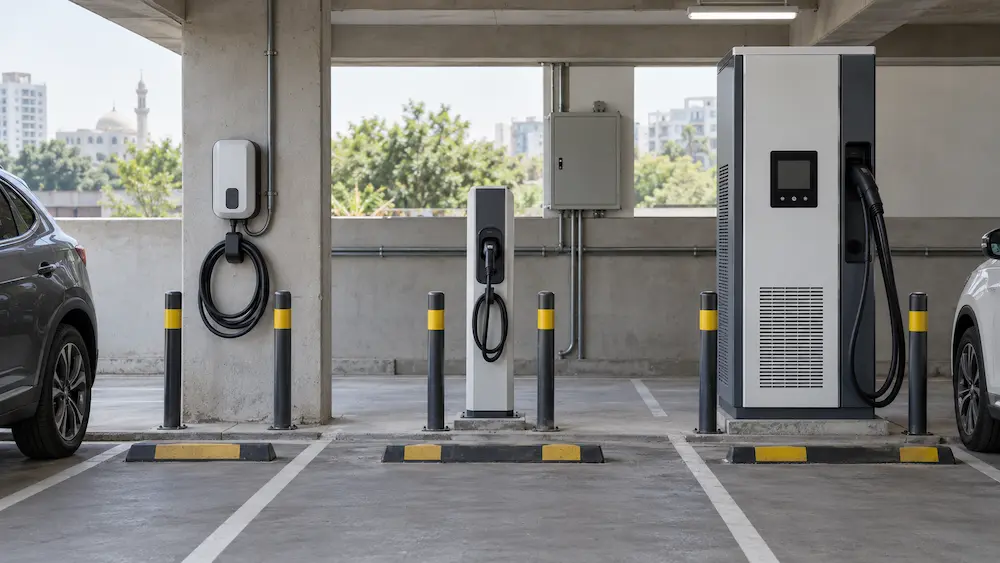
How Does OCPP Actually Work?
OCPP works by sending small, standardized messages back and forth between the charger and the backend over an internet connection. You never see these messages, but they are what make a charger manageable from anywhere.
When a charger powers on, it registers itself with the backend and then sends a regular “heartbeat” so the system knows it is alive. From there, a steady flow of messages handles everyday jobs. Here is what that looks like in plain terms:
- Status updates: the charger reports whether it is available, in use, or faulted.
- Authorization: when a driver taps an RFID card or starts a session in an app, the charger asks the backend “is this person allowed to charge?”
- Start and stop: the backend can start or stop a session, and it logs when each one begins and ends.
- Meter values: the charger reports energy delivered, which the backend turns into a bill.
- Smart charging: the backend can cap or shape power to avoid overloading a site.
- Firmware updates: the backend can push new firmware to the charger remotely, over the air.
Here is what that looks like as a single session. A driver pulls up and taps an app or an RFID card. The charger asks the backend to authorize the driver, the backend confirms, and charging begins.
While energy flows, the charger streams meter values, so the backend always knows how many kilowatt-hours have been delivered. When the driver unplugs, the charger reports that the session has ended, and the backend produces the bill.
All of that happens over OCPP, in seconds, without anyone visiting the site.
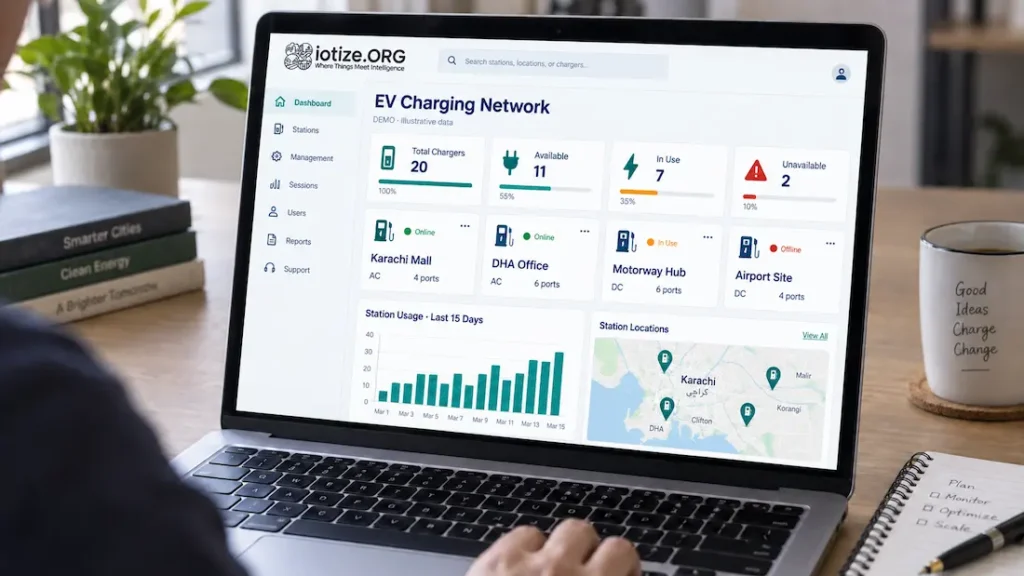
Taken together, this is what the industry calls EVSE management. In practice, the backend gives an operator one screen to monitor every charger, authorize drivers, record sessions, apply pricing, balance load, and update firmware, all without visiting the site.
One quick clarification, because the acronyms pile up fast. OCPP handles the vertical link between a charger and its backend. A separate protocol called OCPI handles the horizontal link between networks, so drivers can roam across different operators. This post is about OCPP, the charger-to-backend language.
OCPP 1.6 vs 2.0.1: What Changed?
OCPP 1.6 is the workhorse that most chargers speak today, while OCPP 2.0.1 is the newer, richer version that improves security, device management, and smart charging. If you only remember one thing, remember that: 1.6 is the widely deployed present, and 2.0.1 is the direction of travel.
A little history explains why. According to the Open Charge Alliance, OCPP 1.6 arrived in 2015 and became the most widely implemented version worldwide.
OCPP 2.0 appeared in 2018 as its successor, but the alliance and the community decided it needed more work, so OCPP 2.0.1 followed in 2020 and is steadily replacing 1.6. Note that 1.6 and 2.0.1 are not compatible, so a charger and a backend need to agree on a version.
OCPP 2.0.1 also carries formal standing: the Open Charge Alliance confirms that OCPP 2.0.1 edition 3 was approved as an international IEC standard, IEC 63584, in 2024.
The newest specification, OCPP 2.1, was released in 2025 and adds bidirectional charging (V2X), distributed energy resource control, and battery swapping. The alliance states that application logic built for 2.0.1 remains compatible with 2.1.
For most charger owners today, though, the real decision is still 1.6 vs 2.0.1.
Here is how the two compare in practice:
| Feature | OCPP 1.6 | OCPP 2.0.1 |
|---|---|---|
| Released | 2015 | 2020 |
| Deployment | Most widely installed today | Growing modern standard |
| Security | Basic | Stronger authentication and secure firmware |
| Device management | Limited | Richer diagnostics and configuration |
| Smart charging | Supported, simpler | Improved energy requests and controls |
| Plug and Charge | Not native | Native ISO 15118 support |
| Offline transactions | Basic handling | More reliable when disconnected |
| Best for | Existing fleets and straightforward sites | New builds and security-sensitive sites |
The practical guidance for an owner is simple. Many chargers in the field today run OCPP 1.6, often the “1.6J” JSON variant, and that is perfectly workable. However, because 2.0.1 is where the ecosystem is heading, the smart move is to choose management software that supports both. Then you can run your 1.6 chargers now and migrate to 2.0.1 hardware later without changing platforms.
One honest caveat belongs here. OCPP support does not automatically guarantee perfect plug-and-play between any charger and any backend. Real interoperability also depends on both sides speaking the same version, and on the specific OCPP functions each one has actually implemented and tested.
So before you commit, it is wise to test your exact charger models with your chosen software rather than assuming the logo on the box is enough. That test is quick, and it saves surprises after the chargers are on the wall.
CPMS vs CSMS: What Is the Difference?
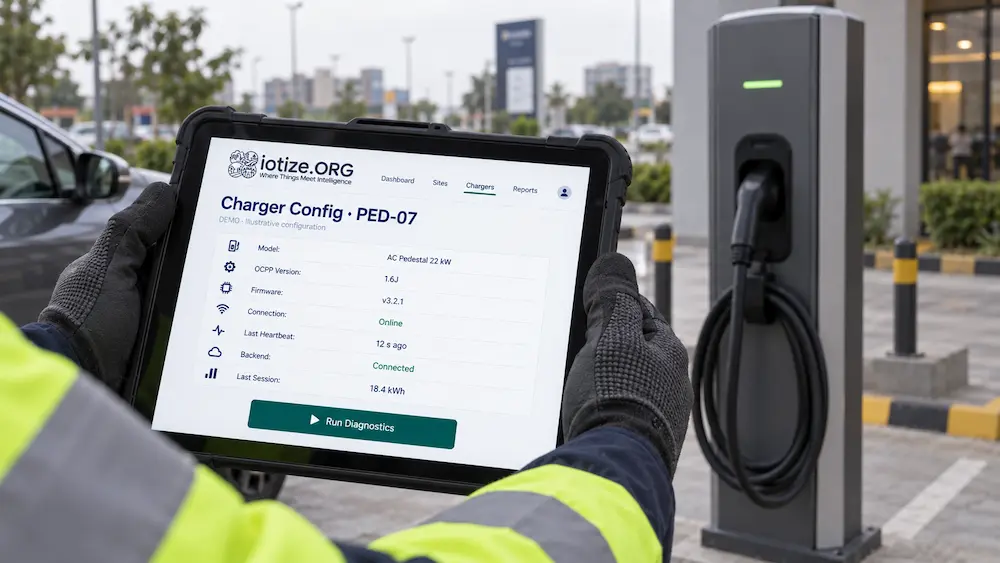
CPMS and CSMS are two names for the same thing: the backend software that manages your chargers. The difference is mostly era and terminology, not capability. So if one vendor calls its platform a CPMS and another calls it a CSMS, that alone tells you very little about what each can actually do.
Here is where each name comes from. CPMS stands for Charge Point Management System.
It is the older, commercial term that grew out of OCPP 1.6 vocabulary, when the charger was called a “Charge Point” and the backend was the “Central System.” CSMS stands for Charging Station Management System, and it is the term the OCPP specification itself now uses, introduced with OCPP 2.0 and standard from 2.0.1 onward.
In short, same backend, different era.
There is one honest nuance worth knowing. Some people use CSMS to mean strictly the OCPP-facing role, the system a charging station connects to, and use CPMS more broadly to include the commercial layer around it, such as billing, driver apps, and roaming settlement. In most procurement documents, though, the two words point at the same platform.
So what should you do with all this? Judge the software by what it does, not by the acronym on the sales deck. Ask whether it handles real-time monitoring, driver authorization, billing, smart charging, load balancing, firmware updates, and open APIs. Those capabilities matter far more than whether the vendor prints “CPMS” or “CSMS” on the brochure.
What Should You Look For in OCPP Charging Software?
Look for software that speaks both OCPP 1.6 and 2.0.1, stays hardware-agnostic, and lets you keep your brand, your customers, and your revenue. That combination is what turns a pile of chargers into a business you actually own.
A short checklist for a first evaluation:
- Dual-version OCPP support. Both 1.6 and 2.0.1, so you can run today’s chargers and migrate later.
- Hardware-agnostic. Works with any OCPP charger, AC or DC, from any brand.
- Full EVSE management. Remote monitoring, remote start and stop, smart charging and load balancing, and over-the-air firmware.
- Billing that fits your market. Support for the local payment gateways your drivers already use, such as Easypaisa and JazzCash in Pakistan, with revenue settling into your own account.
- Three audiences, one platform. A branded driver app, a site-host view, and an operator dashboard, so the charger maker, the site host, and the driver each get what they need.
- Ownership and flexibility. Your data stays yours, and you can deploy as managed SaaS, private cloud, or on-premises. The same principle runs through the whole IoTize IoT platform.
This is exactly the model behind IoTize’s white-label EV charging software: you own the charger, and IoTize provides the application under your brand. Your charger, your customers, your revenue, running on an OCPP platform that speaks both 1.6 and 2.0.1.
If you want the full picture of how that works, the white-label EV charging software page lays it out in detail.
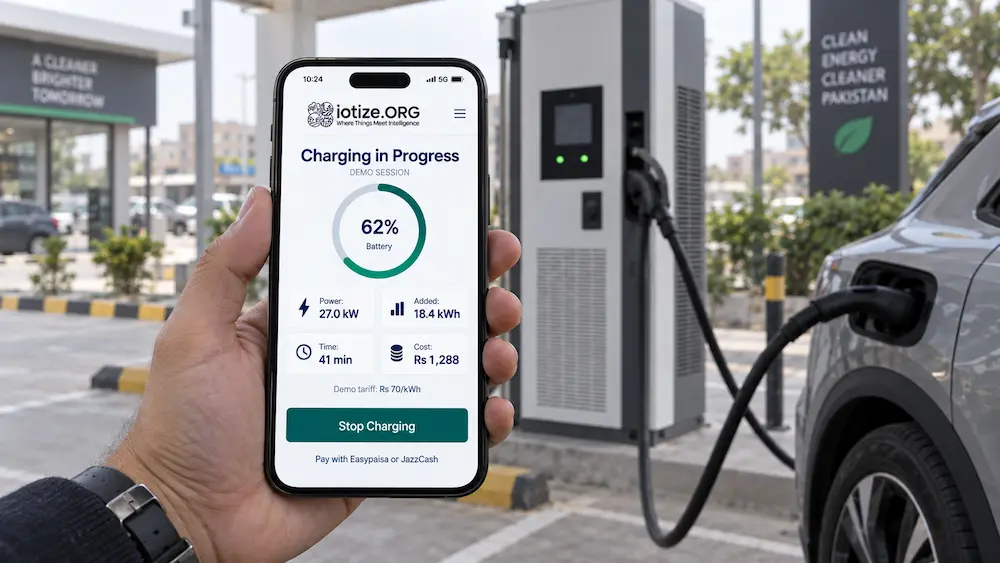
Key Takeaways
- OCPP is the open language between an EV charger (the EVSE) and its backend software, maintained by the Open Charge Alliance.
- It protects you from vendor lock-in. OCPP lets you mix hardware brands and switch software without replacing chargers.
- 1.6 is today, 2.0.1 is next. OCPP 1.6 is the most deployed version; 2.0.1 adds security, device management, and smart charging. OCPP 2.1 (2025) is the newest spec.
- CPMS and CSMS are the same backend, different era. CPMS is the older 1.6-era term; CSMS is the term the OCPP spec uses now.
- Choose software that supports both versions, stays hardware-agnostic, and keeps your brand, data, and revenue.
Where to Go Next
Now that OCPP makes sense, the natural next question is how to turn OCPP-ready chargers into a real business. That is the subject of the next post in this series: How to Start an EV Charging Business in Pakistan (2026). It covers sites, hardware, pricing, and the steps to launch.
If you already own chargers and want to see how an OCPP platform manages them under your own brand, explore the white-label EV charging software page. You can also browse the full range of IoTize solutions.
If you want the practical version, the IoTize EV Charging Operator’s Guide walks through choosing OCPP hardware, setting tariffs, and planning your first sites: IoTize EV Charging Operator’s Guide.
Still unsure which OCPP version your chargers speak, or what it would take to bring them onto one branded platform? talk to our team. Bring your charger list and your sites, and we will map the fastest route to launch.
Bring your OCPP chargers onto one branded platform
Manage mixed AC and DC chargers, local payments, drivers, and sites without giving up your brand or data.
Frequently Asked Questions
What does OCPP stand for?
OCPP stands for Open Charge Point Protocol. It is the open communication standard that lets an EV charging station and its management software talk to each other.
Is OCPP free or open source?
OCPP is an open, royalty-free standard rather than open-source software. The Open Charge Alliance maintains it, and charger makers and software providers can implement it without paying licensing fees, which is why it is described as open.
What is the latest version of OCPP?
OCPP 2.1, released in January 2025, is the newest specification and adds grid features like vehicle-to-grid. In real-world deployment, however, OCPP 1.6 remains the most common, with 2.0.1 growing as the modern standard.
Should I choose OCPP 1.6 or 2.0.1?
Many chargers in the field run 1.6 today, and that works well. Because 2.0.1 is more secure and capable, the safest choice is management software that supports both, so you can run 1.6 now and migrate to 2.0.1 later.
Who maintains OCPP?
The Open Charge Alliance, a global consortium of EV infrastructure organizations, develops and maintains the protocol. It also runs the OCPP certification program and the testing laboratories that verify compliance.
What is EVSE management?
EVSE management means monitoring and controlling your charging equipment through software: checking status, authorizing drivers, starting and stopping sessions, billing, balancing load, and updating firmware remotely. OCPP is the protocol that makes it possible.
What happens to my chargers if I switch software providers later?
If they speak OCPP, nothing physical changes. The chargers stay on the wall and reconnect to the new backend, provided both sides support the same OCPP version and the functions you rely on. Migrating away from a proprietary system usually means replacing hardware instead.
Is OCPP the same as OCPI or ISO 15118?
No. OCPP connects a charger to its backend. OCPI connects networks for roaming between operators. ISO 15118 connects the EV to the charger for features like Plug and Charge. They are complementary standards, not competitors.
Solution: White-label EV charging software
Read next: How to Start an EV Charging Business in Pakistan (2026)
From the blog: Visit the IoTize blog →