
Smart Parking Solutions: IoT Sensors, Guidance Signage and Edge Control
Turn a blind lot into a guided one. IoTize smart parking solutions detect every vehicle at the lane, decide occupancy at the edge, and display it on guidance signage in seconds.
Four live products, one parking guidance system. Start with a single entrance, then scale to a campus or a city on the same hardware. Your data, your way.
Field-proven industrial IoT since 2015 · On-prem, private cloud or SaaS · Open protocols, your data
What smart parking costs you today
The problem is rarely a shortage of spaces. It is a shortage of visibility. A parking lot monitoring system exists because a lot that cannot see itself leaks value in five measurable ways.
- Search traffic: drivers circle the aisles hunting for a space, which congests gates and ramps and raises collision risk.
- Turn-aways: a queue at the gate reads as “full” from the road, so you lose revenue and footfall even with open decks above.
- Manual counting: staff walk the decks, radio counts and keep paper logs, spending labor hours on data you could read live.
- Uneven filling: the ground deck jams while the upper decks sit half empty, so capacity you already own goes unused.
- No usage history: occupancy is guessed rather than recorded, leaving you no evidence for pricing, staffing or expansion cases.
For a mall, hospital or airport, parking is also the first and the last impression a visitor takes away. Connected parking management fixes all five leaks with one layer of hardware, so the answer is not more concrete.
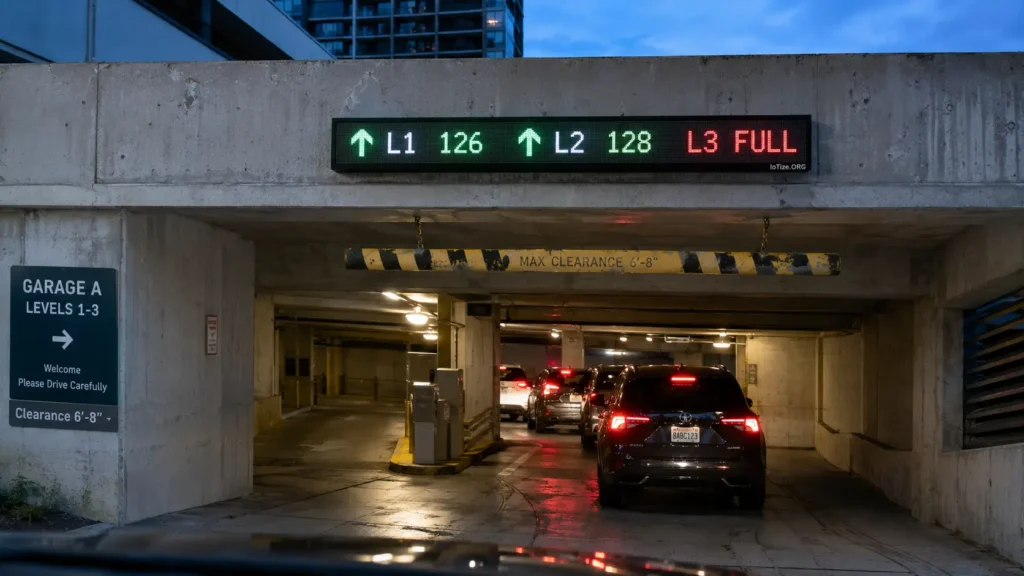
Smart parking by the numbers
Source: INRIX Parking Study (2017), combining a parking database spanning more than 100 countries with a survey of nearly 18,000 drivers. US market research figures shown for context. Industry figures, not a guarantee of results at your site.
What is smart parking, and how does it work
Smart parking is the use of IoT sensors, counters and guidance signage to detect vehicle occupancy in real time, then show it to drivers and operators. An IoT based smart parking system does three jobs.
- Detect. Sensors or counters register vehicles entering, leaving or occupying a space.
- Decide. An edge controller converts those events into live occupancy and applies your rules.
- Display. Guidance signage and dashboards show the result, instantly.
An automated parking guidance system (APGS) is the guidance-focused form of this. Rather than enforce or ticket, it steers each driver to an open space using dynamic parking signage. That is where IoTize hardware sits.
Smart parking technology is best bought as a progression, not as a single purchase.
Manual counts, drivers circle, no usage data.
Live counts feed guidance signs at every decision point.
Full occupancy history drives pricing, staffing and expansion.
A site moves from blind to guided with entry and exit counting plus a display at the door. Next it adds level-by-level and, later, bay-level detection for more precise guidance. Finally the accumulated data optimizes pricing, staffing and expansion. Each stage pays for itself before the next begins.
Smart parking system architecture, step by step
- Detect. A vehicle detection sensor at the lane, or a bay-level parking sensor over a space, registers each car. IoTize starts at the lane with the IoT Entry/Exit Vehicle Counter and grows toward per-bay sensing.
- Count and occupancy. The device turns events into a running figure: count-in, count-out, spaces free by zone or level.
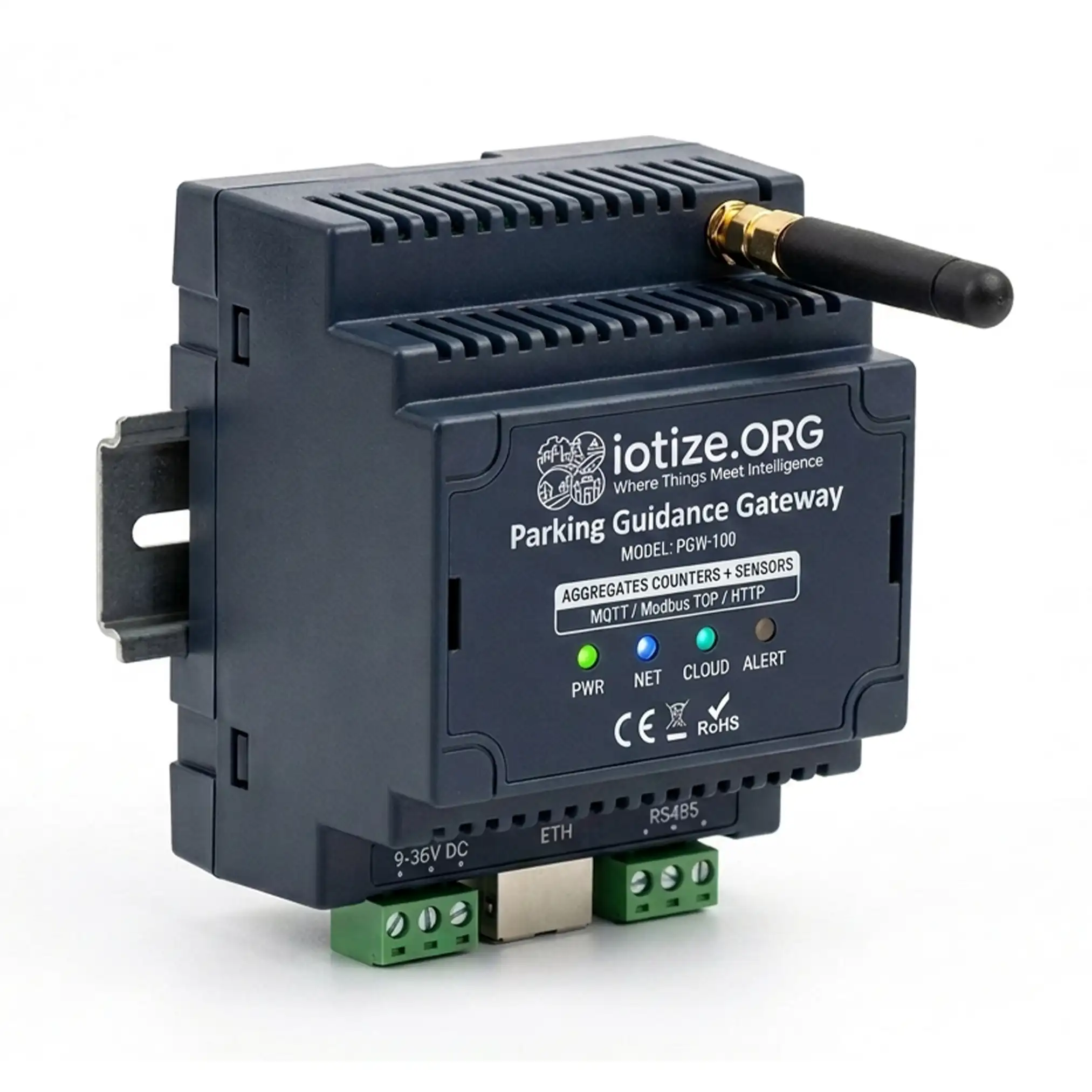
- Edge controller. The Parking Guidance Gateway processes data locally, applies your rules, drives the signs and streams to the cloud. Because it thinks on-site, guidance stays fast and survives an internet outage.
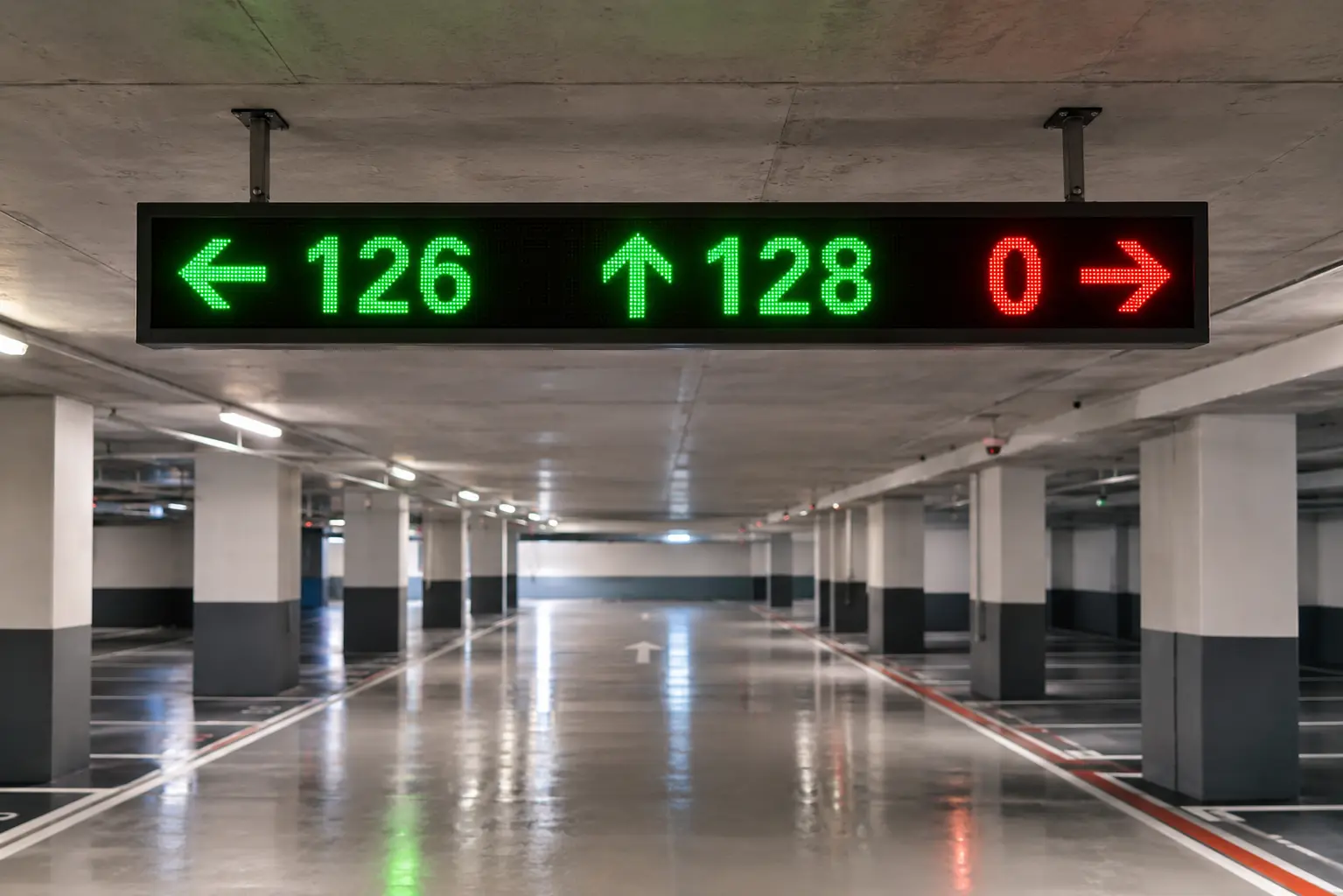
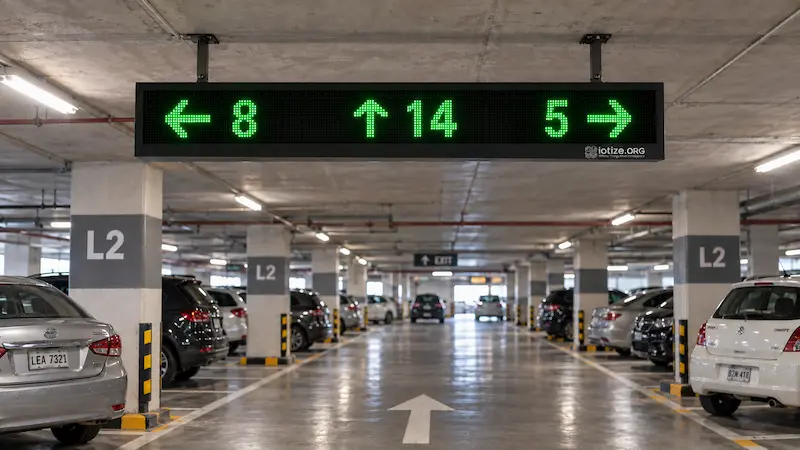
- Guidance signage. The gateway drives the displays: a full-color indoor LED panel inside the garage, or a solar flip-dot sign at the street. Each shows counts, directional arrows or a “spaces free” message.
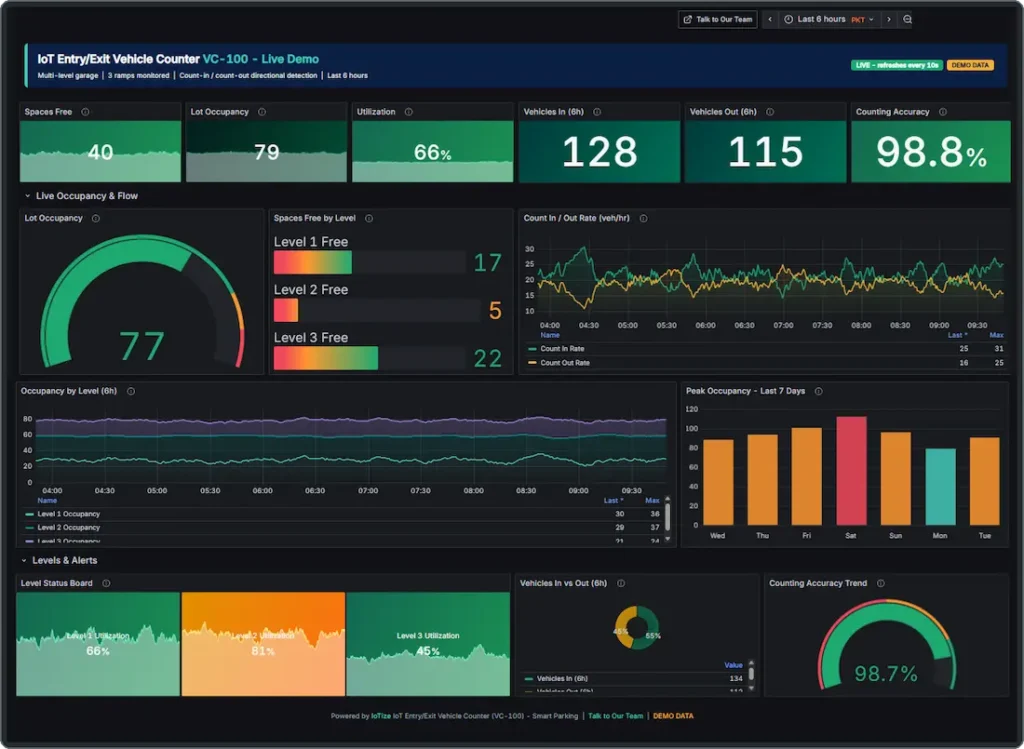
- Driver and dashboard. The driver follows the sign, and your team watches the same live occupancy on-prem or in the cloud.
Every link uses open, standard IoT connectivity, so the parking guidance system drops into what you already run instead of forcing a rip-and-replace.
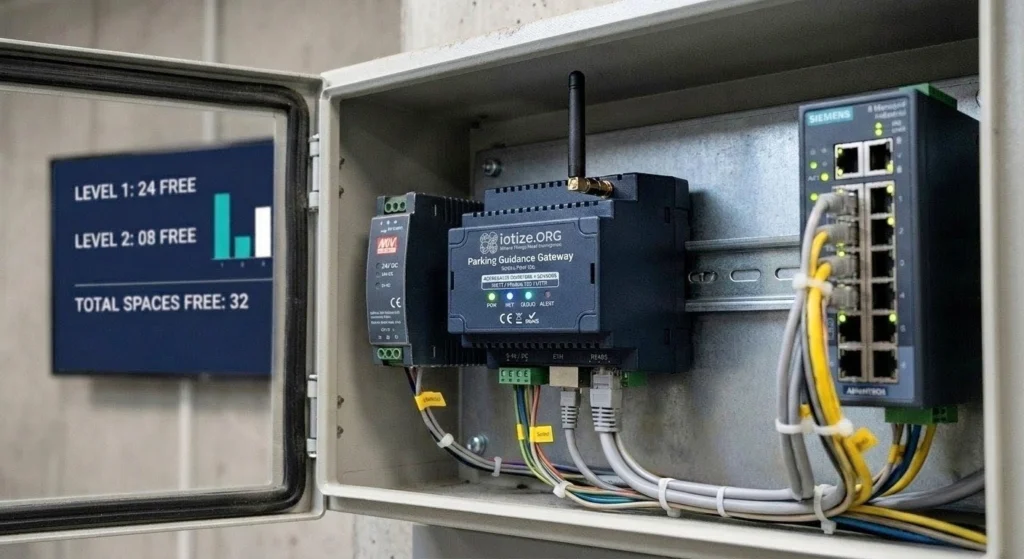
What you can see and control
- Count-in and count-out at the lane, which reveals live total occupancy and spaces free. Best-fit device: IoT Entry/Exit Vehicle Counter.
- Occupancy by level or zone, which reveals which decks fill first and when. Best-fit device: the Vehicle Counter plus Gateway logic.
- Available-space messages and arrows, which tell you where to send each arriving driver. Best-fit device: IoT Indoor LED Signage Display.
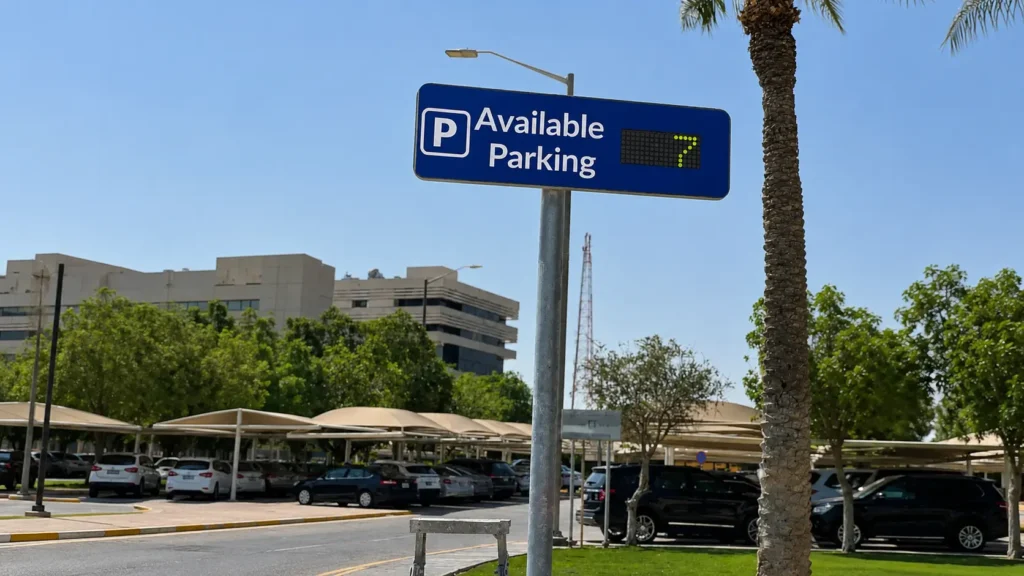
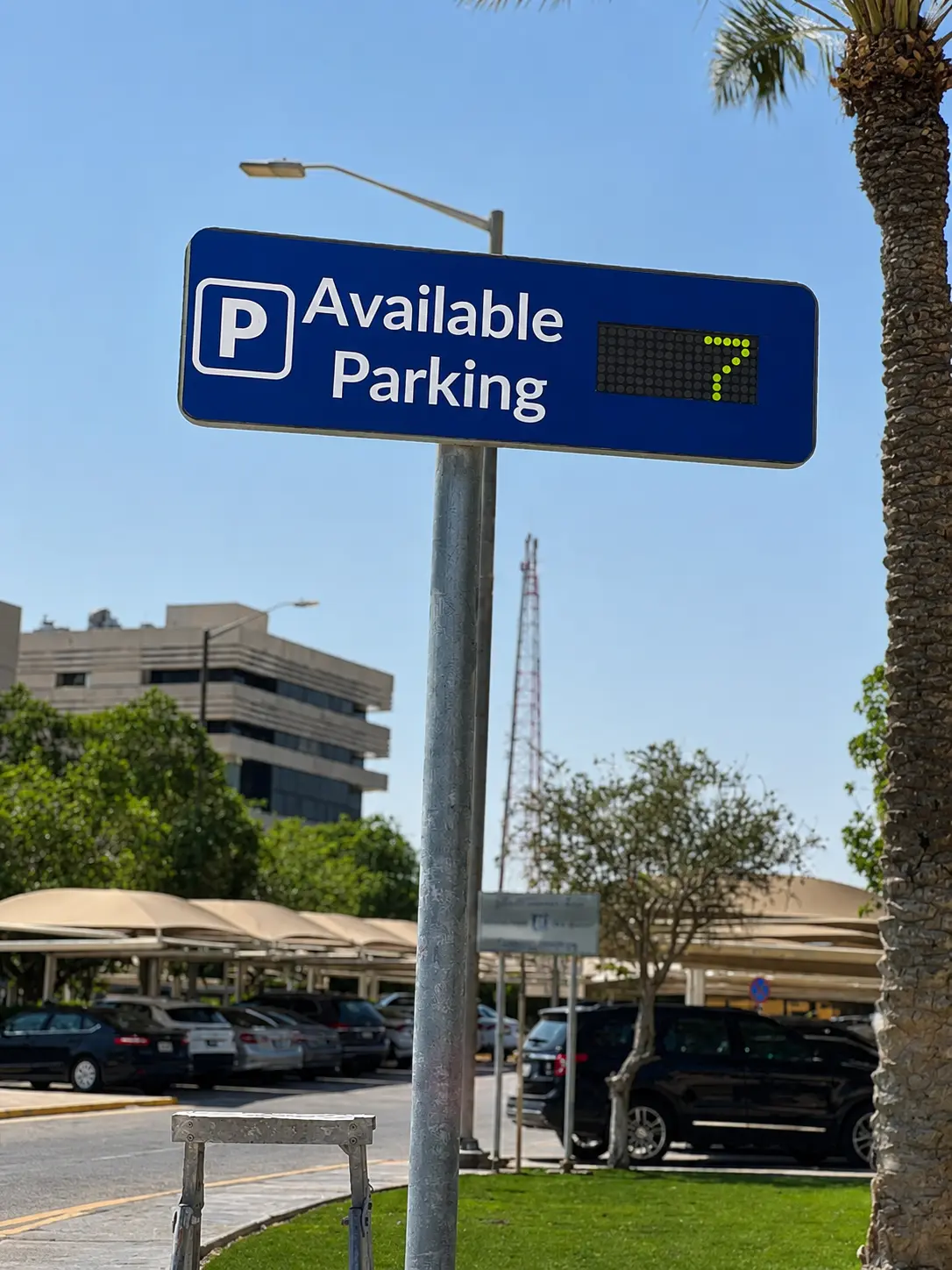
- Street-level “spaces free” at the curb, which lets a driver decide whether to turn in at all, from the road. Best-fit device: Smart Parking Flip-Dot Guidance Signage.
- Per-bay occupied or free, which gives exact open bays for bay-level guidance. Best-fit device: IoT Bay Occupancy Sensor, on the roadmap.
- Full occupancy history and trends, which supports peak planning, pricing, staffing and expansion cases. Best-fit device: any device, via the dashboard.
The gateway logs everything, so historical reporting comes with the live view. Real-time parking occupancy monitoring therefore lets you prove utilization rather than estimate it.
The four building blocks of an IoTize smart parking system
Four live products form a complete detect, decide, display system. Buy them together or one at a time.
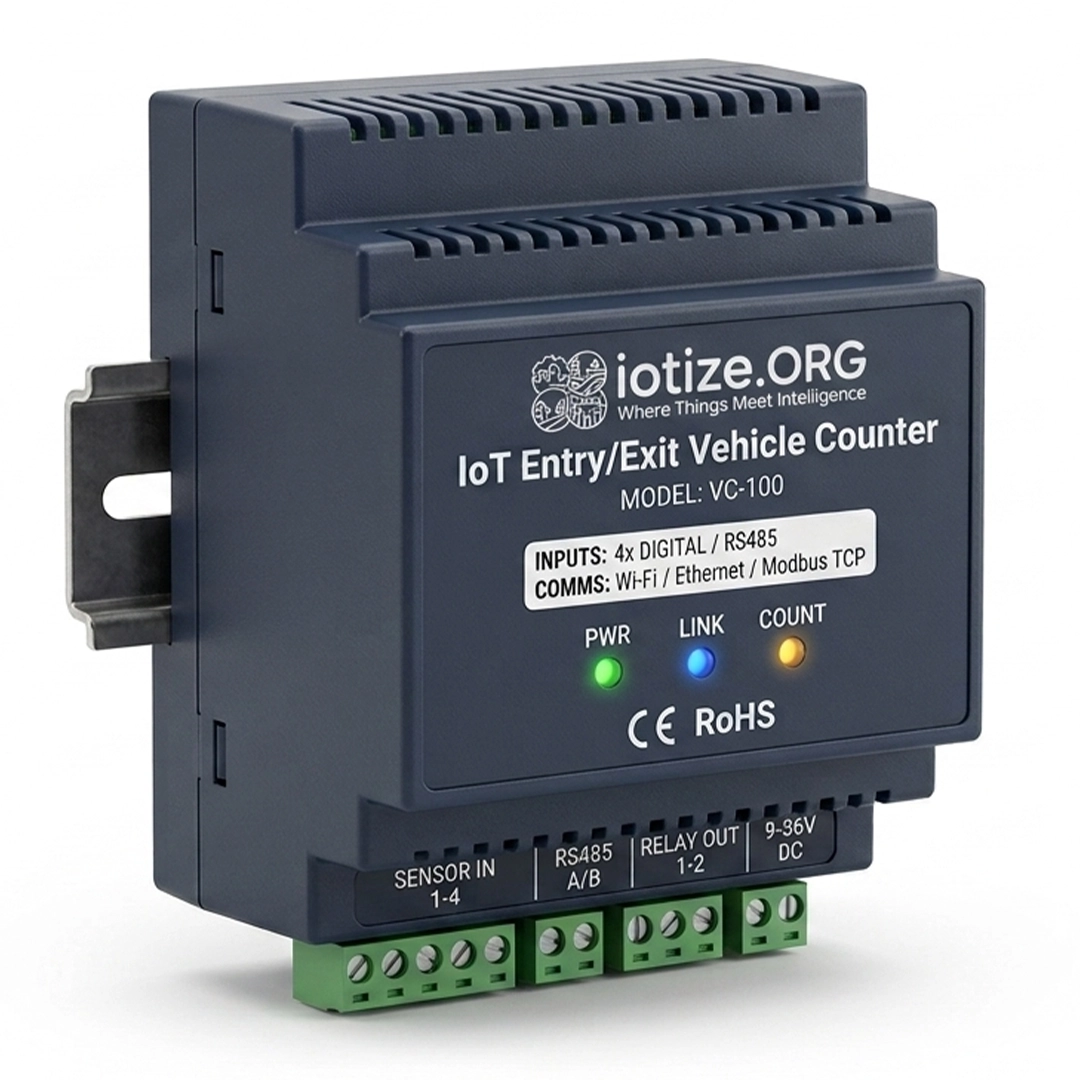
- Detect: the IoT Entry/Exit Vehicle Counter records every count-in and count-out at a lane for a live occupancy figure, without wiring every bay.
- Decide: the Parking Guidance Gateway is the edge controller. It gathers data, applies rules, drives the signs and streams to your dashboard or cloud.
- Display indoors: the IoT Indoor LED Signage Display is a full-color LED panel showing counts, animated arrows, text and logos at each decision point.
- Display outdoors: the Smart Parking Flip-Dot Guidance Signage is a wireless, solar and battery powered sign for curbs with no mains power.
Flip-dot discs are sunlight-readable and bistable, so the sign holds its image on almost no power. That is what makes off-grid, no-trenching guidance practical at the street.
IoTize is extending the range with a per-space IoT Parking Bay Occupancy Sensor and bay-level red and green indicator lights for exact, space-by-space guidance. These are in development and are not available to order yet. Talk to our team if bay-level guidance is on your plan.
Deployment and data ownership
Enterprise parking platforms typically hold your occupancy data inside their cloud and their contract. IoTize does the opposite. You choose where the system runs and who holds the data.
- IoTize SaaS, best for a fast start with minimal IT. You get a hosted dashboard, alerts and reports, ready to use.
- On-prem or private cloud, best for security-sensitive sites. Everything runs on your own servers, under your rules.
- Direct to SCADA, MES or your platform, best for an existing operations stack. Occupancy data streams straight into systems you already run.
The answer to “who owns the data” is always you. Your occupancy history is never bound to our servers, and open protocols keep you free to integrate, export or move it. IT and security teams therefore approve faster, because the usual objection is already handled.
Choose your device: smart parking comparison table
| Product | Series | Role | Placement | Price |
|---|---|---|---|---|
| IoT Entry/Exit Vehicle Counter | Custom | Occupancy detection, count-in and count-out | Entrance and exit lanes | From $249, quoted to your layout |
| Parking Guidance Gateway | Custom | IoT edge controller and connectivity | Field cabinet on site | From $449, quoted to your layout |
| IoT Indoor LED Signage Display | Custom | Full-color availability display and arrows | Inside garages, at decision points | From $999, quoted to your layout |
| Smart Parking Flip-Dot Guidance Signage | Custom | Solar, off-grid availability sign | Curb, entrance, surface lots | From $1,600, quoted to your layout |
Quick guide: one entrance with one display needs a counter, a gateway and one sign. A multi-level garage adds a display at each decision point. A curb with no power calls for the solar flip-dot sign.
The products
60-second smart parking selector
Answer three questions and this selector names the smart parking system that fits your site, along with the products that build it.
1. What is your first goal?
2. Where does the sign go?
3. Do you already have a live occupancy count?
Answer questions 2 and 3 and your recommended smart parking system appears here.
Your recommended system
Guided indoor garage, built from scratch
- IoT Entry/Exit Vehicle Counter to generate the live occupancy number at the lane. From $249.
- Parking Guidance Gateway to process it at the edge and drive the signs. From $449.
- IoT Indoor LED Signage Display at each decision point inside the garage. $999.
Because you want bay-level guidance, start with the Gateway now. It is the integration point for the per-bay IoT Parking Bay Occupancy Sensor when it launches, so nothing you buy today is wasted.
Your recommended system
Guided indoor garage, using your existing count
- Parking Guidance Gateway to take your existing occupancy feed, apply your rules and drive the new signs. From $449.
- IoT Indoor LED Signage Display at each decision point inside the garage. $999.
- No counter needed for now, though adding one later gives you a second, independent source of truth.
Because you want bay-level guidance, the Gateway is also the integration point for the per-bay IoT Parking Bay Occupancy Sensor when it launches, so nothing you buy today is wasted.
Your recommended system
Off-grid curb-side guidance, built from scratch
- IoT Entry/Exit Vehicle Counter to generate the live occupancy number at the lane. From $249.
- Parking Guidance Gateway to process it at the edge and drive the sign wirelessly. From $449.
- Smart Parking Flip-Dot Guidance Signage at the street: solar, battery backed, IP65, no trenching. $1,600.
Because you want bay-level guidance, start with the Gateway now. It is the integration point for the per-bay IoT Parking Bay Occupancy Sensor when it launches, so nothing you buy today is wasted.
Your recommended system
Off-grid curb-side guidance, using your existing count
- Parking Guidance Gateway to take your existing occupancy feed and drive the sign wirelessly. From $449.
- Smart Parking Flip-Dot Guidance Signage at the street: solar, battery backed, IP65, no trenching. $1,600.
- This is the fastest route to street-level “spaces free” at a site with no power run.
Because you want bay-level guidance, the Gateway is also the integration point for the per-bay IoT Parking Bay Occupancy Sensor when it launches, so nothing you buy today is wasted.
Most sites start with one Vehicle Counter, one Gateway and one display, which proves the value on a single entrance before you scale.
Want it on paper first?
Ask for the IoTize Smart Parking Buyer’s Guide, a short PDF matching each site type, from a single gate to a multi-level garage, to the right mix of counters, gateway and signage.
Where smart parking pays off
- Smart parking for shopping malls: shoppers reach open decks fast and spend the time in stores instead, and a “full-looking” gate stops turning footfall away.
- Airport parking guidance system: time-pressed travelers are routed across multiple garages and lots with clear counts at each junction.
- Hospital parking management system: patients and visitors park with less stress, emergency lanes stay clear, and staff stop directing traffic by hand.
- Garage parking guidance system: level-by-level availability at each ramp fills a multi-story garage evenly instead of jamming the lower decks.
- Corporate campus parking solution and smart parking for offices: smooth arrival for employees and guests, plus real occupancy data for facilities planning.
- Smart city parking solutions: curb-side flip-dot signs and counters across districts cut the search-driving that clogs streets.
The hardware is modular, so a single operator can start with one sign while a city rolls out hundreds on the same platform.
Smart parking ROI and cost
Return on a parking guidance system arrives through four channels.
- Recovered revenue, because drivers stop leaving a lot that only looked full.
- Lower labor cost, because manual counts and hand-directed traffic end.
- Higher throughput, because guided drivers park faster, so queues shrink.
- Planning value, because occupancy history shows when to add staff, adjust pricing or expand.
Smart parking system cost tracks scope, so IoTize prices by site. A single guided entrance built from a counter, a gateway and one display is a fixed, affordable starting point. A multi-level garage adds a display per decision point, and a district rollout adds curb-side solar signs and more counters. Because hardware scales in steps, smart parking solution cost follows the value you switch on rather than a large upfront platform fee.
Situation: a three-level mall garage jams on the ground deck while the top deck sits half empty, and drivers who see a gate queue leave for a rival mall.
Change: a Vehicle Counter at each ramp, a Gateway in the field cabinet, an LED display at every decision point, and a solar flip-dot sign at the street showing the live free count.
Outcome: availability is visible from the road, arrivals route to the emptier upper deck, the gate queue eases, and the team works from a live dashboard instead of a clipboard. Exact gains depend on the site. The mechanism is simply that visible availability turns away fewer cars and moves the rest faster.
One platform: parking, energy and predictive maintenance
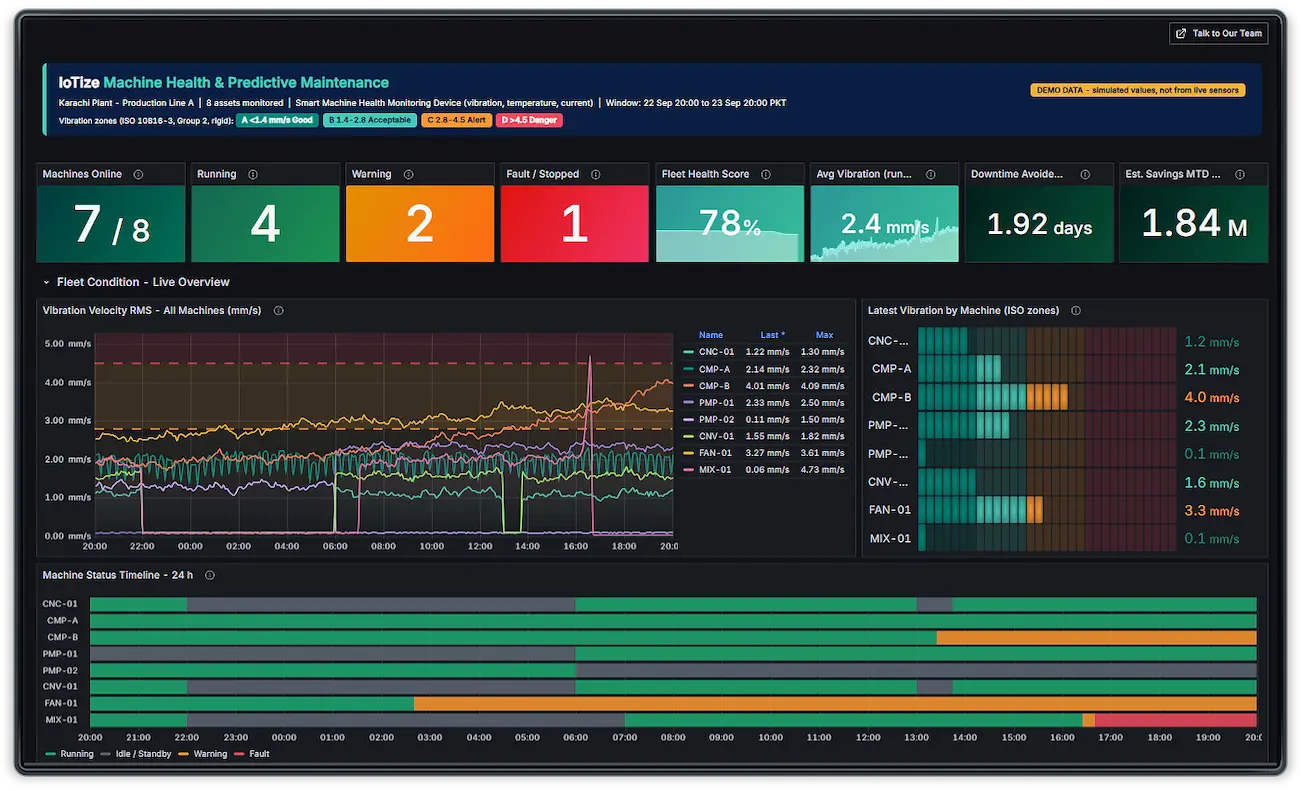
Smart parking runs on the same IoTize platform as your machines and meters. The gateway, dashboards, deployment choices and data-freedom promise are shared across every solution, so a facility that guides its parking today can monitor energy and predict equipment failures on the same system tomorrow.
- Predictive Maintenance: predict machine failures before they happen.
- Energy Efficiency: cut electricity costs with device-level monitoring.
Industries we serve
Shopping malls and retail centers, airports and transport hubs, hospitals and healthcare campuses, universities and colleges, corporate campuses and office parks, municipal and on-street parking, and mixed-use developments. IoTize is based in Pakistan and ships worldwide, so the same smart parking system serves a single local garage or a global operator.
Why IoTize
- Real hardware, real prices. Named products with published starting prices and a clear quote path, not a vague platform with a hidden bill.
- Wireless and solar options. The flip-dot sign needs no power run and no trenching, which reaches sites others cannot.
- Edge intelligence. The gateway keeps guidance instant and resilient, even through an internet outage.
- Your data, your way. SaaS, on-prem, private cloud, or straight into SCADA and MES, with no vendor lock-in.
- Modular and scalable. Start on one entrance, then grow to a campus or a city on the same platform.
- Field-proven since 2015. Industrial IoT designed, assembled and tested in-house, deployed worldwide.
Get started in four steps
- Map one entrance. Pick a single lane or level to prove the system.
- Add detect, decide, display. Install a Vehicle Counter, a Gateway and one sign.
- Watch it live. Confirm the live count and guidance on the dashboard.
- Scale with confidence. Roll the same building blocks out to more levels, curbs and sites.
All Your Devices, One Live Platform
This solution is just one piece. The IoTize Platform brings every connected device together, so you can monitor, analyse and act on live data from a single place.
- Real-time dashboards and instant alerts
- Health, energy and production data side by side
- Access from any browser, on any device
Guide your first entrance this quarter
Detect, decide and display with four live products. Start a smart parking solution at one lane, then scale it across the site on the same hardware.
Frequently asked questions
What is smart parking?
Smart parking is the use of IoT sensors, counters and guidance signage to detect vehicle occupancy in real time and show it to drivers and operators. Instead of letting drivers circle, it steers each one to an open space and gives the operator a live view of the site.
How does smart parking work?
A vehicle detection sensor or entry and exit counter registers cars, an IoT edge controller turns those events into a live count and applies your rules, and guidance signage displays the result. The driver follows the sign to a space while your team watches the same data on a dashboard. In short: detect, decide, display.
How much does a smart parking system costs?
Cost depends on scope, so IoTize prices by site. A single guided entrance, built from a counter, a gateway and one display, is an affordable fixed starting point, while IoT parking sensor price and signage scale with the lanes, levels and curbs you cover. The IoT Entry/Exit Vehicle Counter starts at $249 and the Parking Guidance Gateway at $449, each quoted to your layout. The IoT Indoor LED Signage Displayis listed from $999 and the Smart Parking Flip-Dot Guidance Signage from $1,600.
What sensors are used in smart parking?
Two families do most of the work: lane-level vehicle detection, which counts cars entering and leaving for a total occupancy figure, and per-bay parking occupancy sensors, which report whether a single space is free. IoTize starts with lane counting via the IoT Entry/Exit Vehicle Counter and is adding per-bay occupancy sensors to the range.
How accurate are parking occupancy sensors?
Accuracy depends on method and site. Entry and exit counting is highly reliable for a total “spaces free” figure at a gated facility, while per-bay sensors give exact space-by-space status where pinpoint guidance matters. For expected accuracy at your layout, talk to our team.
How do parking systems reduce congestion?
They cut the search-driving that clogs aisles and entrances. When drivers see availability from the road and get pointed straight to an open space, they stop circling, so traffic inside the lot and at the gate flows more freely.
Can this work for shopping malls, airports and hospitals?
Yes. The same detect, decide, display system scales from a single hospital lot to a multi-garage airport. Signage placement and the mix of counters and sensors change with the site. The platform does not.
Do I have to use IoTize’s cloud?
No. Run the system on our SaaS, on your own servers or private cloud, or stream data straight into your SCADA, MES or existing platform. Your occupancy data is always yours.
Explore more
Smart parking products: Browse the smart parking range · Shop all IoTize devices
Related solutions: Predictive Maintenance · Energy Efficiency
Talk to us: Contact the IoTize team →