

Technical Reviewer: Zia ur Rehman
15+ years in embedded systems and industrial IoT · Reviewed
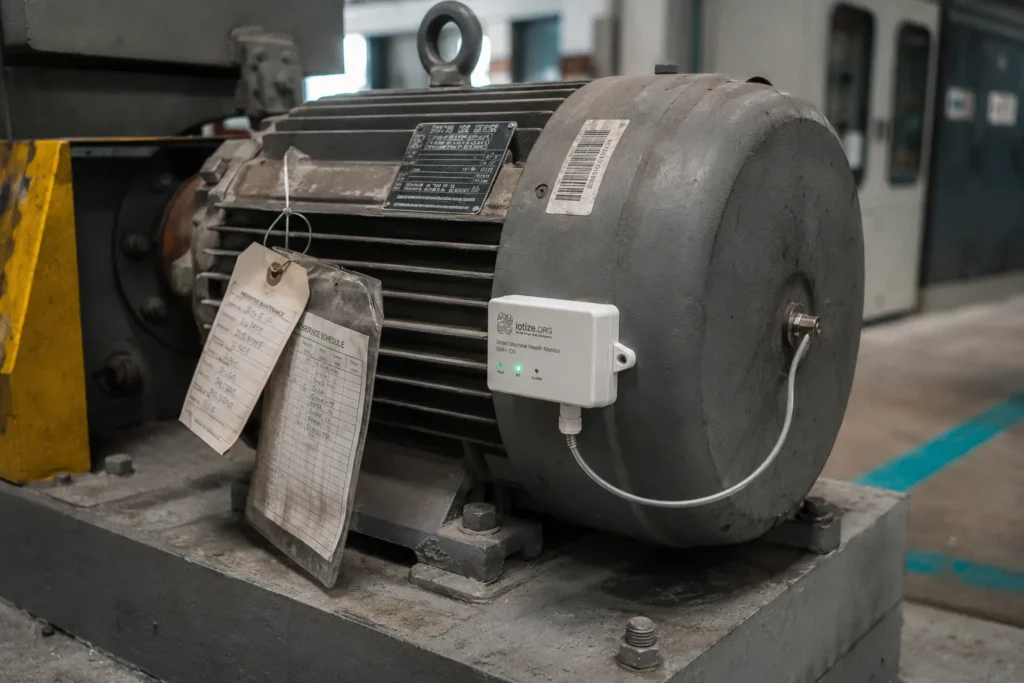
Every plant manager has lived this moment. A critical motor seizes mid-shift, the line stops, and the cost of that unplanned downtime starts climbing by the minute. The question that follows is always the same. Could we have seen it coming? That question sits at the heart of the predictive vs preventive maintenance debate, and choosing between these two strategies, or knowing when to combine them, is one of the highest leverage decisions a maintenance leader makes.
Both approaches are proactive. Both beat waiting for things to break. However, the difference between predictive and preventive maintenance comes down to a single idea: what triggers the work. Preventive maintenance runs on the calendar. Predictive maintenance runs on the machine’s actual condition. In this guide, you will learn how each one works, what they really cost, and how to decide which is right for your factory.
What Is Preventive Maintenance?
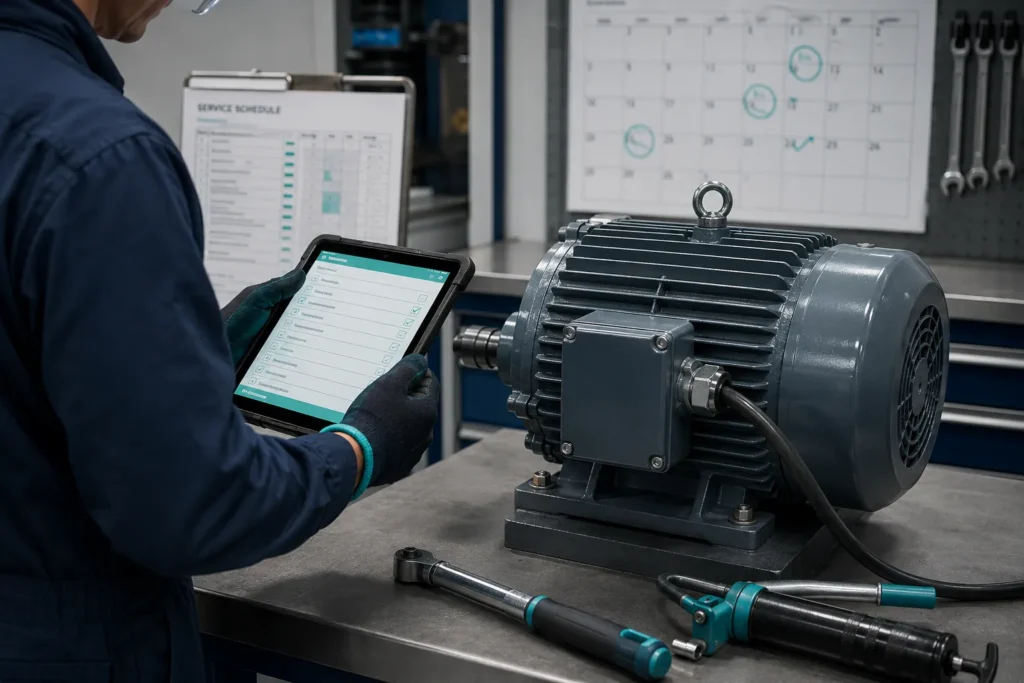
Preventive maintenance (PM) is maintenance performed on a fixed, predetermined schedule, by time, by runtime hours, or by usage cycles, regardless of whether the machine actually needs it yet. In practice, it is the service every three months or every 5,000 hours model that most factories already run. The preventive maintenance definition, then, means recurring, planned tasks designed to head off failure before it starts.
- Scheduled lubrication of bearings and gearboxes
- Quarterly inspection and calibration of equipment
- Replacing belts, filters, or seals at set intervals
- Routine cleaning and tightening on a fixed checklist
Because it is time-based, preventive maintenance is simple to plan, easy to budget, and a sensible default for low-criticality or predictable-wear assets. However, its weakness is also built in: you maintain on a schedule, not on reality. As a result, two classic preventive maintenance disadvantages appear. First, over-maintenance, where you replace healthy parts and spend labor you did not need to. Second, missed failures, where a bearing that degrades faster than the interval assumed still fails between services.
What Is Predictive Maintenance?
Predictive maintenance (PdM) is maintenance triggered by the real-time condition of the equipment. Instead of acting on a date, you act on data. Continuously, sensors watch vibration, temperature, current, and runtime patterns, and work is scheduled only when the data shows a developing problem. Therefore, the predictive maintenance definition is condition-driven maintenance: a form of condition-based monitoring (CBM) enhanced with analytics that flag the early warning signs of failure.
- A sensor-based predictive maintenance setup that watches a motor’s vibration signature and alerts you when imbalance, misalignment, or bearing wear first appears
- Tracking a gearbox’s temperature trend and flagging an abnormal rise before it becomes a fault
- Monitoring motor current and runtime to catch overload and electrical anomalies early
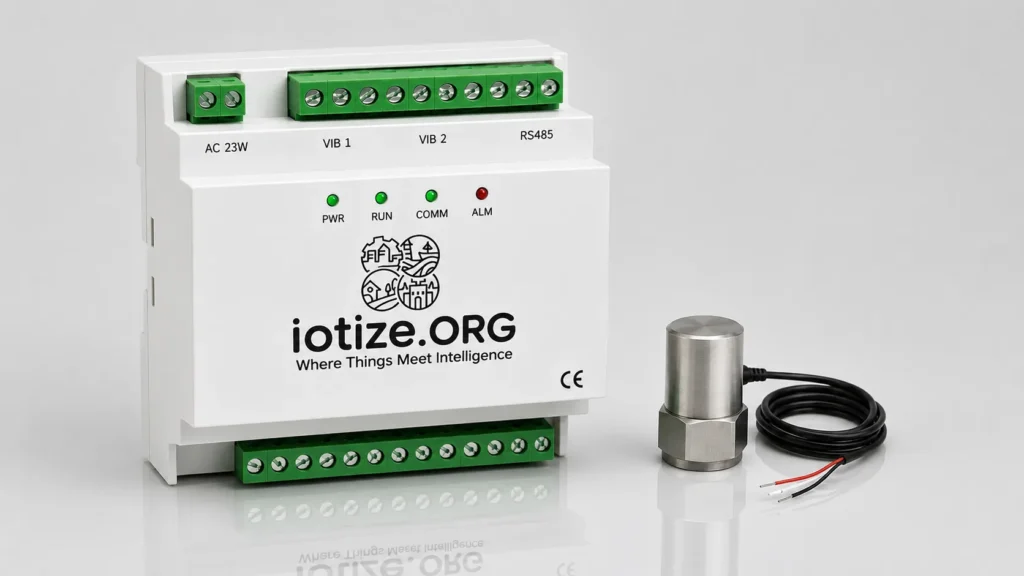
The predictive maintenance benefits are clear. You catch failures earlier, you stop replacing parts that still have life left, and you schedule repairs around production instead of around a guess. However, PdM needs sensors, connectivity, and a way to read the data. That is exactly where industrial IoT comes in. For example, a bolt-on device such as the Enterprise IoT Vibration Monitoring Device turns a motor’s raw vibration into early-warning alerts, which is the practical starting point for most predictive programs.
Predictive vs Preventive Maintenance: The Core Difference
The single difference between predictive and preventive maintenance is the trigger. Preventive is scheduled. By contrast, predictive is condition-based. Everything else, including cost profile, complexity, and accuracy, flows from that one distinction. Ultimately, this is the essence of time-based vs condition-based maintenance, sometimes written as PdM vs PM.
| Preventive Maintenance (PM) | Predictive Maintenance (PdM) | |
|---|---|---|
| What triggers the work | A schedule: time, hours, or usage | Real-time condition data |
| Approach | Time-based | Condition-based |
| Technology needed | Checklists, spare parts | Sensors, connectivity, analytics |
| Upfront cost | Lower | Higher, with affordable entry options |
| Risk of over-maintenance | Higher | Lower |
| Catches early-onset failures | Sometimes | Often, and earlier |
| Best fit | Predictable-wear, lower-criticality assets | Critical, high-value, hard-to-predict assets |
For a deeper neutral primer on the distinction, IBM sets out the two approaches clearly. In short, remember the trigger and the rest follows.
Reactive, Preventive, Predictive: Where Each Fits
Most factories do not run a single strategy. Instead, they run a mix. Therefore, it helps to see the full ladder of maintenance types, because the reactive vs preventive vs predictive maintenance comparison frames the whole decision.
- Reactive: run-to-failure, or corrective maintenance when it restores a failed asset. You fix it after it breaks. It is the cheapest to plan and the most expensive when it counts. It is fine for trivial, non-critical items, and dangerous for anything that stops production.
- Preventive: the proactive baseline. Scheduled work that reduces the odds of failure.
- Predictive: the data-driven layer that tells you when a specific asset actually needs attention.
In short, the proactive vs reactive maintenance divide is about acting before failure versus after it. Within the proactive category, preventive and predictive are two gears of the same engine.
Cost and ROI: Predictive vs Preventive Maintenance
This is where most internal cases are won or lost. Therefore, be precise. The honest cost comparison looks at two layers: the upfront cost, and the hidden cost. First, consider the direct spend. Preventive is cheaper to start, because it needs labor, scheduling software, and spare parts. Predictive carries a higher entry cost, because it needs instrumentation: sensors, connectivity, and an analytics layer. Consequently, that is the simplest answer to why predictive maintenance is more expensive. You are buying intelligence, not just labor.
Next, consider the hidden cost, where the picture flips. Preventive hides an over-maintenance cost: parts swapped while still healthy, downtime taken unnecessarily, and labor spent on a schedule rather than a need. By contrast, predictive attacks those hidden costs directly, with fewer unnecessary interventions, fewer surprise failures, and repairs timed to planned shutdowns. As a result, preventive tends to deliver faster, smaller near-term returns, while predictive usually needs a longer payback period, then compounds savings as avoided downtime and extended asset life add up.
Above all, predictive no longer requires an enterprise budget to begin. IoTize’s affordable predictive-maintenance devices bring the entry cost down to a level most plants can pilot without a capital request. For example, the Smart Machine Temperature Monitoring IoT Device, a contact-sensor device for affordable predictive maintenance, starts at $59, and the Smart Machine Health Monitoring IoT Device, which tracks vibration, temperature, and current, is $99. Consequently, the cost question turns from a large one-time bet into a small, provable first step.
Where predictive maintenance earns its ROI back
Source: U.S. Department of Energy, Federal Energy Management Program, “O&M Best Practices Guide,” Chapter 5: Types of Maintenance Programs (www1.eere.energy.gov/femp). Industry ranges, not a guarantee for every facility. Price current at time of writing; confirm live at iotize.org.
Which Is Right for Your Factory?
The accurate answer is that it depends on the asset. Therefore, the real skill is choosing a maintenance strategy asset by asset rather than picking one for the whole plant. In practice, score each asset on two axes: criticality, meaning what failure costs you, and failure predictability, meaning whether it wears on a clean, known curve. Then the right call becomes obvious.
- High criticality and unpredictable failure means predictive. Main-line motors, critical pumps, gearboxes, and spindles fit here, because an unexpected stop is costly and the sensors pay for themselves. This is the sweet spot for predictive maintenance for motors and rotating equipment.
- Lower criticality and predictable wear means preventive. Auxiliary equipment and simple consumables fit here, because a schedule is cheaper and good enough.
- Trivial or non-critical means reactive is acceptable, because instrumenting it is not worth the cost.
For most manufacturers weighing predictive or preventive maintenance for manufacturing, that asset-by-asset scoring is the best maintenance strategy for factories, not a single doctrine applied everywhere.
You Do Not Have to Pick One: The Hybrid Approach
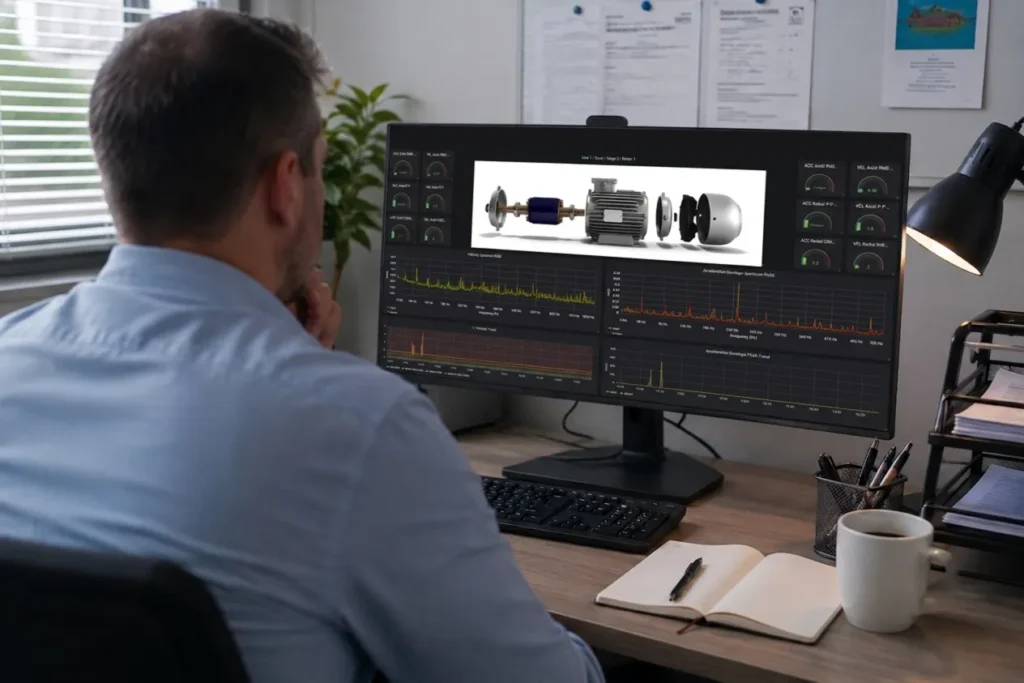
Here is the part the versus framing hides. The strongest programs are not predictive or preventive. Instead, they are both. A hybrid maintenance strategy keeps preventive schedules on routine, lower-criticality assets, while it layers predictive monitoring onto the critical, high-value machines where surprise failures hurt most.
Crucially, this also reframes the transition from preventive to predictive maintenance. You do not rip out your PM program. Instead, you start small. First, pick a handful of your most critical, most failure-prone assets. Next, instrument those first. Then prove the value, and finally expand. Vibration is usually the best first signal to add, because it reveals the earliest mechanical faults on rotating equipment.
Read next: How IoT Vibration Sensors Detect Motor Failures Before They Happen, which walks through the detection mechanics step by step.
Putting Predictive Maintenance to Work with IoTize
Shifting from a schedule to real-time condition data only works if every machine, new or decades old, can actually be monitored. That is the gap IoTize.ORG closes, with affordable Industrial IoT devices that bolt onto existing equipment and turn raw machine signals into early-warning alerts. In total, IoTize offers five devices built specifically for predictive maintenance, across two tiers.
Across the range, you deploy your way, on-premises, private cloud, or IoTize SaaS, and you keep ownership of your data. To see how these devices map to your equipment and your goals, visit the IoT predictive maintenance solution page.
Enterprise IoT Vibration Monitoring Device
Deep vibration monitoring (RMS, peak, FFT) for motors, gearboxes, and spindles. Catches imbalance, misalignment, and bearing wear early.
View Product →Smart Machine Health Monitoring IoT Device
Vibration, temperature, and current on one machine, for affordable predictive maintenance and a low-risk first pilot.
View Product →Smart Machine Temperature Monitoring IoT Device
A contact-sensor device that brings temperature-based predictive maintenance to almost any machine at the lowest entry cost.
View Product →Enterprise Smart Machine Health Monitor (Dual-Point)
Watches vibration, temperature, and current together across two points for higher-stakes machines. HTTP, MQTT, Modbus TCP, optional speed input.
View Product →IoT Smart Energy Monitoring Sensor (Single-Phase)
Tracks single-phase energy and current, so abnormal load shows up early. Speaks HTTP, MQTT, and Modbus TCP, and is SCADA-ready.
View Product →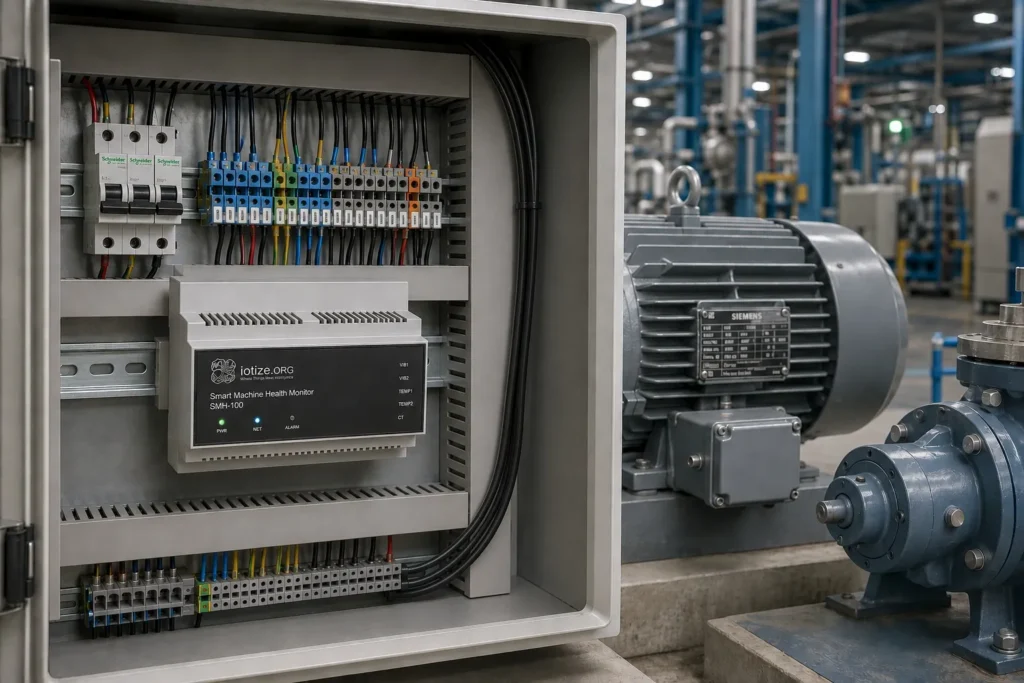
The Bottom Line
Put the right strategy on the right machine
Predictive vs preventive maintenance is not about a winner. It is about giving your most critical assets the early warning that only real-time data provides. Start on a few machines, prove the ROI, then scale.
Frequently Asked Questions
Is predictive maintenance better than preventive maintenance?
Not universally. It is better for critical, high-value, or hard-to-predict assets, where catching failures early outweighs the cost of sensors. For predictable-wear, low-criticality equipment, preventive maintenance is often the more cost-effective choice.
What is the difference between predictive and preventive maintenance?
Preventive maintenance is triggered by a fixed schedule of time, hours, or usage. Predictive maintenance is triggered by the equipment’s real-time condition data. Scheduled versus condition-based is the core distinction.
Can predictive and preventive maintenance work together?
Yes, and they usually should. A hybrid strategy keeps preventive schedules on routine assets and layers predictive monitoring onto critical machines, so each method covers what it does best.
Does predictive maintenance replace preventive maintenance?
No. Predictive maintenance complements rather than replaces preventive maintenance. Most plants keep a preventive baseline and add predictive monitoring where unplanned failure is most costly.
What triggers predictive vs preventive maintenance?
Preventive maintenance is triggered by the calendar or a usage threshold. Predictive maintenance is triggered by condition signals such as vibration, temperature, or current that indicate a developing fault.
Why is predictive maintenance more expensive to start?
Because it requires instrumentation: sensors, connectivity, and an analytics layer. That higher upfront cost is typically offset over time by reduced downtime and fewer unnecessary part replacements, and affordable devices now lower the barrier considerably.
Products: Vibration Monitoring Device · Smart Machine Health Monitor ($99) · Temperature Monitor ($59)
Read next: How IoT Vibration Sensors Detect Motor Failures Before They Happen
From the blog: Visit the IoTize blog →